


newsmakers
Adani Green Energy
Setting India’s Clean Energy Transition Goal
Adani Green Energy Limited (AGEL) ups the ante; boosts target to 50 GW renewables by 2030. The revised target supports 10% of India’s 500 GW non-fossil fuel energy goal.
Rupam Singh Gupta
India is the world’s third-largest economy in terms of energy needs and its energy demand is projected to surge 25-35% by 2030, according to International Energy Agency (IEA). India’s vision is to achieve Net Zero Emissions by 2070, in addition to attaining near-term targets which include increasing non-fossil fuel energy capacity to 500 GW by 2030, meeting 50% of energy requirements from renewables, reducing cumulative emissions by one billion tonnes by 2030, and reducing emissions intensity of India’s gross domestic product (GDP) by 45% by 2030.
Aligned to India’s clean energy transition goals, Adani Green Energy Ltd (AGEL) has enhanced its target to 50 GW renewable energy (RE) capacity by 2030 from 45 GW currently. This will account for 10% of India’s target of decarbonising the grid with 500 GW non-fossil fuel energy by 2030.
AGEL’s enhanced target of 50 GW is in line with the addition of pumped storage projects (PSPs) of 5,000+ MW to its portfolio mix by 2030 in the first phase. It has begun the construction for the first 500 MW PSP in Andhra Pradesh. AGEL has a robust development pipeline of pumped storage projects across Andhra Pradesh, Maharashtra, Tamil Nadu and Telangana.
The company aims to deliver a greenfield capacity addition of 6 GW in FY25, which is more than double the figure it achieved in the last financial year. In FY24, AGEL brought on stream 2,848 MW renewables capacity, the largest greenfield expansion in India’s RE sector. This included 2,418 MW solar and 430 MW wind projects. Adani Green alone accounted for over 15% of India’s total renewable capacity addition in FY24.
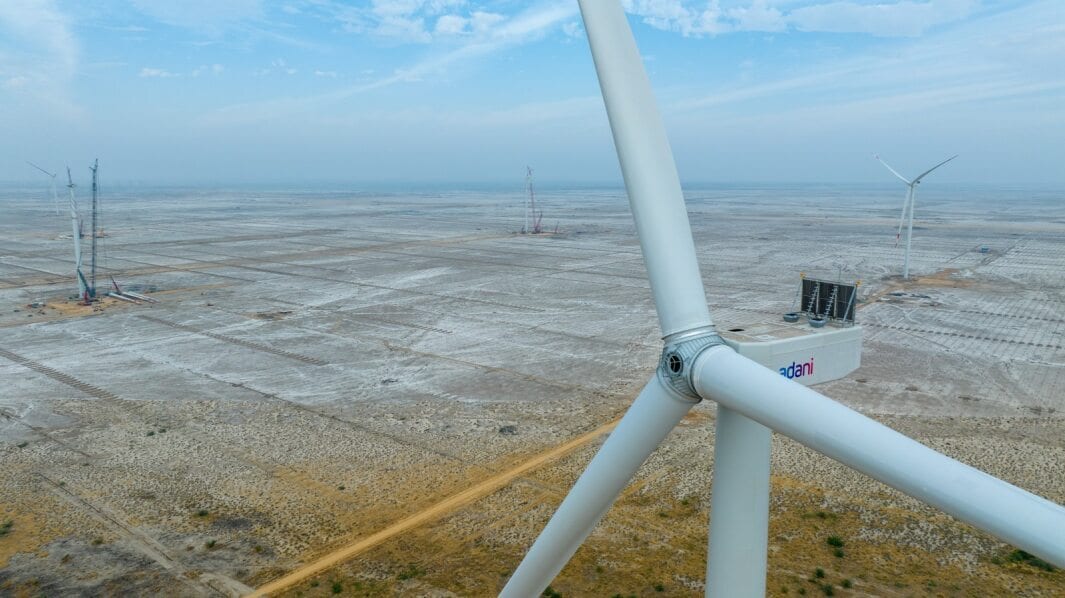
Notably 2 GW of solar capacity last fiscal came from Adani Green Energy’s world’s largest renewable energy project of 30 GW being built at Khavda, Gujarat. The project is spread across 538 square kilometres, almost five times the size of the city of Paris. Once built, it will be the largest power plant in the world, regardless of the energy source.
India Ratings and Research (Ind-Ra) recently upgraded Adani Green Energy Limited’s Long-Term Issuer Rating to ‘IND AA-’/ Stable from ‘IND A+’
AGEL’s current operational portfolio is 10,934 MW which consists of 7,393 MW solar, 1,401 MW wind and 2,140 MW wind-solar hybrid capacity. AGEL is the first company in India to surpass the 10,000 MW renewable energy capacity.
Over the past five years, AGEL’s operational capacity addition has outpaced the industry, achieving a CAGR of 41% as compared to India’s 13%.
AGEL’s Growth Enablers
AGEL’s total locked-in portfolio stands at 21,953 MW (10,934 MW is operational and 11,019 MW is under-execution). About 93% of AGEL’s portfolio comprising 20,368 MW is backed by 25-year fixed tariff PPAs (power purchase agreement) with sovereign/sovereign equivalent counterparties which gives it revenue predictability and 7% is merchant portfolio, offering higher realisations.
AGEL is on track to achieve 50 GW by 2030 target with its unique advanced resource assessment approach, encompassing robust manpower and supply chain planning, land acquisitions, transmission connectivity planning, securing PPA and financial closures.
AGEL has the largest land bank aggregated at 2,00,000 acres with 40 GW renewable energy potential in resource-rich sites in Rajasthan and Gujarat and locked-in transmission connectivity. Being construction-ready they provide a clear path for long-term growth with unprecedented speed and scale.