


WINDOWS TO NAYA BHARAT
Bold Blueprint For India’s Tech Future
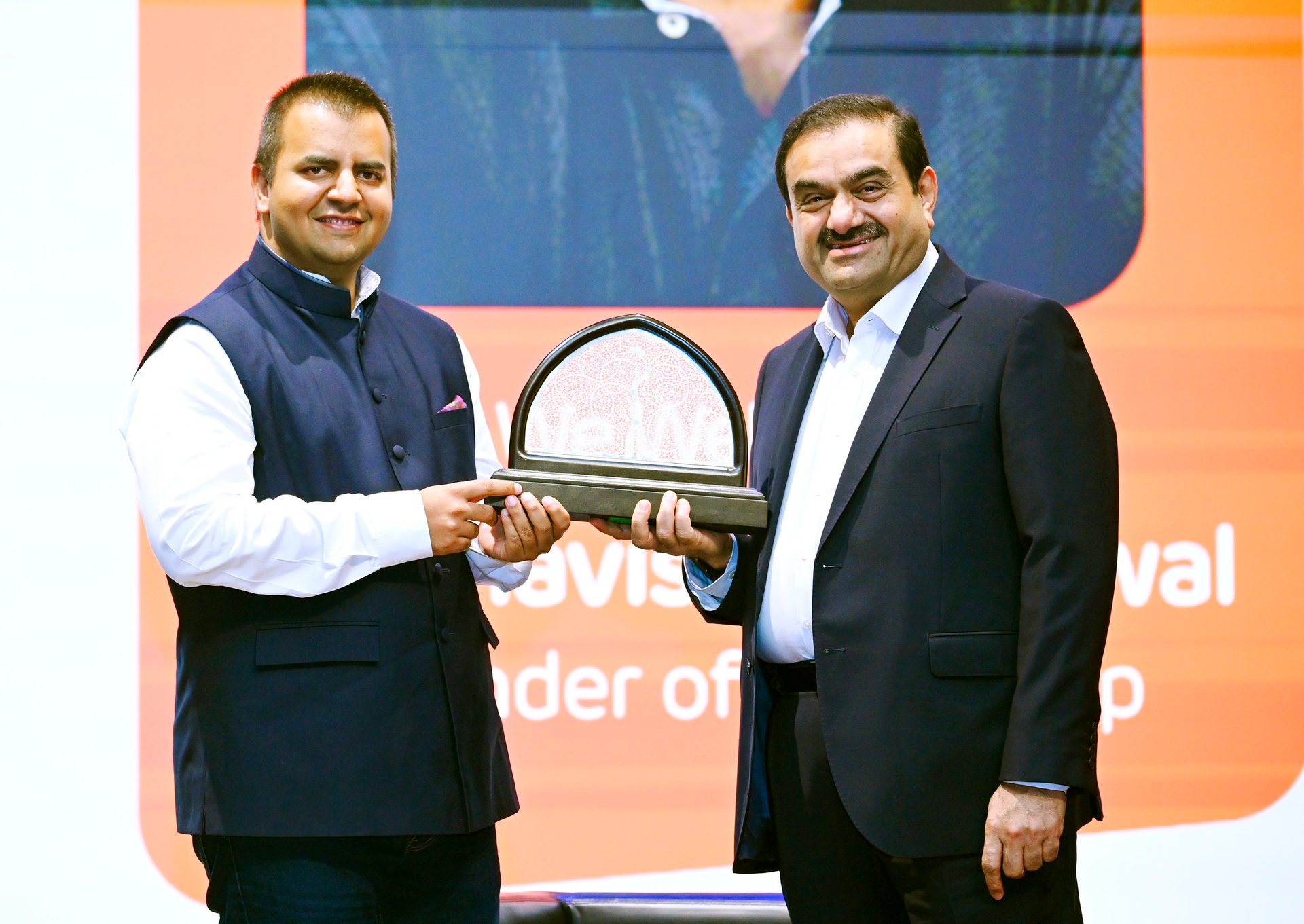
At Windows to Naya Bharat, an Adani Group Business Excellence initiative—India’s first unicorn co-founder Bhavish Aggarwal joined NDTV’s CEO & Editor-in-Chief Rahul Kanwal for a candid conversation on building not just companies but conviction, character and a self-reliant India.
Sneha TS
There’s something about Bhavish Aggarwal that makes you lean in. Maybe it’s the way he speaks,not like a CEO trying to impress a boardroom, but like a friend who’s been through the wringer and still believes the best is yet to come.
On August 1, at Windows to Naya Bharat—part of the Adani Group’s 'Your Growth Matters' initiative— Mr Aggarwal stepped into a packed room at Adani Corporate House (ACH) in Ahmedabad and left behind a playbook for ambition rooted in empathy. The freewheeling, hour-long conversation, titled “The Making of a Young Serial, Maverick and Unicorn,” was in equal parts heart, hustle and hilariously self-deprecating honesty.
Moderated with poise by Rahul Kanwal, the session didn’t just map a founder’s mind it walked us through his soul.
Built on Discipline, Driven by Disruption
Mr Aggarwal, 39, was born in Ludhiana, Punjab, into a middle-class Punjabi family. His father, a doctor, raised him in a household grounded in discipline, education, and respect for hard work,a classic Indian upbringing where stability was prized and entrepreneurship rarely featured at the dinner table.
A standout student, he pursued computer science at IIT-Bombay, graduating in 2008. Like many of his peers, he landed a coveted job at Microsoft Research India, where he spent two years. There, he filed two patents and published three papers in international journals,early evidence of his technical depth and restless curiosity.
But the monotony of corporate life, coupled with a deep-seated urge to create, soon stirred something bigger.
The Spark That Became Ola
The idea for Ola wasn’t born in a boardroom,it came from a bad road trip.
While managing a side hustle in holiday planning, Mr Aggarwal had a harrowing experience with a cab ride from Bengaluru to Bandipur. The driver demanded a fare renegotiation mid-way and eventually abandoned him on the road. That frustration became fuel.
He saw that India’s taxi ecosystem was fragmented, opaque, and deeply unfriendly to customers. What if technology could be solved for trust and transparency in mobility?
In 2010, at just 24, he teamed up with Ankit Bhati to launch Ola Cabs from a small Mumbai apartment. It started as a basic cab aggregator but quickly evolved into a full-stack mobility platform, redefining how India moved, from metros to mid-tier towns.
What started as a solution to a personal pain point became one of India’s most iconic start-ups and Mr Aggarwal, its quietly audacious architect.
That one leap laid the foundation for many more—from mobility to electric vehicles and now to artificial intelligence (AI).
Technology = Destiny
For Mr Aggarwal, technology isn’t just a tool. It’s India’s ticket to global leadership, as he rattled off numbers to make a cogent point. And the numbers are telling. India’s digital economy is worth USD 4 trillion; the US’s stands at over USD 30 trillion. Software contributes just 0.5% to India’s GDP, compared to USD 600 billion in the US. “That’s not a gap. That’s a canyon,” he said. “But even canyons can be crossed,if we start building bridges today.”
Krutim AI: A Model That Speaks Aapki Bhaasha
Then came the big reveal: Krutim AI—India’s first foundational AI model, built entirely in-house. “We’re not cloning ChatGPT,” Mr Aggarwal clarified. “We’re building something that understands Indian languages—all at once.”
The audience chuckled, but the ambition was serious. To be truly sovereign in the AI era, India must create, not copy. And that means building intelligence systems that understand India, linguistically and culturally.
The challenge? India has limited public training data in native languages. Ola’s solution? Synthetic data generation. “We’re creating datasets out of thin air to reflect how Indians talk, search, complain, flirt and shop.”
His view: “We can’t build like the West. So, we build smarter.”
The Supply Chain Mindset: Think Big, Build Local
He was candid about India’s constraints, lower research and development (R&D) budgets, less venture capital (VC) funding and a deeply price-sensitive consumer base. That’s why Ola Electric is laser-focused on affordability. “A petrol two-wheeler costs over a lakh. Ours is electric, packed with tech, but built for India’s middle class.”
The game-changer? Ola’s Bharat cell, a lithium-ion battery developed in India. It delivers more energy per kilogram than its Chinese counterparts and is cheaper to produce.
“It’s not just about making EVs [Electric Vehicles],” Mr Aggarwal said. “It’s about India owning its energy supply chain.”
This is where he drew parallels with China’s long-term industrial strategy and how the US scaled by betting on computing talent. “They’ve invested for decades. We’re just getting started. But we must think like builders, not buyers.”
Betting on Energy: The Next Century’s Currency
Energy independence, he stressed, is not a policy option, it’s a survival strategy.
Whoever controls generation, storage and flow of energy will control the next century. In this context, he acknowledged the role of giants like the Adani Group, whose investments in renewables, logistics and infrastructure are enabling the kind of backbone India’s tech and mobility sectors need.
“Whether it's AI, EVs, or clean energy, India's future will be built on deep capabilities, not shallow consumer apps,” he said.
Windows to Naya Bharat: Where Dreams Scale
This wasn’t just another leadership keynote. Windows to Naya Bharat, through its emotionally intelligent, curiosity-driven format, didn’t just celebrate growth—it celebrated becoming. Mr Aggarwal reminded everyone that the road to unicorns begins with code but it is completed with courage.
As the applause faded and the audience gradually dispersed, only hope floated in the near-empty auditorium. The kind that smells like ambition, laughs like resilience and speaks every Indian’s mother tongue. Because India doesn’t need to dream only in English anymore.
It’s time to build, right here for the world. And Mr Aggarwal is showing us the way while leading from the front.