

skills
From Theory To Reality
Technology is transforming how we learn and apply skills. With Artificial Intelligence (AI), Virtual Reality (VR), and drones leading the way, the gap between theory and practice is closing, creating an exciting new era in education.
Vishakha Katekhaye
For decades, the obstacles in education and training have been undeniable: how can we ensure that individuals possess both knowledge and the practical skills to apply it effectively? Traditional methods often fail to prepare learners for the challenges of real-world situations. However, we are now on the verge of a groundbreaking transformation fueled by Artificial Intelligence (AI), Virtual Reality (VR), and drones—technologies that transcend mere tools and act as powerful drivers of a new learning era. Embracing these innovations can empower learners to navigate complexities with confidence and competence.
"Tell me, and I may forget. Immerse me, and I will never stop learning." This powerful mantra beautifully encapsulates the role of Virtual Reality in skill development.
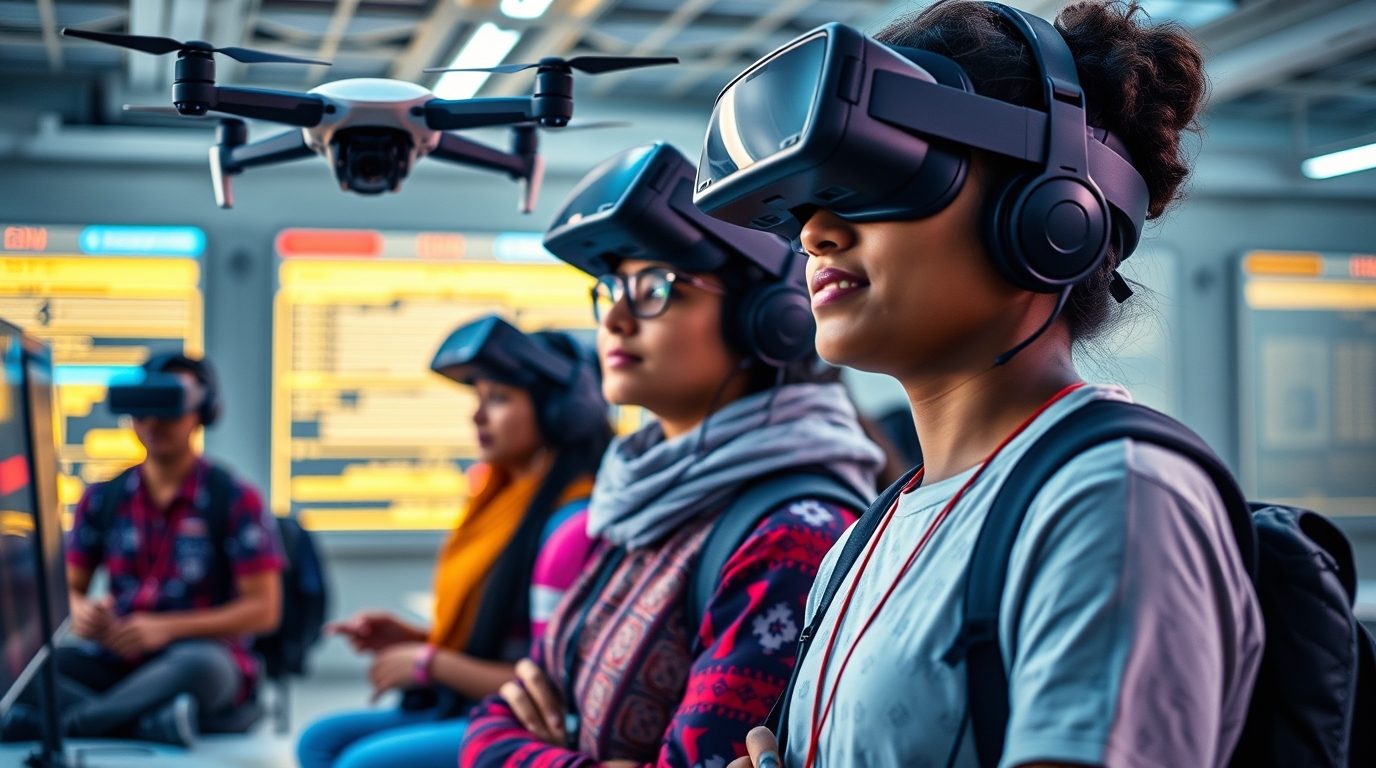
VR immerses learners in lifelike environments where they can interact with complex systems in ways traditional methods simply cannot match. Trainees have the opportunity to practise everything from assembling machinery and troubleshooting technical processes to responding to emergency situations—all within a virtual world that feels as real as the actual one. For instance, aspiring fire safety professionals can simulate navigating hazardous environments, while electricians can refine their skills by rehearsing intricate wiring tasks with exceptional precision.
Drones: Grounding Learning in Practicality
Drones are much more than just technological gadgets; they are transformative tools in skill training. At the Adani Skill Development Centre (ASDC), trainees are mastering drone operations for a wide range of applications—from monitoring agricultural fields to conducting inspections in industrial settings.
“Operating a drone is not just about flying; it’s about understanding automation, spatial awareness, and applying skills to solve real-world problems,” explains Shonu George, DGCA Certified Remote Pilot / Trainer and a member of the ASDC Saksham team. Whether mapping difficult-to-reach terrain or delivering essential supplies, drone training bridges the gap between theoretical knowledge and practical application, equipping learners for roles in emerging industries.
A Synergistic Approach
The true power lies in the integration of these technologies. Imagine a scenario where AI designs a personalised learning path, VR simulates a real-world challenge, and drones facilitate practical execution. This holistic approach not only enhances skill acquisition but also fosters confidence, creativity, and critical thinking.
While these technologies hold immense potential, their implementation presents challenges such as high costs, infrastructure requirements, and the need for skilled instructors. However, with strategic investments and partnerships, these barriers can be overcome, paving the way for accessible and scalable solutions.
Adopting these technologies is not without its hurdles—cost, infrastructure, and the need for skilled instructors are genuine challenges. But ASDC has transformed these barriers into opportunities, leveraging strategic partnerships and investments to build an ecosystem where innovation flourishes.
The Bigger Picture
The journey from theory to practice has always been the most difficult aspect of education, but technologies such as AI, VR, and drones are redefining that path. They enable learners not only to understand but to experience, apply, and excel. Through initiatives like those championed by ASDC, the future of education is no longer a distant dream—it is here, it is immersive, and it is changing lives.
At the heart of this transformation is a simple belief: learning is not just about acquiring skills; it is about empowering individuals to shape their futures. And with AI, VR, and drones, that future has never been brighter.
Operating a drone is not just about flying; it’s about understanding automation, spatial awareness, and applying skills to solve real-world problems.”
Shonu George
DGCA Certified Remote Pilot / Trainer