


newsmakers
Adani Ports & SEZ
Mundra Port Docks History
Mundra Port makes maritime history, berthing India’s first fully laden Very Large Crude Carrier and setting a global benchmark in energy logistics.
Himanshu Sharma & Sneha T S
Mundra Port witnessed a decisive milestone in India’s maritime journey on 6 Jan 2026, as Adani Ports and Special Economic Zone (APSEZ) successfully berthed MT New Renown, the country’s first fully laden Very Large Crude Carrier (VLCC), carrying 3.3 lakh cubic metres of crude oil. The achievement established Mundra as the first port in India—and among a select few globally, with a dedicated jetty capable of directly berthing fully loaded VLCCs, strengthening supply-chain efficiency and national energy security. Accomplished amid strong currents, high winds and challenging sea conditions, the operation reflected robust infrastructure, meticulous marine planning and the high level of operational expertise of the APSEZ marine and port management teams.
Berthing a Mark in India’s Maritime History
The capability to berth a fully laden Very Large Crude Carrier (VLCC) at maximum displacement represents a transformational leap in India’s crude oil logistics, redefining how large-scale energy shipments are received and managed. By enabling direct jetty operations, the facility eliminates the need for offshore lighting, significantly reducing handling time, operational risk and overall logistics costs. This capability ensures safer, faster and more efficient crude handling, while accommodating vessels carrying upwards of 3 lakh cubic metres of crude in a single call—an operational scale that few ports globally can manage. Beyond operational efficiency, this milestone highlights APSEZ’s leadership in developing world-class, future-ready port infrastructure, engineered to meet India’s growing energy security needs, support expanding trade volumes and integrate seamlessly with global supply chains, positioning Mundra Port as a strategic hub in the international maritime ecosystem.
A Rare Global Capability
Direct jetty berthing of fully laden VLCCs is a capability possessed by only a handful of ports worldwide, given the extreme draft, displacement and specialised infrastructure required for such vessels. With this achievement, Mundra Port joins an elite league of global crude-handling hubs, enhancing India’s strategic presence on the international maritime and energy map. The port’s advanced vessel-handling capabilities now eliminate reliance on offshore Single Point Moorings (SPMs) or traditional Lightering operations, enabling safer, faster and more cost-efficient handling of ultra-large crude carriers. This milestone not only highlights Mundra’s engineering excellence but also reinforces India’s ability to manage high-volume energy imports with world-class operational efficiency.
India’s First-of-Its-Kind VLCC Jetty
The purpose-built Very Large Crude Carrier (VLCC) jetty at Mundra stands as a definitive testament to advanced maritime engineering and operational excellence, meticulously designed to accommodate the world’s largest crude oil carriers with uncompromising safety and efficiency.
Extending over an impressive 400 metres, the jetty is supported by a berth pocket depth of 25 metres, enabling the safe berthing of VLCCs with a maximum acceptable Length Overall (LOA) of 333 metres, a maximum displacement of 360,000 tonnes and a maximum operational draft of 21.6 metres. These parameters collectively position the facility among the deepest and most capable crude-handling jetties globally.
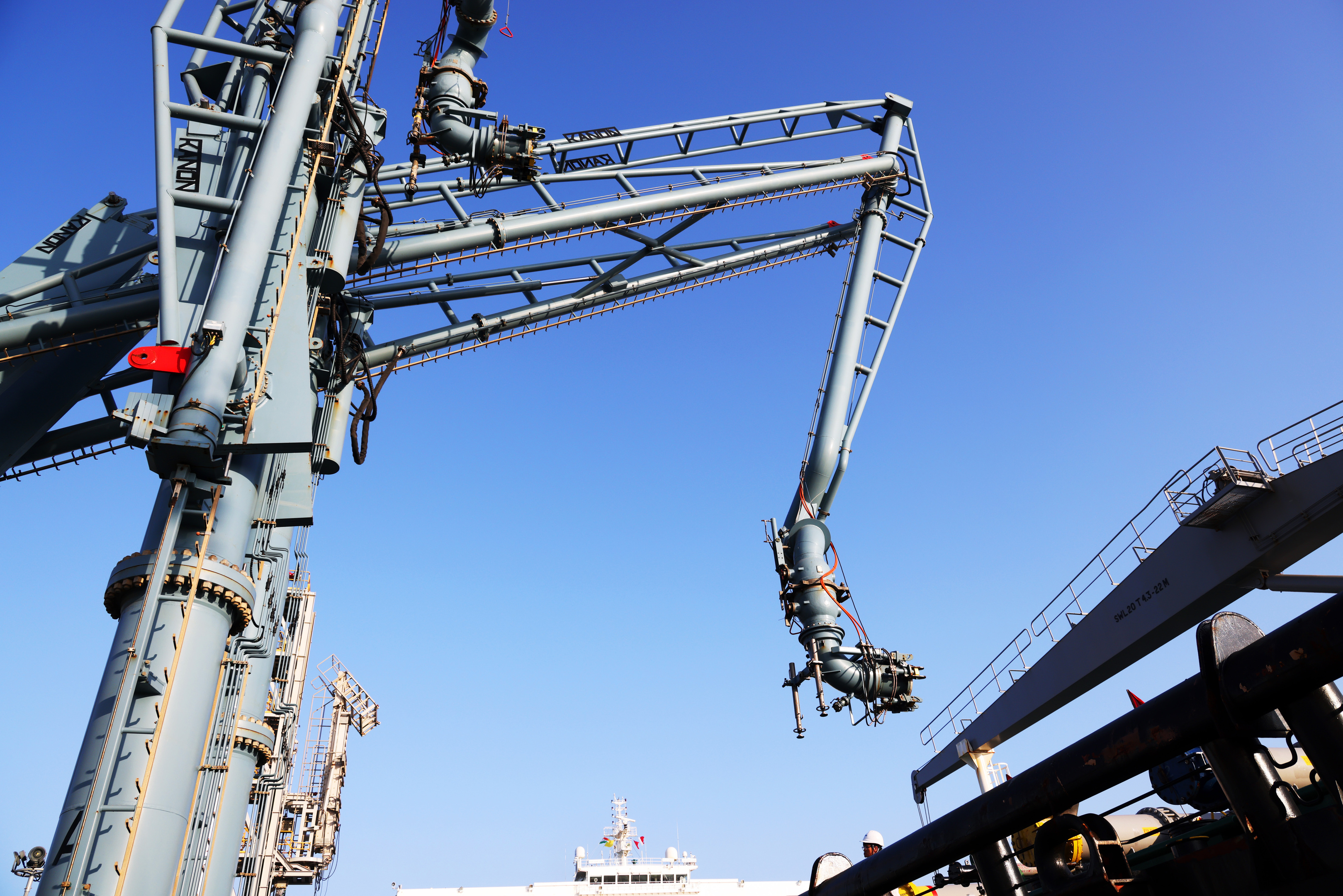
Cargo transfer operations are executed through two 20-inch crude oil loading arms, engineered for high-throughput performance, facilitating a maximum discharge rate in the range of 10,000 to 12,000 cubic metres per hour. This robust configuration ensures rapid vessel turnaround while maintaining stringent safety and control standards.
The jetty’s marine infrastructure is a masterfully integrated system designed to counteract the immense kinetic and environmental forces exerted by ultra-large vessels. It incorporates four breasting dolphins, which serve as the primary load-bearing interfaces during berthing. These heavily reinforced structures, equipped with advanced fender systems, absorb lateral berthing energies and maintain controlled vessel alignment, thereby safeguarding both the ship’s hull integrity and the jetty framework.
Complementing these are six mooring dolphins, strategically positioned to ensure precise and secure vessel restraint. These dolphins are fitted with high-capacity quick-release mooring hooks, each rated up to 150 tonnes Safe Working Load (SWL), providing exceptional holding capability under extreme wind, wave and current conditions. Their design ensures operational resilience while enabling rapid and safe mooring and unmooring operations.
Together, the breasting dolphins, mooring dolphins and state-of-the-art fender systems form a resilient and harmonised berthing arrangement. This integrated infrastructure underscores Mundra’s VLCC jetty as a pioneering facility, capable of reliably supporting ultra-large crude carriers while adhering to the highest standards of maritime safety, efficiency and engineering precision.
An Infrastructure Powerhouse
Mundra, APSEZ’s flagship port and India’s largest commercial port, is strategically located in the Gulf of Kutch and serves as a critical maritime gateway for northern and western India. As a deep-water, all-weather port, Mundra is distinguished by its extensive and versatile infrastructure, comprising 27 operational berths and two Single Point Moorings (SPMs). The port is capable of handling a wide range of cargo, including dry bulk, break-bulk, project cargo, liquids, containers, automobiles and crude oil. Its advanced marine facilities enable the accommodation of Cape-size vessels, Very Large Crude Carriers (VLCCs), Ultra Large Crude Carriers (ULCCs) and ultra-large container vessels (ULCVs), reflecting their ability to operate at the highest levels of global maritime standards. Mundra is also India’s largest container-handling port, with the country’s highest container throughput as well as leading capacities in import coal and overall commercial cargo handling. In 2024–25, Mundra became the first port in India to handle more than 200 million metric tonnes (MMT) of cargo in a single year, a milestone that firmly reinforces its unmatched scale and operational leadership.
Mundra Port has earned recognition in the World Bank’s Container Port Performance Index (CPPI) for 2024 and 2025, reflecting its strong operational efficiency, service reliability and adherence to internationally accepted best practices in port management and container handling.