


COVER STORY
When Perseverance Rewrites Possibility
BeConnected, the women’s collective of the Adani Group, in collaboration with TEDx and Adani University, brought together trailblazing women whose courage, vision and dedication are shaping industries, communities and the nation.
Sneha T S
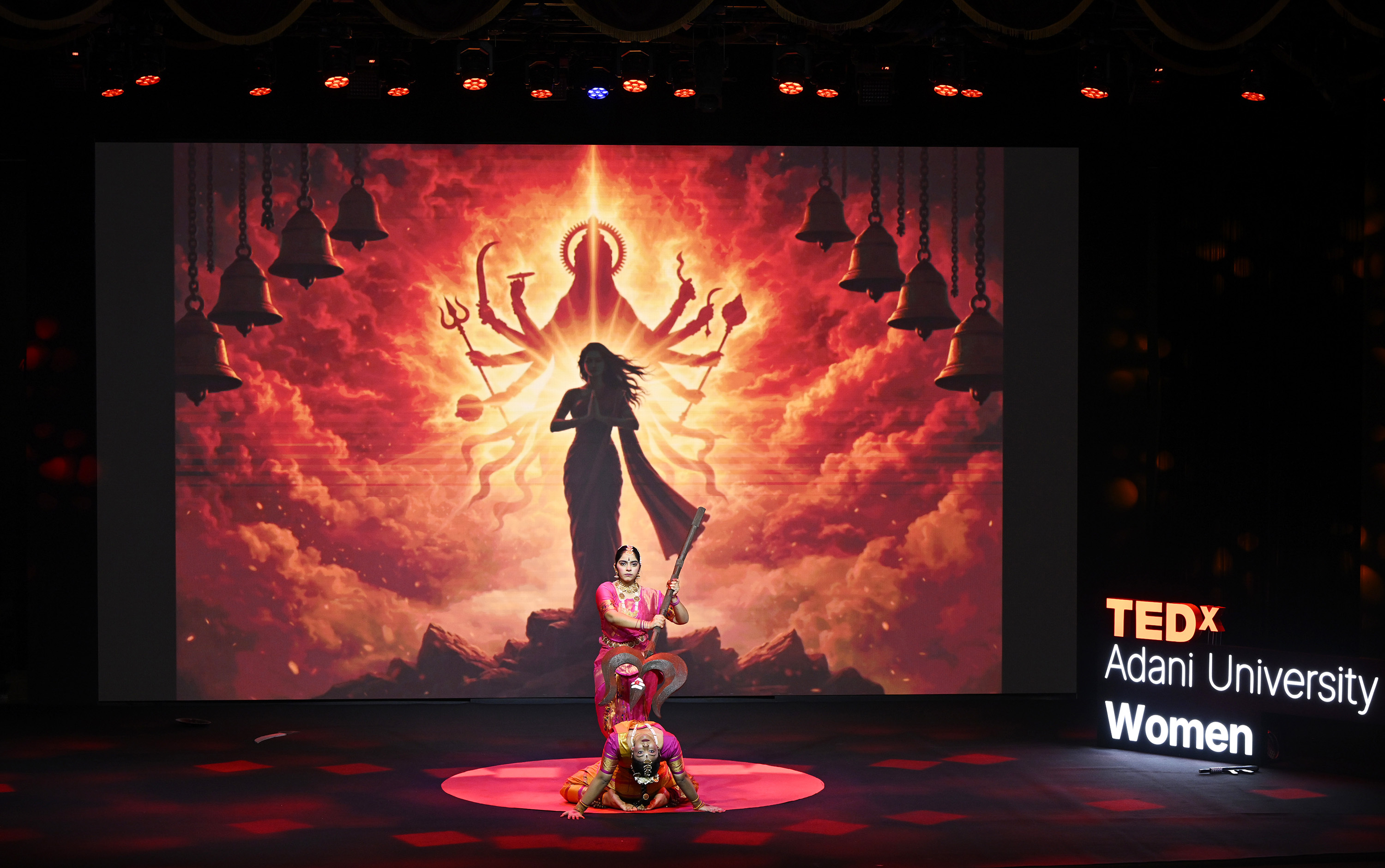
On a January afternoon charged with reflection and resolve, the Adani Corporate House became a space for stories that refused to be ordinary. TEDx Adani University Women, held on 23 Jan 2026, brought together voices that have shaped, challenged and redefined the idea of success—women whose journeys were forged through adversity and sustained by purpose. Anchored in the theme “Stories of Struggle to Success,” the event cast a thoughtful spotlight on exceptional trajectories marked by resilience, courage and quiet determination. Each narrative unfolded not as a moment of triumph alone, but as a continuum of perseverance—where setbacks became stepping stones and conviction outweighed constraint.
Curated by BeConnected, the women’s wing of the Adani Group, in collaboration with Adani University, the gathering moved beyond inspiration to introspection. The TEDx stage became a platform where lived experiences carried as much weight as achievement, inviting the audience to reimagine possibility through the lens of grit and grace.
From trailblazers in defence and administration to athletes who redefined endurance, and from social reformers to pioneers in space science, the speakers represented a compelling cross-section of impact. Their testimonies were neither embellished nor abstract; they were grounded, candid and resonant—stories that illuminated the realities behind recognition and the discipline behind distinction.
Majestic Maverick
Captain Hansja Sharma
Born on 9 March 1998 in Jammu, Captain Hansja Sharma has etched her name in history as the Indian Army’s first woman pilot qualified to fly the Rudra armed helicopter, a frontline combat platform of the Army Aviation Corps. A graduate of the Combat Army Aviation Training School (CAATS), Nashik, she currently serves with the 251 Army Aviation Squadron, commanding one of the Army’s most advanced helicopters.
Captain Sharma traced her journey back to an incident at sixteen, when she fell asleep while milk simmered on the stove, filling the house with smoke. Her mother’s remark, “May my daughter land a job that makes her wake up even before the sun rises,” proved prophetic, foreshadowing a life of discipline and early mornings.
Initially aspiring to the civil services, Captain Sharma’s outlook changed through college debates, theatre and her involvement with the NCC. “I started as a middle-class girl thinking, What if I try?” she recalled. Before joining the Army, she underwent corrective nasal surgery, entering training during physical vulnerability. The regimen was relentless. “You name an animal and there is a punishment in its name wherever required,” she said, describing grueling drills that tested endurance and resolve.
Her pipping ceremony during COVID-19 was marked by family absence, making the milestone deeply solitary. When flying roles opened to women, she persevered through self-doubt and setbacks, earning her wings and the Silver Cheetah Trophy on 23 Nov 2023. “The harder you work, the luckier you get,” she reflected.
Flying the Dhruv and later the Rudra, she described combat aviation vividly, “Up there we don’t just fly; we hunt. We feel the thrust of weapons and the roar of missiles cutting through the sky!” Posted in Jammu and Kashmir, she learned that challenges were often mental. “They were never truly physical obstacles—they were in my mind.”
Her journey stands as a testament to courage, discipline and perseverance, redefining what is possible for women in uniform.
“I ASpire, I Strive”
Sunaina Tomar
Sunaina Tomar, a senior Indian Administrative Service (IAS) officer of the 1989 Gujarat cadre, has spent over three decades shaping public policy and governance across key departments. She currently serves as Additional Chief Secretary for Higher and Technical Education in Gujarat, while holding additional charge of the Social Justice and Empowerment Department.
Raised in a disciplined yet encouraging household, Ms Tomar spent her childhood playing alongside boys. “Many of my friends were boys. We played with marbles, traded iron scraps for orange candies,” she recalled. Though academically unremarkable early on, moving to an officer colony sparked ambition. From securing an all-India 17th rank in Class 10, each success strengthened her resolve. “I didn’t want to become a doctor or engineer. My father became my saviour when I confessed that I did not like maths or physics,” she said.
College years brought independence and self-realisation. “I realised that I had to carve my own path. The IAS was no longer a distant aspiration—it became a relentless pursuit,” she added. As college union president, she learned leadership firsthand. “I remember winning the election with nothing but strategy, persistence and conviction.”
Facing scepticism during civil services preparation, she channelled doubt into determination. “I was told I did not even know enough… I took that as a challenge to immerse myself in learning, to outwork everyone,” she recalled. Even television inspired her; the serial Udaan, with Kavita Chaudhary’s portrayal of an IPS officer, ignited an inner fire. “That fire kept me awake at night, not just to study, but to envision the life I wanted to lead,” she said.
Entering the IAS in 1989, Ms Tomar was aware of the implicit biases women faced. History, she notes, demands that women exert tenfold effort to achieve parity with men. She cites Savitribai Phule, the pioneering educator: carrying an extra saree to endure insults while teaching girls in Pune. “I believe struggle is synonymous with hard work. Be it a man or a woman, no one achieves success without toil and perseverance,” she insisted. Dr APJ Abdul Kalam’s counsel remains central to her philosophy: “We may not all be equally talented, but we are certainly surrounded by equal opportunities to prove our talent. One must make the most of them.”
Hockey and Hustle
Navneet Kaur
Navneet Kaur, born in 1995 in Shahabad Markanda, Haryana, is among Indian women’s hockey’s most accomplished forwards, having represented the country in over 200 international matches. A key contributor to India’s historic campaigns—including the Junior Asia Cup silver and Junior World Cup in 2016, and the Tokyo 2020 Olympics—she currently serves as vice-captain of the senior national team. She also captained SG Pipers to the 2025–26 Women’s Hockey India League title, scoring four crucial goals and earning Player of the Tournament honours.
Her journey began on Shahabad’s modest fields, shaped by early mornings and relentless practice. “When I was nine, I had barely imagined that hockey would become the axis of my life. My father wanted me to play cricket, yet the field called me every morning. My medals today are my degrees—they embody every bruise, every dawn, every sacrifice in pursuit of excellence,” she recalled.
Facing skepticism during the Women’s Hockey India League auction, she asserted herself. “When I went for the bidding, everyone questioned whether I deserved a place. I simply asked, 'Why not me?' That question changed everything.”
Introverted early on, she learned the value of confidence. “Even when I knew the answers… I learned that confidence is as vital as competence.” Reflecting on Tokyo, she added, “It still hurts knowing we were just a step away from an Olympic medal… It is not a burden—it is purpose.”
She transforms setbacks into opportunities for reflection and renewed effort. Through her journey, Ms Kaur embodies the modern Indian woman athlete: focused, strategic and fearless in asserting her worth. Her story inspires aspiring players to confront doubt with courage and turn obstacles into milestones of personal and collective achievement.
The Altruist’s Lens
Sushama Oza
Sushama Oza’s early life was shaped by resilience and service. Her mother’s guiding belief—“God gives trials only to those He trusts to overcome them”—and her father’s Gandhian values instilled social responsibility. Frequent relocations due to his work demanded adaptability and emotional strength from a young age.
At school, she confronted the dual challenge of academic excellence and a scholarship examination. “Transitioning to an English-medium school was daunting, but I resolved to confront it with determination.” Her intellectual pursuits extended beyond formal study. She joined the NCC, took swimming lessons and frequented eminent libraries, including the Gandhi Smriti Library. “I had to conceal books beneath my textbooks to read them before returning.” These early endeavours nurtured both her curiosity and disciplined initiative.
Following graduation, Ms Oza pursued a Master of Social Work. Her first-semester fieldwork in the Plastic Surgery and Burns Ward exposed her to unvarnished human suffering, including the death of a young patient. Her supervisor’s counsel crystallised the lesson: “Witnessing these realities strengthens you.” This experience instilled in her an enduring empathy and equanimity, crucial for confronting human fragility in her professional life..
Her early professional years were marked by financial adversity. Without remuneration for several months, Ms Oza undertook a hunger strike—not in rebellion, but as an assertion of ethical integrity. “I wanted only the salary I had rightfully earned.” Her modest first salary became a lesson in prudence. “Experience mattered more than pay; I seized every responsibility to learn extensively.” She immersed herself in hospital administration, programme management and grant writing, accruing a breadth of practical expertise that would underpin her later leadership.
Relocation to the United States introduced fresh challenges. She had to learn to drive, navigate new cultural and professional norms and work with differently-abled individuals entangled in criminality and substance misuse. Recognising the imperative for advanced skills, Ms Oza obtained licensure as a Clinical Social Worker. “Advanced training enabled me to genuinely impact rehabilitation and reintegration.” She devoted over 3,200 hours to restorative programmes, guiding vulnerable individuals towards treatment, skill acquisition and reintegration with society.
Returning to India, she joined the Adani Foundation, leading initiatives in Mundra and other rural regions. Ms Oza encountered entrenched resistance, logistical complexities and high-risk environments, yet she safeguarded her team and ensured morale remained high. “Every challenge honed my resolve and shaped my ability to translate vision into tangible impact.” Through these endeavours, she translated strategy into measurable social development, benefiting entire communities.
Stellar Pursuits
Dr Rashmi Sharma
Dr Rashmi Sharma, Deputy Director at the Space Applications Centre (SAC), Ahmedabad, is a distinguished figure in India’s space research ecosystem, with decades of contributions spanning oceanography, air–sea interaction, environmental monitoring and applied space sciences. Her journey began in rural Bihar, where education depended more on perseverance than infrastructure.
“My early life is not extraordinary, nor filled with remarkable events—just a story of breaking stereotypes and facing challenges. Every step has been worth it,” she recalls. Guided by her grandfather, a teacher, and her grandmother, who lacked formal schooling, she developed curiosity and discipline early on.
A move to Mumbai in Class 11 proved transformative. “I had to learn technical English and adapt to concepts I had never encountered before. Those early struggles became the cornerstone of my growth,” she says. These challenges prepared her for postgraduate studies in Physics at Bombay University.
Dr Sharma joined SAC in 1991 with limited exposure to space science. “I had no prior knowledge of space technology… but somehow, I was selected.” The opportunity aligned with a deeper purpose. “This is the place where you can live your dream, but also the dream of the nation. I wanted to contribute to Dr Vikram Sarabhai’s vision.”
Now a senior leader, she emphasises focus and sacrifice. “There is no standard template for balancing work and life.” Her advice remains constant: “Be steadfast in pursuit of your goals… it is a marathon.” Her journey stands as enduring inspiration.
Her life attests that intellect, determination and imagination are the instruments by which boundaries can be transcended. “If a small girl from a village in Bihar can pursue space science, navigate oceans and contribute to the nation’s vision, then any of you sitting here can achieve remarkable things,” she said, offering both inspiration and practical guidance. Her journey demonstrates the extraordinary possibilities that emerge when talent meets steadfast purpose.