


PEOPLE
A Leap From Wall Street To Space
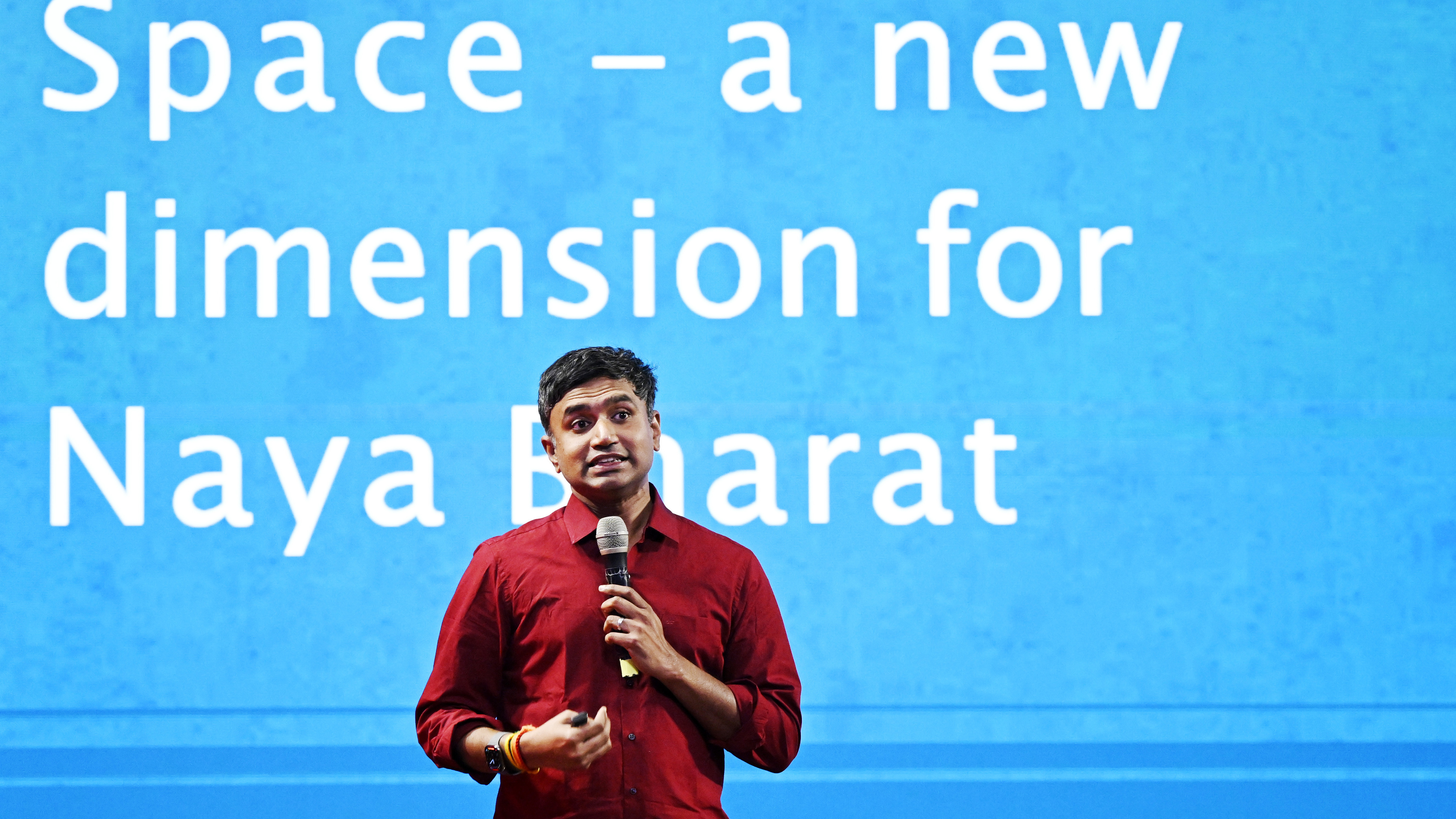
Srinath Ravichandran, AgniKul’s co-founder and CEO and aerospace entrepreneur, charts India’s bold path skyward at the recent Windows to Naya Bharat session.
Soumalya Santikari
Srinath Ravichandran, aerospace entrepreneur and Co-Founder and CEO of Chennai-based AgniKul Cosmos, shared a personal journey that blends precision with audacity, mirroring a new India’s growing confidence in building world-class solutions at home.
Trained in financial engineering at Columbia University, Mr Ravichandran once thrived in the high-pressure corridors of Wall Street. By every conventional measure, he had already arrived. Yet beneath the spreadsheets and market models lay a childhood fascination rooted in his native Chennai, an enduring obsession with rockets, propulsion and space.
“Space shouldn’t be harder to reach than any other place on Earth,” he remarked, distilling the belief that would eventually pull him away from finance.
The real inflection point came in Los Angeles, where he pursued aerospace engineering and observed the rapid rise of small satellites. While satellites were becoming smaller, faster and more agile, access to orbit remained slow, expensive and inflexible. The disconnect was impossible to ignore.
Satellites, some no larger than shoeboxes, sat idle in laboratories for months, waiting for massive rockets designed for a different era. The world had moved towards on-demand services in almost every sphere, yet the gateway to space remained rigid and crowded.
Rather than wait for the industry to evolve, Mr Ravichandran chose to build what was missing.
He returned to India and co-founded AgniKul Cosmos at the IIT-Madras incubator, with a singular mission to democratise access to space. The company’s defining breakthrough came with Agnilet, the world’s first fully 3D-printed semi-cryogenic rocket engine manufactured as a single piece. By eliminating hundreds of traditionally assembled components, the innovation dramatically simplified rocket construction and shortened development cycles.
“If you want to make space affordable, you don’t just build a better rocket,” he explained. “You rethink how a rocket is built from the ground up.”
For Mr Ravichandran, rockets are only the beginning. He spoke of a future where pharmaceuticals are developed in microgravity, data is stored in space, and access to orbit becomes routine rather than rare. His vision is not only technological but deeply democratic, centred on lowering barriers and expanding possibilities.
As he stepped off the stage, it was evident that Mr Ravichandran’s story is not merely one of career reinvention, but one of belief, the belief that India can build, launch and lead on its own terms.