


SOLAR POWER
A Decade Of Growth Elevates Solar Manufacturing Globally
Adani Solar’s inclusion in Wood Mackenzie’s global top 10 highlights India’s manufacturing scale, operational discipline and rising clean energy leadership.
Asha Bajpai & Joydeep Sen Gupta
India’s solar sector has undergone a dramatic transformation over the past decade. From an installed base of less than 2.5 gigawatts (GW) in 2014, the country’s solar capacity has expanded to over 140 GW in 2025. India is now the third ranked country globally in terms of installed solar manufacturing capacity and the third largest solar power producer in the world. The number of companies manufacturing solar modules has risen from 21 in 2021 to around 100 today, underscoring the rapid expansion of the sector.
This growth has been supported by several policy measures such as the Approved List of Models and Manufacturers (ALMM) and the Approved List of Cell Manufacturers (ALCM) among others. Together, these initiatives have strengthened domestic manufacturing capability while enabling Indian companies to expand their export footprint. As India assumes a more prominent role in the global solar transition, its manufacturers are increasingly being benchmarked against international peers.
Global recognition in a diversifying solar market
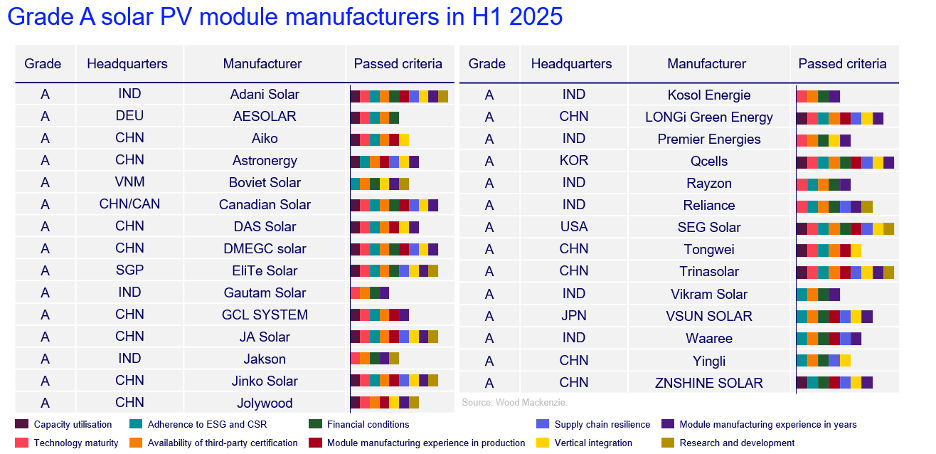
Against this backdrop, Adani Solar, the solar photovoltaic (PV) manufacturing arm of Adani New Industries Limited (ANIL), has been ranked seventh globally in the Global Solar Module Manufacturer Ranking for the first half of 2025 by Wood Mackenzie, a global energy and natural resources research and consultancy firm. It is the only Indian company to feature in the global top 10.
Wood Mackenzie’s evaluation framework assesses manufacturers across 10 parameters, including third-party reliability testing, supply chain resilience, vertical integration, environmental social and governance performance, financial health, manufacturing track record, research and development (R&D) intensity and patent activity. Adani Solar was assigned a Grade A classification, reflecting benchmark performance across these dimensions.
While the ranking continues to be dominated by China-based manufacturers, the report highlights that emerging challengers from India, South Korea, Singapore and the United States point to a competitive landscape that is becoming more geographically diversified. Commenting on the findings, Yana Hryshko, Head of Global Solar Supply Chain at Wood Mackenzie, noted that financial discipline and operational excellence are proving decisive in a difficult market environment.
Manufacturing scale and operational performance
The report also notes that Adani Solar and DMEGC Solar achieved a 100% utilisation rate in the first half of 2025, compared with an average utilisation rate of 70% across the top 10 manufacturers globally.
India’s solar module manufacturing capacity has now expanded to approximately 140 GW per year. Industry trends suggest that India is likely to be the principal driver of global solar growth over the next two years, particularly as other major markets face policy uncertainty and signs of saturation.
Adani Solar recently crossed a significant milestone by shipping more than 15,000 megawatts (MW) of solar modules across domestic and international markets as of 2025. Of this total, 10,000 MW were deployed within India, while another 5,000 MW were exported. Around 70% of these modules were manufactured using solar cells produced by Adani in India. The company is the first and fastest Indian manufacturer to reach this scale, creating over 8,000 direct jobs along with a substantial number of indirect green jobs.
India’s solar momentum and the road ahead
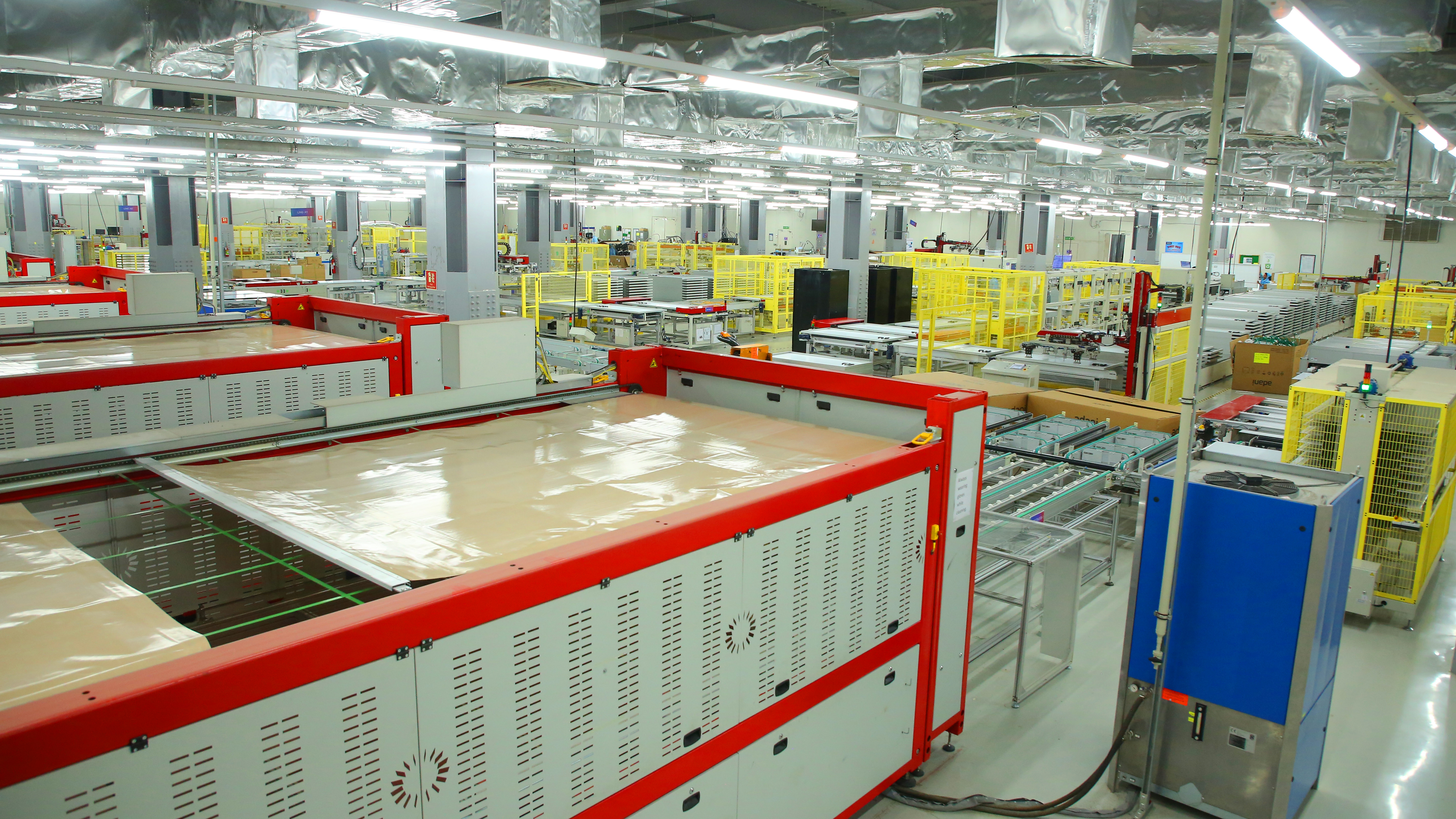
Adani Solar plans to expand its manufacturing capacity from 4,000 MW to 10,000 MW per annum by the next financial year. Its manufacturing facility at Mundra in Gujarat produces next generation high efficiency solar modules and has end to end capabilities spanning ingots, wafers, cells, modules and key ancillary materials such as solar glass, aluminium frames and Ethylene Vinyl Acetate (EVA) components.
The company has also been recognised as a Top Performer by Kiwa Photovoltaic Evolution Labs for the eighth consecutive year and as a Top Brand Photovoltaic 2025 by EUPD Research, a global market research and certification firm. It has maintained Tier One status with Bloomberg New Energy Finance across multiple quarters, including the third quarter of 2025.
Looking ahead, Bloomberg New Energy Finance projects that India will become the world’s second largest solar market in 2026, surpassing the United States for the first time. India is expected to add just over 50 GW of new solar capacity in 2026, representing a 6% year-on- year increase, supported by continued rooftop growth through government subsidy programmes.
India has already exceeded its 2015 Paris Agreement commitment, with non-fossil sources accounting for 51.5% of installed power capacity achieved five years ahead of the 2030 schedule. With a target of 500 GW by 2030, the country’s solar manufacturing ecosystem is increasingly shaping the next phase of the global clean energy transition.