


TRAVELOGUE
Bhutan And The Measure Of Gross National Happiness
Led by Kings Jigme Singye Wangchuck and Jigme Khesar Namgyel Wangchuck, Bhutan advanced a development model balancing collective well-being with economic, cultural, environmental and spiritual priorities.
Joydeep Sen Gupta
I entered Bhutan at the southern border town of Phuentsholing, crossing over from Jaigaon in West Bengal, where the plains begin to rise into the first folds of the eastern Himalayas. The transition announces itself quietly as the road begins to climb, the air cools and the land sheds the noise of the lowlands. Traffic thins along Asian Highway (AH) 48. What replaces it is the sound of wind threading through trees and water slipping over stone. Forests close in. Small settlements appear and recede. Prayer flags flicker against the green and whitewashed stupas perch above the road, their presence less declarative than contemplative, built not to gather crowds, but to slow the mind.
From Phuentsholing to Thimphu, winding ascents replace distance with silence, forests deepen, rivers run colder, and arrival feels earned—a gradual settling shaped by altitude, light and retreat from world.
Here, the mountains stop being scenery and begin to assert authority. The shift is felt most clearly when the journey lifts briefly from the road to the air. Flights into Paro International Airport thread narrow corridors between steep ridgelines, guided as much by terrain and weather as by precision. Only a small circle of pilots, fewer than 20 worldwide, are specially trained to make this descent, often into what is described as one of the most beautiful airports in the world. As the aircraft drops lower, the Valley opens below in composed stillness. Fields settle into careful geometry. Farmhouses sit low and unassuming. Monasteries cling to slopes as if anchored by centuries of devotion. Entry feels ceremonial, not by design but by consent, as though the land itself allows passage on its own terms.
And then the gaze lifts again. High above the Paro Valley, at an altitude of around 10,240 feet, Taktsang Monastery, better known as Tiger’s Nest, clings improbably to a sheer cliff face. According to Buddhist belief, Guru Padmasambhava flew here on the back of a tigress in the eighth century, subduing dark forces and meditating in a cave that later became the monastery’s spiritual core. The story is not treated as legend so much as inheritance. In Bhutan’s Vajrayana tradition, myth, landscape and belief do not compete; they co-exist, reinforcing one another in lived experience.
The Capital and the Architecture of Belief
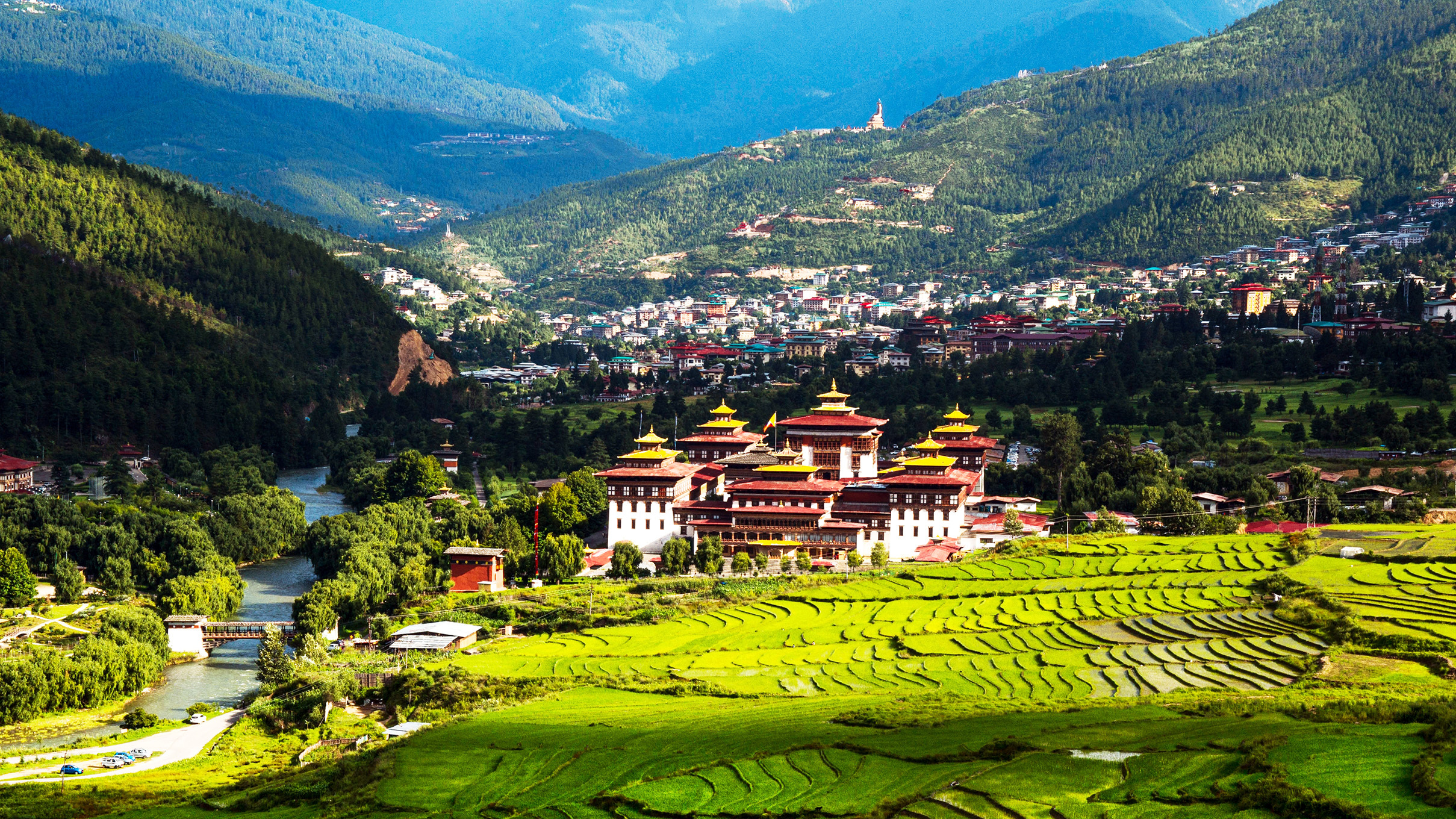
Thimphu, Bhutan’s capital, carries this same sense of measured confidence. It is a city without traffic lights and without excess, where governance follows form and form follows belief. Buildings adhere to traditional architectural codes and strict height limits of five storeys and a basement. Monks walk alongside civil servants. Daily life moves at a pace shaped more by intention than urgency. Above the city, at an altitude of around 8,500 feet, the Buddha Dordenma rises in quiet dominance. Started in 2006 to commemorate the 60th anniversary of King Jigme Singye Wangchuck and completed in 2015, the monumental 169-foot bronze and gilded statue was built at a cost of roughly USD 47 million by Aerosun Corporation of Nanjing, China, with sponsorship from Singaporean businessman Rinchen Peter Teo and other international patrons and the larger project is estimated at over USD 100 million.
Vajrayana Buddhism shapes Bhutan beyond ritual. Rooted in the Himalayan transmission of Tantric Buddhism from India through Tibet, it emphasises compassion, impermanence and interdependence. These ideas extend naturally into governance, environmental stewardship and social policy. Their most visible expression is found in the dzongs, or Buddhist fortress monasteries, which serve simultaneously as religious and administrative centres. Their massive white walls enclose inward-facing courtyards, reflecting a worldview in which authority is moderated by introspection and power is exercised with restraint, a sensibility shaped as much by belief as by Bhutan’s small population of around 800,000.
Winter sharpens this order. The air turns crisp. Skies clear to a luminous blue. Mornings begin with frost on rooftops and incense drifting through monastery courtyards. Rivers run clear and unhurried, reinforcing a rhythm that privileges balance over speed.
Punakha and the Moral Centre of Kingship
South of the high valleys, the land opens into fertile plains. Punakha, Bhutan’s historic capital, founded in 1577 and remaining the seat of power until 1955 when Thimphu, 72 kilometres away, assumed that role, located at the confluence of the Mo Chhu and Pho Chhu. The pace here is gentler, the air warmer, the valley broader in spirit as well as geography.
Fields stretch across the valley floor, holding colour even in winter. Crossing the suspension bridge over the Pho Chhu, heavy with prayer flags, feels like stepping into a living archive. Punakha Dzong rises beyond it, once the heart of political authority and still central to the nation’s ceremonial and spiritual life. Here, Je Khenpo, Bhutan’s chief abbot, presides over the monastic order, a living reminder that governance and faith are not parallel tracks but intertwined paths.
This balance was articulated most clearly under King Jigme Singye Wangchuck, whose reforms introduced Gross National Happiness as a guiding framework for development. Progress, in this vision, was never reduced to economic output alone. Cultural continuity, environmental preservation and collective wellbeing were accorded equal weight. Infrastructure expanded, but always within boundaries drawn by restraint.
That inheritance continues under King Jigme Khesar Namgyel Wangchuck, whose stewardship has favoured continuity over rupture. Modernisation proceeds, but carefully, framed as responsibility rather than disruption.
The Southern Frontier and Mindful Growth
Today, this philosophy finds contemporary expression in southern Bhutan. The proposed Gelephu Mindfulness City (GMC), located roughly 250 kilometres south of Thimphu, is envisioned as an economic gateway shaped by low-carbon principles, wellness and ecological balance, aligned closely with the kingdom’s long-standing development ethos. Hydropower remains the backbone of the economy, with an estimated potential of around 30,000 megawatts (MW), providing clean energy, export revenue and long-term regional stability.
Within this landscape, selective private participation has begun to mirror Bhutan’s emphasis on patience and alignment. The Adani Group’s engagement in hydropower and its association with the Gelephu vision unfold quietly, with an emphasis on continuity rather than scale. Long-standing warmth and mutual respect between the Adani Group Chairman Gautam Adani and Bhutan’s royal family lend the collaboration a foundation of trust, with any future involvement expected to remain closely aligned with the country’s environmental and cultural priorities.
What makes Bhutan irresistible, often described as a modern Shangri-La, is not merely its scenery or monasteries. It is the coherence of its worldview. Tourism is carefully regulated. Development is calibrated to serve people and ecology together. Spirituality is lived daily, not curated for display, reinforcing a national rhythm shaped by the Buddhist middle path.
As I left Bhutan by road, the journey felt like a quiet summation of everything encountered along the way. At Dochula Pass, prayer flags stretched across the wind-scoured ridge and the 108 chortens stood in silent formation against distant Himalayan peaks. Built in 2004 to honour Bhutanese soldiers who lost their lives in a military operation along the southern border with India, these Buddhist memorial structures enshrine remembrance, protection and devotion in stone and whitewash.
Earlier, at Chele La Pass, the country’s highest motorable crossing at over 13,000 feet and the threshold between Paro and the remote Haa district, the air thinned and the world seemed to fall away entirely, leaving only snow- dusted slopes, forested valleys and an enveloping stillness. It is a stillness that does not recede with descent, but settles within, carried onward through the journey.
Above Thimphu, the Buddha Dordenma holds that same silence in watchful repose, overlooking the capital with a calm that feels both protective and instructive. Winding down from the Paro Valley as the mountains soften into lower hills, the impression deepens rather than fades. This is a land shaped by continuity, where authority rests lightly and change unfolds without rupture.
Bhutan measures success not by accumulation, but by balance. In a world driven by acceleration and excess, it offers a rarer measure of progress, shaped by mindfulness, patience and the quiet discipline of stillness, sustained under a monarchy that has learned to lead by restraint rather than command.