
PROJECT UTTHAN
Rewriting Lives That Almost Faded Away
Juhi Chakraborty

Across Mumbai’s government primary schools, Project Utthan is helping children overcome learning gaps through personalised support, community engagement and a strong network of Utthan Sahayaks.
Before he could learn to read, Pratik Mukhiya had to learn to live again.
After surviving the fire that claimed his father's life, young Pratik returned to his Class 3 desk at Pantnagar School, Ghatkopar East as a stranger to himself. The trauma of severe burns and profound grief had silenced his curiosity. Letters and numbers had faded into meaningless shapes on a page. It was then that Bhurabai Choure stepped in and changed the course of Pratik’s life.
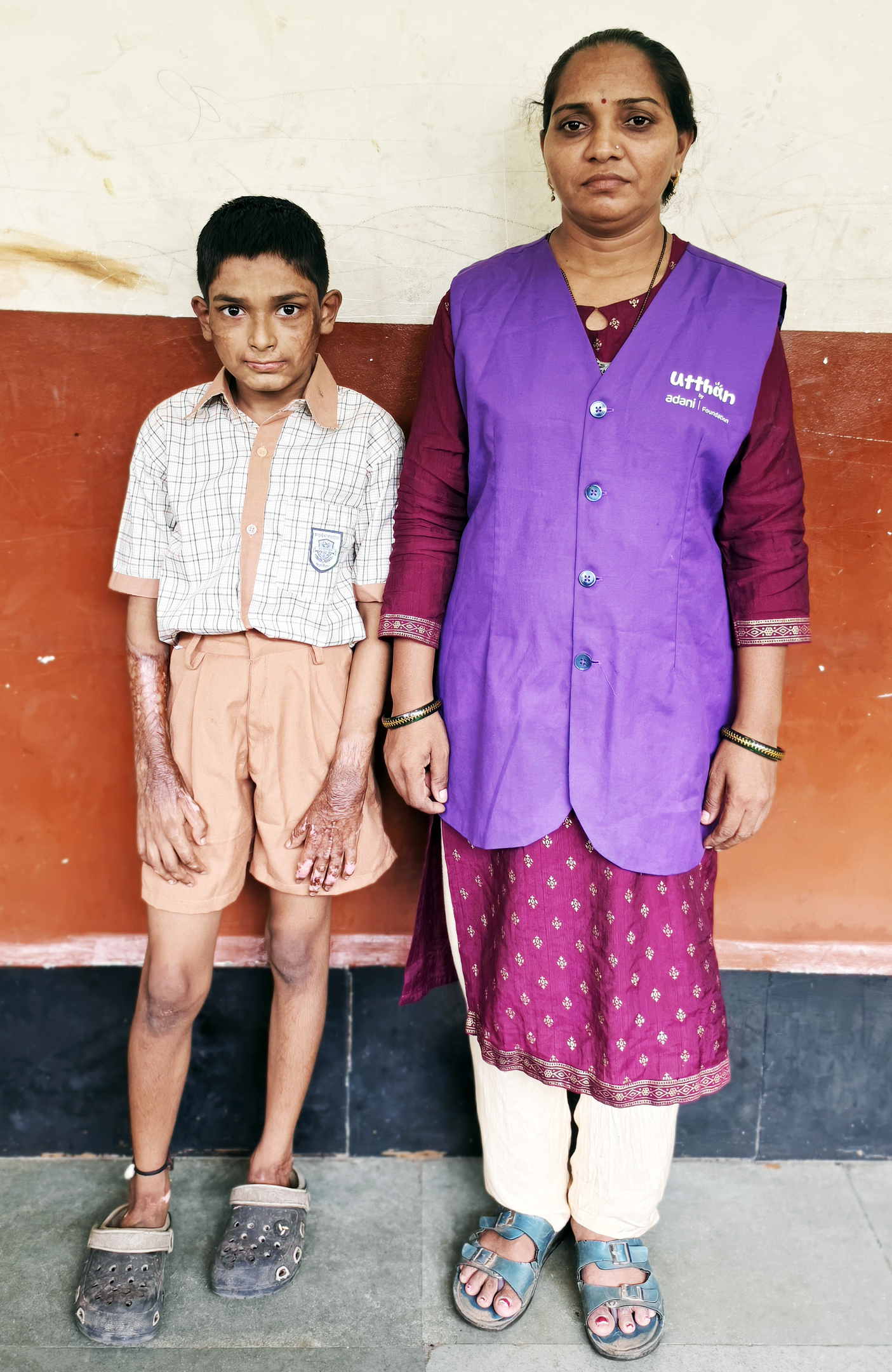
Pratik Mukhiya with Bhurabai Choure
Ms Choure refused to let him slip away. By spending hours simply building trust rather than pushing textbooks, she gently coaxed Pratik out of his shell. She brought him back to his friends, his studies, and his childhood. Ms Choure is one of the many Utthan Sahayaks—enablers of change—who bring hope to thousands of young learners struggling to find their footing across municipal schools in Mumbai.
A Child’s Background Should Never Dictate Their Future
To help children from difficult backgrounds find their way, the Adani Foundation's Project Utthan enters municipal classrooms to offer solid foundational learning and the self-confidence needed by these children to grow.
Since starting in 2018 with just 17 schools in Mundra (Gujarat), Project Utthan has reached more than 1,200 schools and around 1.8 lakh students across five states.
Today, this foundational learning initiative reaches 947 Brihanmumbai Municipal Corporation (BMC) primary schools across 24 wards, supporting more than 1.40 lakh students in Classes 1 to 4 across eight mediums of instruction. It focuses closely on children from vulnerable backgrounds, many of whom are first-generation learners with no academic support at home.
In Mumbai, the change is already clear. Between the September 2025 baseline and the March 2026 midline assessment, the number of children achieving Level 5 reading outcomes rose from 15-21% to 25-32% across Classes 1 to 4.
Pratik is one of many children from difficult circumstances who have been hand-held by Project Utthan. In Mumbai, a child’s struggle to read, write, or solve a simple sum often begins long before a lesson starts. It can stem from a troubled home, a language barrier, irregular attendance, or simply not having anyone to help make sense of what is being taught.
Project Utthan is rewriting their stories.
1 child. 1 learning journey. 1 connected support system.
Schools
lakh+ students
Geeta Joshi: When a Teacher Learnt Differently
Asalpha Nagar Kannada School student Bhoomika Koli's hearing and speech difficulties made classroom communication challenging. Her Utthan Sahayak, Geeta Joshi, was not trained as a specialist. So she taught herself how to teach Bhoomika, using visual cues, gestures, writing, repetition and speech activities.
The breakthrough was gradual. Bhoomika began participating, writing independently in Kannada and pronouncing some words clearly.
Ms Joshi did not wait to become an expert. She learnt because one child needed her to.
Vishal: The Mathematics of Everyday Life
Vishal Rathod struggled after moving from a Hindi-medium to Goregaon East Mumbai Public School, which is a Marathi medium institution. His attendance became irregular as he helped his family sell goods on local trains.
His Sahayak, Pushpa, discovered his hidden strength: numbers.
“If someone gives you INR 100 and buys a pen for INR 20, how much will you return?” she asked.
Vishal knew the answer immediately.
By connecting classroom mathematics to the calculations he made every day, Pushpa helped him see learning differently. The child who had struggled with school began finding confidence in what he already knew.
Pranjali: Finding Her Own Identity
For Pranjali Pawar, Project Utthan began as a means to support her family. With a paralysed father and elderly mother depending on her, she became the family's primary breadwinner.
Four years on, she has grown from Utthan Sahayak to Cluster Coordinator.
Today, her parents proudly introduce her as a professional. Her own ambition has grown too: she dreams of giving her mother a home in Mumbai.
Sulochana: A Second Beginning
When the pandemic ended nearly two decades of home tuition, Sulochana Kore lost her income. Utthan gave her another opportunity.
She bought her first laptop through instalments, learnt new technology and gradually took on greater responsibility. Today, she coordinates 47 schools and supports other Utthan Sahayaks.
For Ms Kore, it was more than employment. It was a second beginning.
These stories capture the heart of Utthan: learning does not always begin with a textbook. Sometimes, it begins with a conversation, a calculation, a patient teacher or someone willing to believe in a child.
And when that support reaches a family, the transformation can travel far beyond the classroom.
Source: Project Utthan baseline assessment, September 2025, and midline assessment, March 2026; Classes I–IV, Mumbai.
(With inputs from Jatin Upadhyay, Adani Foundation)