


Our comprehensive Enterprise Risk Management (ERM) framework enables us to identify, assess, and address risks while capitalising on opportunities to drive long-term growth and success.
Risk Governance
Adani Green has adopted a three-tier risk governance structure with defined roles & responsibilities for the stakeholders involved in the risk management process.
Risk Governance Structure
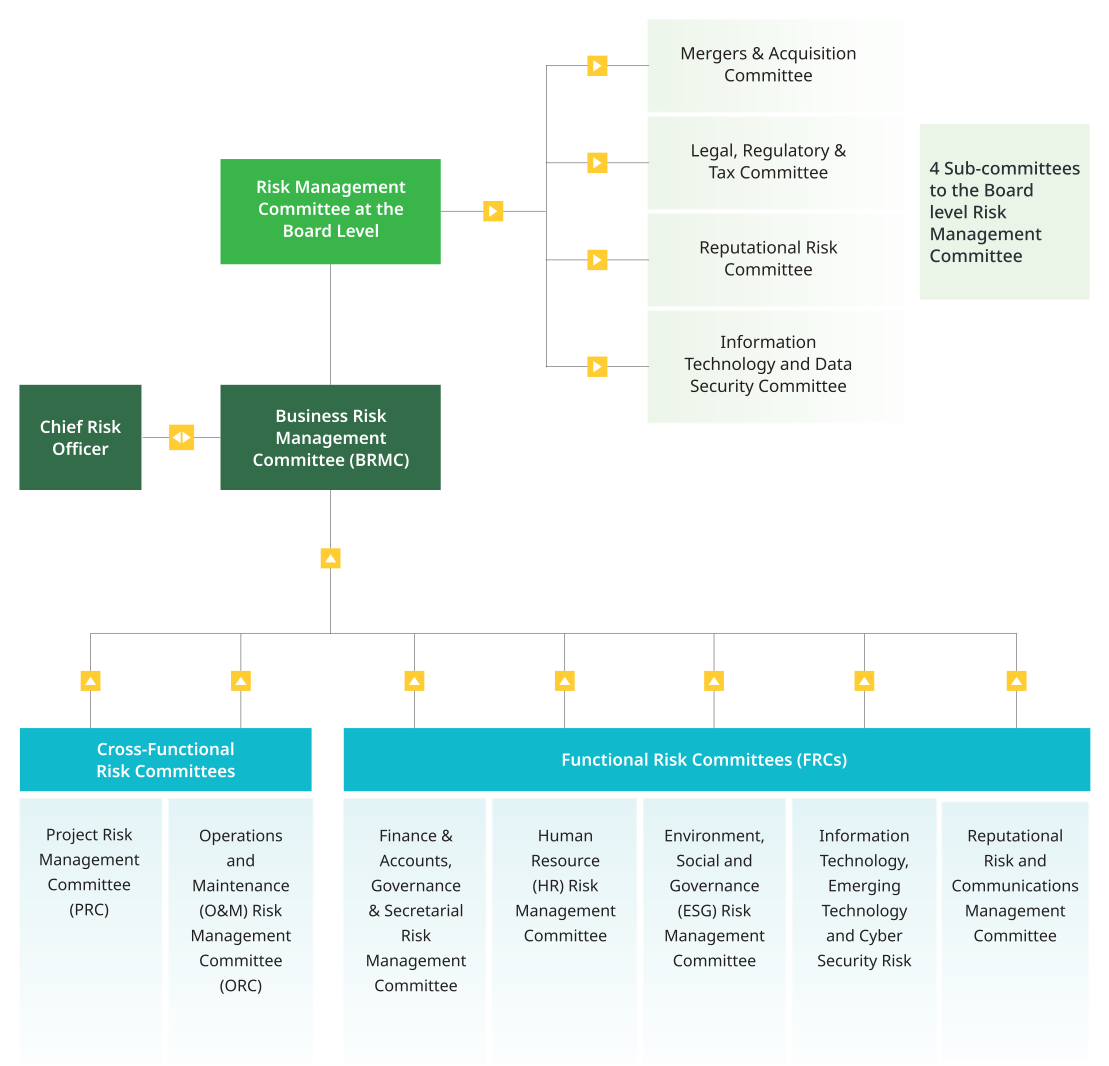
Each Committee is led by a senior leadership member as the head of the committee and supported by the cross-functional team members.
Roles & Responsibilities of Risk Management Team:
1. Risk Management Committees at the Board-level
- Review the strategic risks & provide guidance
2. Business Risk Management Committee (BRMC)
- Oversee the enterprise risks and implementation of the mitigation plan
- Provide guidance on top-priority risks and their mitigation plans
- Advise on risks addition or deletion to the Enterprise Risk Register
3. Functional/Cross-Functional Risk Committees
- Conduct periodic risk review meetings involving the members of respective risk committees
- Review and discuss new or existing risks for the respective risk register
- Review and approve the quarterly updated version of the risk register and associated mitigation plans
- Sign off the deletion of any risk from the risk register along with risk committee meeting minutes
- Share updated risk register, associated mitigation plans, and minutes of the risk review meeting with the Chief Risk Officer every quarter
4. Chief Risk Officer (CRO)
- Develop and maintain the Risk Management Framework
- CRO, as a coordinator of Enterprise Risk Management, anchors the Risk Mitigation process
- Prioritises risks at the business level
- Highlight prioritised risks, potential impact, and plan for mitigation to BRMC
- Maintain communication between the Business Risk Committee and the Functional Risk Committees
- Provide feedback and guidance to the Risk Subcommittees
- Conduct regular BRMC meetings
5. Risk Owner & Risk Champions
- Implementation of risk mitigation plans
- Control or mitigate a particular risk and be accountable for it
ERM Framework and Risk Management Process
The following are the objectives of the Enterprise Risk Management:
- Ensure sustainable business growth by managing the organisation's risk landscape proactively through set practices, procedures and plans
- Establish a consistent, systematic and clear approach to identify, analyse, evaluate, treat, monitor, report and benchmark enterprise risks
- Provide a clear and strong basis for informed decision-making regarding risk management at all levels of the organisation
- Engage internal and external stakeholders for effective risk management. The stakeholder requirements, needs & expectations, and associated risks shall be identified, analysed, and treated through the ERM processes
- Ensure process resilience & continuity against business operation disruptions, natural disasters, climate change, and information & data security through risk assessment, continuity planning, testing, security controls, and incident management
- Strive towards strengthening risk management through continuous monitoring, improvement, and learning. Adopt technology or information systems for ERM implementation & sustenance
- Create a risk management culture by encouraging employee participation and ensuring that every employee is recognised as having a role in risk identification and mitigation
- Develop risk management skills and knowledge through periodic training and communications. Ensure access to risk management processes and information for employees and other stakeholders
Risk Categorisation
Adani Green has categorised risks into eight broad categories listed below:
 Business &
Commercial Risks
Business &
Commercial Risks
This entails potential risks arising from business strategy, expansion, market instability, infrastructure needs, and policy shifts during ongoing operations or entering new businesses.
 Financial Risks
Financial risks include reduced access to funds, increased project costs, and inability to deliver suitable returns. Other financial risks include sudden fluctuations in the stock market, increased interest rates, unfavourable economic climate, and failure of financial transactions
 Environmental &
Social Risks
Environmental &
Social Risks
Environmental risks include changing weather patterns, which can impact business continuity. Social risks include social issues, community conflict, untended stakeholder relationships, employee health and well-being, supply chain management, and branding and communications.
 Project Risks
Project risks arise from project development, engineering, procurement, construction, and management. They also include health and safety and disaster-related risks.
 People Risks
People and human resource risks, as well as human rights risks, can impact the talent of an organisation, as well as other factors such as productivity and attrition of human resources.
 Regulatory &
Governance Risks
Regulatory &
Governance Risks
Regulatory risks emerge from a constantly changing regulatory environment and can negatively impact business.
 Operations &
Maintenance (O&M) Risks
Operations &
Maintenance (O&M) Risks
Operational risks include risks related to operations and maintenance, asset life cycle management, and events that can lead to closure of operational plants, interruptions and forced shutdowns.
 Information
Technology & Cybersecurity Risks
Information
Technology & Cybersecurity Risks
IT and cybersecurity risks include risks related to infrastructure availability, connectivity, integrity, and reliability of information technology. Cybersecurity-related risks such as breaches, data thefts, system hacking, and scams can also negatively impact the business.
Risk Management Process
The Adani Green risk management process consists of the following steps:
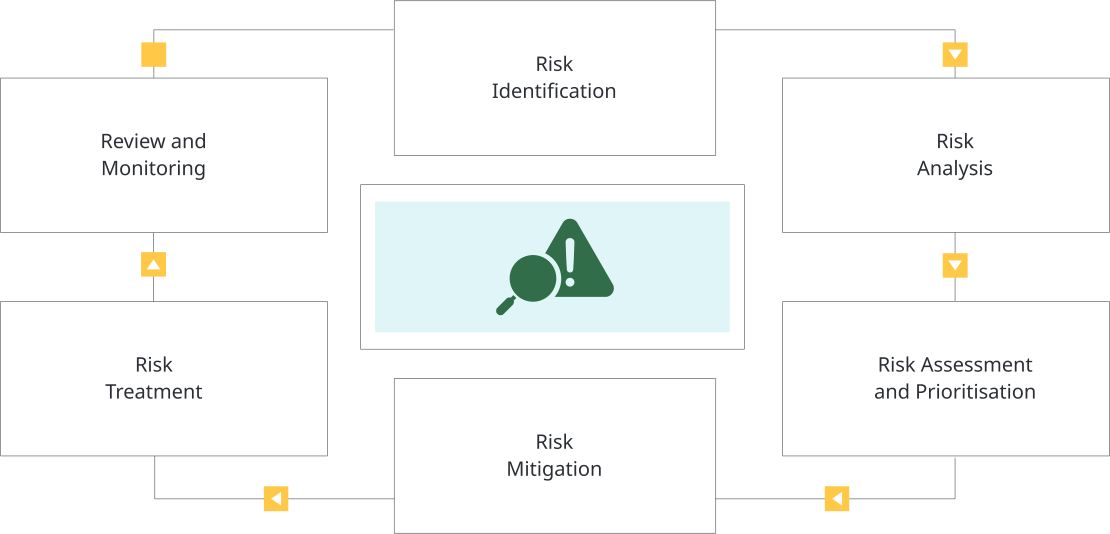
Risk Identification
- Identifying potential risks that can hinder operations from achieving its set objectives and expected targets
- Techniques and tools used to identify the risks include Brainstorming, Root cause analysis / assumptions and constraints / SWOT analysis, meetings and reviews
- Compilation of the identified risks in the risk registers
Risk Analysis
- Assessing the level of exposure of each identified risk based on its sources, likelihood of occurrence, magnitude of potential impact, and mitigation strategies
- Assigning a risk severity score and likelihood score to the risks
Risk Assessment and Prioritisation
- Prioritisation of the analysed risk based on the risk rating
- Assigning a timeline to prioritise and assess risks for the risk owners
Risk Mitigation
- Developing and implementing risk mitigation strategies by the risk owner and champions at each business level
- Monitoring of the responses by Risk Champions and Owners and making necessary interventions
Risk Treatment
- Treating the risk using the 4T approach: Transfer, Terminate,
Tolerate, and Treat:
- Transfer the risk by involving third parties by means of insurance
- Terminate the risk by making changes in the process
- Tolerate by accepting the risk that may have low impact on our operations
- Treat by developing corrective action plans to derisk the functions to a tolerable level
Review & Monitoring
- Periodic reviewing and monitoring of the risk by the BRMC and Board-level Risk Committee to ensure compliance with defined mitigation strategies
- Measuring progress of mitigation actions for each risk
- Gathering the insights from the ongoing process for further analysis and developing an organisation-wide learning process
Our Top Risks
| Risk | Category | Risk | Category |
|---|---|---|---|
|
R1 Competition Risk
|
Business & Commercial |
R9 Procurement & Supply Chain Risk
|
Projects |
|
R2 Merchant Power Risk
|
Business & Commercial |
R10 Attrition Risk
|
People |
|
R3 Geographic Focus Risk
|
Business & Commercial |
R11 Cybersecurity Risk
|
Information Technology |
|
R4 Debt Repayment Risk
|
Financial |
R12 SCADA Risk
|
Information Technology |
|
R5 Liquidity Risk
|
Financial |
R13 Solar & Wind Intermittency Risk
|
Operations & Maintenance |
|
R6 Foreign Exchange or Interest Rate Risk
|
Financial |
R14 Technology Obsolescence Risk
|
Operations & Maintenance |
|
R7 Climate Change Risk
|
Environmental & Social |
R15 Compliance Risk
|
Regulatory & Governance |
|
R8 Project Management Risk
|
Projects |
R16 Regulatory Risk
|
Regulatory & Governance |

Key Risks and Mitigating Actions
R1Competition Risk
Capitals at Risk

Strategy at Risk
Material Topics
Risk Description
Increased competition and pressure on bid tariffs as well as merchant market
Impact on Value
- Decline in the electricity tariffs
- Lower margins
- Impact on growth rate
Mitigating Measures
- Strategic selection of projects with an attractive profitability and hurdle rate
- Strategic partnerships and cost reduction to enhance competitiveness
- Robust techno-commercial capabilities with integrated cross-functional support for competitive bids
- Adapting business strategy plans to changing market conditions
- Explore new business opportunities internally & externally like international markets, energy storage, etc.
R2Merchant Power Risk
Capitals at Risk

Strategy at Risk
Material Topics
Risk Description
Risk associated with volatility in electricity prices on the energy exchange
Impact on Value
- Loss of revenue
- Underutilisation of assets
Mitigating Measures
- Close monitoring of merchant rates on a concurrent basis
- Short-term or long-term arrangements for power sale with prospective buyers directly or through exchange at appropriate rates to ensure maximum profit & minimise the pricing risk for merchant plants
- Financial closure for merchant projects is made considering higher equity contribution in the project
R3Geographic Focus Risk
Capitals at Risk

Strategy at Risk
Material Topics
Risk Description
Negative impact on the Company due to its higher geographical concentration
Impact on Value
- Concentration in select geographies & associated with changes in weather patterns or others causing disproportionate impact on revenue
Mitigating Measures
- Assets are strategically located in 12 diverse resource-rich states mitigating the impact of geographical concentration
- Capacity expansions are planned in Rajasthan and Gujarat, which are India’s most wind and solar resource-rich states
R4Debt Repayment Risk
Capitals at Risk

Strategy at Risk
Material Topics
Risk Description
Any failure to repay or service the debt on time could impact Company's prospects
Impact on Value
- Decline in credit rating
- Reputation loss
- Unfavourable cost of debt
Mitigating Measures
- Periodic review of the liquidity management plan
- Maintaining adequate DSRA / Cash Balances for 6-9 months of Debt Servicing to ensure that there is no delay/default in debt servicing
- Project financing with a relatively low equity load and long-term debt exposure at low cost
R5Liquidity Risk
Capitals at Risk

Strategy at Risk
Material Topics
Risk Description
Difficulties in meeting the Company's short-term financial obligations due to insufficient cash or liquid assets
Impact on Value
- Decline in credit rating
- Reputation loss
Mitigating Measures
- Review of Liquidity Management Plan regularly
- Proactive Capital Management Plan (long-term, short-term, and medium-term) for fund requirements of the company based on various scenarios including high growth phase
R6Foreign Exchange or Interest Rate Risk
Capitals at Risk

Strategy at Risk
Material Topics
Risk Description
Potential for financial loss due to fluctuations/volatility in the exchange rate or interest rates
Impact on Value
- Currency movements and interest rates adversely affecting debt repayment obligations
- Exchange rate adversely affecting procurement costs
Mitigating Measures
- Well-defined policy in place for hedging foreign exchange exposure
- Long-term capital management plan to ensure optimised financial costs while meeting growth targets
R7Climate Change Risk
Capitals at Risk

Strategy at Risk
Material Topics
Risk Description
Climate change risks include damage to infrastructure from extreme weather, reduced efficiency due to temperature changes, and other natural disasters
Impact on Value
- Business operations disruptions
- Asset damage
- Human casualty and injuries
Mitigating Measures
- Identify climate change risk in project planning stage and accordingly prepare management plan
- Area flood and drainage study before start of the project
- Insurance coverage of climate change risk
R8Project Management Risk
Capitals at Risk

Strategy at Risk
Material Topics
Risk Description
Risks that can negatively impact a project's objectives, such as scope, schedule, cost, and quality.
Impact on Value
- Delays in commissioning solar and wind energy projects
- Potential breach of PPA terms & conditions
- Delayed return on investment
Mitigating Measures
- Location due diligence and acquisition of land banks at strategic locations in advance, in line with the business plan
- Advance ROW clearance with the help of local stakeholders
- Identify and de-board non-performing vendors and contractors
- Engaging reputed agencies (Tier I or II) in project execution, including EPC mode of execution
- Vendor pre-qualification & Contractor performance evaluation
- Proactive approach and Public Relations with govt. bodies including PGCIL for power evacuation system readiness
- Streamlined coordination across resource assessment, land acquisition, construction readiness, technical studies and supply chain management
R9Procurement & Supply Chain Risk
Capitals at Risk

Strategy at Risk
Material Topics
Risk Description
Risks of adverse commodity market trends, unavailability of key materials, or supply chain disruptions
Impact on Value
- Cost increases in critical material e.g. silicon wafers, solar cells and modules
- Unavailability of raw materials
- Disruptions in international supply chains
Mitigating Measures
- Disciplined approach to securing material costs, ensuring no open and vulnerable raw material positions while bidding for project tariff auctions
- Fixed rate contracts wherever possible and implementation of price variation clauses in contracts
- Strategic buying in bulk when the market is low
- Long-term strategic tie-up for logistics & FOB (Free on board) based freight booking
R10Attrition Risk
Capitals at Risk

Strategy at Risk
Material Topics
Risk Description
Loss of critical talent and employee turnover
Impact on Value
- Loss of productivity
- Loss of institutional knowledge
- Disruption in business operations
Mitigating Measures
- Identification of high-potential individuals & critical roles and work on succession/career path
- Reward & recognition mechanism rewarding high-performing critical talent
- Employee Learning & Development interventions and employee engagement interventions
- Forum to connect with Leadership/Voice employee views
R11Cybersecurity Risk
Capitals at Risk

Strategy at Risk
Material Topics
Risk Description
Disruption of critical IT services and data loss due to cyber attack
Impact on Value
- Exposure of sensitive data
- Destruction or corruption of data
- Failure of IT services
- Network breakdown
Mitigating Measures
- Implementation of firewall at site IT network
- Compliance monitoring and protection tools
- Patch management process in place to mitigate vulnerability related to OEM product
- Policy and Procedure for Data Privacy, Employee Privacy Notice, Data Breach Management, Data Retention and Disposal, Privacy Compliance Monitoring, Privacy Notice
- Awareness sessions for all employees on phishing and other cybersecurity aspects
R12SCADA Risk
Capitals at Risk

Strategy at Risk
Material Topics
Risk Description
Potential threats and vulnerabilities associated with SCADA systems
Impact on Value
- Operational efficiency compromised
- Projects operating below optimal potential
Mitigating Measures
- Centralised and analytics-driven O&M system, Energy Network Operation Centre (ENOC), which facilitates real-time insights
- Periodic maintenance of SCADA
- VDI (Virtual Desktop Infrastructure) is in place for remote access to SCADA for integrating third party systems. Remote solution implemented for access and authorisation of SCADA vendor.
- Replacement of ILL (Internet Leased Line) line with MPLS (Multiprotocol Label Switching)
R13Solar & Wind Intermittency Risk
Capitals at Risk

Strategy at Risk
Material Topics
Risk Description
Risk of insufficient energy supply due to variability in radiation or wind resources.
Impact on Value
- Loss of revenue for solar projects due to radiation shortfall
- Loss of revenue for wind projects due to wind resource shortfall
Mitigating Measures
- In-house capability building of solar and wind forecast using AI/machine learning & continuous model training
- Analysis of CUF & generation budgeting based on the irradiation/wind speed forecasted by in-house tool
- Tracking minimum CUF penalty
R14Technology Obsolescence Risk
Capitals at Risk

Strategy at Risk
Material Topics
Risk Description
Operational risks for commissioned renewable plants due to the obsolescence of technology
Impact on Value
- Higher cost and delay in delivery of spare components for obsolete technology
- Plant outages and unavailability
Mitigating Measures
- OEM support for critical technology products to maintain plant availability
- Clause in place in the contract for rights to access documents (design, drawing, etc.) in case OEM is obsoleting the technology or shutting the business
- Long-term contracts & buyback arrangements wherever possible
R15Compliance Risk
Capitals at Risk

Strategy at Risk
Material Topics
Risk Description
Non-compliance with statutory requirements/EMP/regulatory clearances/guidelines, etc.
Impact on Value
- Penalty for non-compliance
- Reputation loss
- Litigations/Qualification in statutory reports
- Operational discontinuation
Mitigating Measures
- All compliance requirements are managed by department heads with periodic Board oversight on compliance reports and third-party assessments
- Legatrix system enables IT-enabled monitoring of economic, environmental and social compliance across all locations
- Robust internal controls cover documentation of policies, guidelines, approval procedures, monitoring, internal audit, non-compliance flagging and periodic reporting to management
R16Regulatory Risk
Capitals at Risk

Strategy at Risk
Material Topics
Risk Description
Changes in regulatory framework affecting long-term prospects of the Company
Impact on Value
- Adverse effect on financial viability of existing & new projects
- Potential censure and operational slowdown
Mitigating Measures
- Policy advocacy through industry associations to represent the issues that may be faced by the industry
- Consultations from experts in the respective field on all key regulatory matters
- Legal remedies from court / appellate tribunal as and when required


