


Air Emissions Management
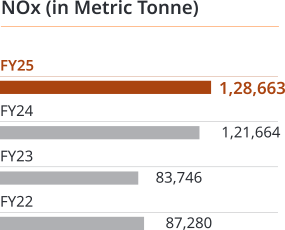
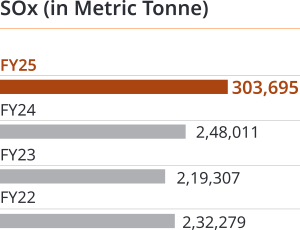
We are committed to controlling emissions of NOx, SOx, and particulate matter, which are critical to reducing air pollution and ensuring compliance with regulatory standards. Through advanced technologies and operational improvements, we continuously work to minimise these emissions, contributing to cleaner air and a healthier environment for surrounding communities
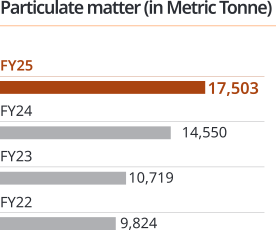
| Particles | Unit | FY 2024-25 | FY 2023-24 |
|---|---|---|---|
| i. Volatile Organic Compounds (VOCs) | MTCO2e | NA | NA |
| ii. Hazardous Air Pollutants (HAPs), Hg | MTCO2e | BDL | BDL |
| iii. Persistent Organic Pollutants (POP) | MTCO2e | NA | NA |
| iv. Other standard categories of air emissions identified in relevant regulations | MTCO2e | NA | NA |
Note: The air emission sources (stacks, chimneys etc.) are monitored on a defined frequency by an approved laboratory/agency as mandated by the Central and respective State Pollution Control Boards.
Transition Towards Net Zero Carbon Footprint
We are steadily advancing towards our goal of achieving a net-zero carbon footprint. This is being realised through the successful implementation of Carbon Capture, Utilisation, and Storage (CCUS) technology across our operational fleet. Our efforts are in line with India’s broader ambition of achieving net-zero emissions by 2070. As the power sector contributes 70% of total emissions, integrating CCUS technology will significantly reduce our carbon output and support the production of cleaner electricity and sustainable products, such as green aggregates, green ammonia, and methanol.
CCUS Initiatives Undertaken by Adani Power
Adani Power has been proactive in advancing CCUS initiatives. Our Flue Gas CO2 Capture and Conversion Project has made significant strides, with design and engineering efforts progressing well. A detailed techno-economic analysis (TEA) and a feasibility report (DFR) are currently in progress, which will guide the next phase of our CCUS implementation across our plants.
Collaborative R&D for Carbon Capture and Utilisation
We have also expanded our collaborative research and development efforts. An MoU has been signed for the Algal Bio-Energy Carbon Capture and Utilisation (ABECCU) project, marking an important step towards developing sustainable solutions. Additionally, we have partnered with the Tata Institute of Fundamental Research (TIFR) in Mumbai to advance a joint project focussed on Carbon Capture and Utilisation (CCU) technology, further reinforcing our commitment to innovation in emission reduction
Efficient Material Management
For Material Management, Adani Power focusses on optimising resource use and implementing a circular economy model to maximise the value derived from waste, helping to conserve natural resources and support biodiversity. By utilising a real-time IT-based platform, our decision support system allows us to closely monitor and track plant operational data.
This platform is integrated with an industry-standard enterprise resource management framework, which facilitates the efficient management of inventory, logistics, procurement, and financial aspects, strengthening our ability to optimise processes and minimise waste across our operations.
Material Consumption (in Metric Tonnes)
| Parameter | FY 2024-25 | FY 2023-24 | FY 2022-23 |
|---|---|---|---|
| Coal | 6,12,42,677.00 | 5,12,71,728.69 | 3,64,25,494.73 |
| Chemicals | 17,721.30 | 35,250.46 | 3,455.13 |
| Lubricating Oils | 490.10 | 565.82 | 393.57 |
| Grease | 50.80 | 44.36 | 40.57 |
| LDO | 9,369.79 | 8,141.44 | 17,509.14 |
| HFO | 1,881.96 | 1,379.00 | 1,677.90 |
| HSD/Diesel (other than boilers) | 4,495.38 | 4,039.21 | 3,376.39 |
| R22 | 1.70 | 2.02 | 1.06 |
| Total Materials | 6,12,76,688.03 | 5,13,21,151.00 | 3,64,51,948.49 |


