Pioneering the future of sustainable cooling
Cooling demand in India is poised for exponential 8x rise in this decade. This would cause a 4x increase in the power demand posing huge challenge to the nation’s Power Generation, Transmission and Distribution infrastructure as also on the sustainable and renewable energy roadmap. Consequently, the carbon emissions would increase by 25-30% impacting the Net Zero Goals. The Adani Cooling Solutions Ltd (ACSL) has been created under the Adani Energy Solutions vertical as a first mover to lead the market and redefine the space cooling landscape with cutting-edge centralised cooling systems that are highly energy-efficient, cost-effective, and minimise environmental impact significantly. Through this, we create a win-win situation – addressing demand-supply gap on one end and easing peak load on distribution networks on the other. Additionally, through our ‘Cooling-as-a-Service’ model, which eliminates upfront capital investment for users and operates on a pay-per-use basis, we create a compelling value proposition for widespread adoption.
52,700 TR
Projects under implementation
( 584%)
584%)
TR: Tonne of Refrigeration
2,50,000 TR
Identified project pipeline

Adani Cooling Solutions Limited underwent a remarkable transformation in FY 2024-25, evolving from a single project-entity to a market-leading player with 52,700 TR of projects under implementation which includes the largest District Plant of India at Mundra and a robust pipeline of ~2,50,000 TR. What started as a bold vision to address India’s cooling gap with sustainable technologies, has today propelled us into a formidable force, powered by our team's dedicated efforts, strategic collaborations with key stakeholders and nation-wide outreach initiatives covering all growth engines of Real Estate, Airports, IT Hubs, Industrial Estates, Data Centers, Metro Rails etc.
Moving ahead, our focus remains on delivering innovative, customer-centric solutions and business models that not only drive operational excellence and long-term value but contributes meaningfully to Adani portfolio’s ambitious Net Zero target by 2050. We will continue to invest in scalable, efficient, and environmentally responsible technologies to transform the future of urban space cooling – one that is smarter and more sustainable.
Industry Scenario
The cooling market in India is significantly under-penetrated. The nation’s per capita cooling energy consumption was ~147 kWh in 2023, significantly lower than the global average of 1,539 kWh while the AC ownership was at 8% as compared to 60% to 90% in other developing countries. This is despite India having the highest Person Cooling Degree Days (CDD) at above 4,200 billion, driven by the large population and consistently high ambient temperature. Total cooling demand is expected to grow by 8X by 2037-38 while Space cooling demand is expected to grow by 11X which would be reach 74% of the total cooling demand by 2037-38.
With immense untapped potential, India’s refrigerant-based installed equipment to meet space cooling needs of housing and realty infrastructure is estimated to grow from 130 million TR in FY 2022-23 to 720 million TR by FY 2037-38 as per India Cooling Action Plan (ICAP) 2019 and District Cooling Guidelines 2023. This would necessitate an additional 120 GW of power generation and a corresponding increase in transmission & distribution (T&D) network by 2030 rise of 11% over 2022.
ICAP in association with the Bureau of Energy Efficiency has therefore emphasised the critical need for energy-efficient and sustainable centralised cooling and thermal energy storage solutions.
To achieve this, the installed capacity of District cooling systems (DCS) market has to grow at an aspirational ~20% CAGR from a meagre 9 million TR in 2023 to around 32 million TR by 2029-30. This surge will drive a threefold increase in market share Chiller based installations from 7% to 15%.
Our joint market study with Cushman & Weikfield identifies a potential space cooling market of 43 million TR in the coming years across commercial spaces, data centers, airports, industrial parks, and integrated townships. Notably, 11 million TR of this demand will be concentrated in Tier 1 cities, with our targeted market estimated at ~1.6 million TR.
229 million TR( 76% vs FY 2022-23)
India’s estimated growth of cooling equipment installed capacity by FY 2029-30
32 million TR( 20% CAGR from FY 2022-23)
India’s potential increase in installed Cooling capacity due to District Cooling Systems by FY 2029-30
Segment Overview
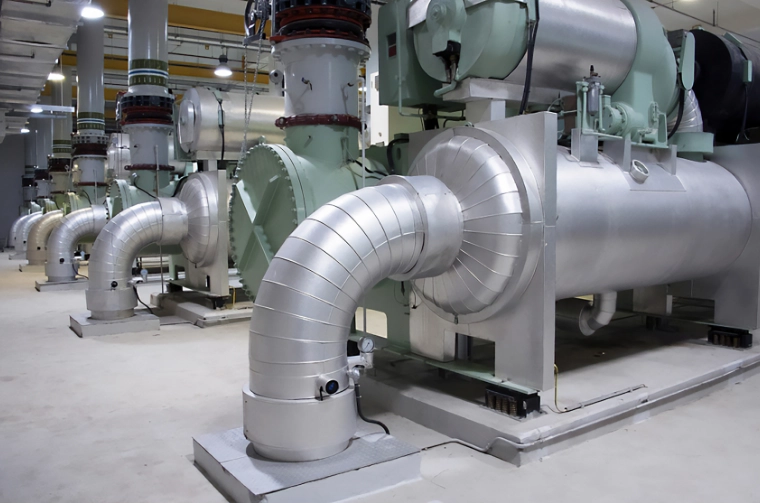
Adani Cooling Solutions Limited (ACSL), a wholly-owned subsidiary of Adani Energy Solutions, leads the Company’s efforts to deliver energy-efficient and sustainable centralised cooling solutions aligned with the nation’s urgency. ACSL primarily focusses on establishing large, centralised cooling stations that produce chilled water and distribute it through underground pipes and supply to end users through meter pay per use arrangement. This innovative approach can significantly reduce electricity and water use as well as cooling costs.
We focus on serving a diverse customer base, including commercial and residential buildings, airports, data centers, industrial estates and other infrastructure development businesses within the Adani portfolio and externally in Tier-1 and Tier-2 cities.
Our competitive edge
Business Synergies
Rising cooling demand is set to significantly increase energy consumption, necessitating additional power generation and T&D infrastructure. DCS and other centralised cooling solutions can cut power use by 35%, peak demand by 30%, and infrastructure costs by 45%.
Our integrated operations create strong synergies. Our transmission and distribution businesses benefit from optimised infrastructure, power procurement and transmission costs. The cooling solution business gains a secure and cost-effective electricity supply with thermal energy storage systems which enables effective demand management. Our T&D business’ focus on blending renewable energy will further make our DCS solutions more sustainable and affordable.
Integrated Offering
At ACSL, we are committed to offering cutting-edge, sustainable cooling solutions through a DBFOO (Design, Build, Finance, Own & Operate) model through a Cooling-as-a-Service (CaaS) framework. This approach ensures energy-efficient, cost-effective cooling for large-scale developments while reducing carbon footprints.
Our “cooling as a service (CaaS)” model offers several key benefits:
- No Capex Burden: Completely removes the capital expenditure burden from developers.
- Life Cycle Metered Cooling Service: Guarantees consistent performance standards, alleviating the need for HVAC maintenance.
- Optimised Capital Expenditure & Space Utilisation: Employs innovative technology for efficient capital and space usage.
- Energy Savings: Provides approximately 35 to 45% energy savings.
- Reduced Carbon Footprint: Decreases emissions by 30%, aligning with green initiatives.
- Lower Water Consumption: Cuts water use by up to 40%.
- Additional Enhancements: Potential augmentation with thermal storage and renewable energy integration.
Additionally, we can integrate STP (Sewage Treatment Plant) water into our systems, further enhancing sustainability and making our solutions even more environmentally friendly.
Our integrated solutions further offer flexible power sourcing – from the grid, wholesale markets, or captive sources – which ensures reliable, efficient cooling solutions tailored to each client’s unique needs. Our T&D expertise combined with our advanced cooling technologies, would also enable delivering sustainable, cost-effective solutions to address the growing demand for commercial real estate, industrial facilities, data centers, and airports.
Indian Market Expertise
India’s centralised cooling market is in its early stage, primarily dominated by international competitors. Our diverse business expertise and comprehensive understanding of the Indian market position us to lead in this sector, executing large and complex national-scale projects that few players can undertake. This aligns with the Adani portfolio of companies’ commitment to building sustainable, more efficient infrastructure and supporting India’s net zero emissions vision. Adani Energy Solutions will benefit from enhanced energy efficiency and improved grid stability, alongside optimised costs and carbon emissions. This can reduce peak demand, optimise resource use, and ease burden on our distribution networks.
Business Performance
Advanced construction work on the ~7,700 TR cooling solutions project within Shantigram Township, Ahmedabad, which will deliver chilled water to the Energy Centre buildings complex under a customer cooling service agreement.
Finalised project at Mundra involving the construction of a 45,000 TR centralised DCS, catering to the cooling needs of nearby manufacturing facilities. Procurement work for this largest-of-its-kind project in India is completed. Upon completion, it will optimise efficiency and eliminate the need for standby capacity in individual plants.
Created a robust pipeline of ~2,50,000 TR covering all growth engines, including real estate, airports, IT hubs, industrial estates, data centers, and metro rails, which are at various stages of finalisation.
Signed an MoU with MAHAPREIT (Mahatma Phule Renewable Energy and Infrastructure Technology Limited), which is engaged in renewable energy, infrastructure, and sustainability projects. This MoU explores the possibility of establishing district cooling infrastructure and providing cooling as a service in Maharashtra for the Mumbai Metropolitan Region or any other suitable locations in Maharashtra and other states under MAHAPREIT's jurisdiction.
Sustainability Performance
Centralised cooling is one of the most efficient and sustainable ways of meeting demand in the comfort and space cooling sector. Our sustainable cooling solutions are designed to offer the following environmental benefits:
Optimise energy consumption and lower related carbon/ GHG emissions by 15%-25%, promoting a low-carbon future
Reducing fire hazard risk as associated with conventional air conditioning systems
Ensure a healthy microclimate with no heat island effect in buildings
Reduce freshwater usage by reusing treated wastewater in cooling processes, helping buildings achieve platinum ratings for sustainability
Water-cooled chillers, housed in a controlled environment with safety measures like refrigerant detectors, reduce refrigerant use and potential leaks and greenhouse gas emissions, thereby lowering ozone depletion potential
Outlook
Moving into FY 2025-26, our focus will be on the successful completion of our marquee projects at Shantigram and Mundra SEZ, as well as the conversion of our current pipeline of 2,50,000 TR centralised cooling systems between FY 2025-26 and FY 2029-30, which are in various stages of discussion or planning. Over the next few years, we anticipate making significant investments to identify and execute large independent DCS systems on public infrastructure land with right of way under municipal roads, serving real estate Outlook communities, townships, university campuses, and industrial estates in the vicinity. Additionally, we aim to attract strategic investors to support our growth prospects.
To make DCS viable in India, we have partnered with premier organisations such as AEEE, ASHRAE, and ISHRAE. Additionally, we are actively leading the AHEAD programme, a joint initiative by DPIIT, GOI, and the World Bank. This programme aims to create an enabling policy and regulatory support mechanism to help us achieve our aspirational business targets.
Strengthening our in-house capabilities remains a priority. We are actively exploring advanced cooling technologies for data centers in collaboration with a leading international player. Additionally, we are investigating opportunities to drive innovation and industry development with renowned Indian and global consultants, as well as large real estate developers.