Environmental
Material TopicBiodiversity Conservation and Habitat Management
SDG Alignment

Financial Implication
Strategic Priorities
S2
S6
Rationale for Identifying the Risk/Opportunity
Biodiversity conservation and habitat management are crucial for
Adani Energy Solutions due to the environmental impact of its
operations, regulatory requirements, and importance of corporate social responsibility.
By focussing on these areas, Adani Energy
Solutions can mitigate risks, enhance its reputation, achieve cost savings, and
contribute to global sustainability goals.
Potential Risks & Opportunities and their Impact on Capitals
Risks
| Topics |
Capitals Impacted |
| Habitat fragmentation because of new transmission lines |
|
| Species deterioration through operations/projects in eco-sensitive zones
|
|
| Community backlash |
|
| Reputation damage |
|
| Increased compliance/project costs |
|
Opportunities
| Topics |
Capitals Impacted |
| Innovative construction practices |
|
| Species conservation programmes |
|
| Engaging local communities |
|
| Reputation enhancement |
|
| Access to green financing |
|
| Market differentiation |
|
| Operational resilience |
|
Actions to Mitigate Risks/Capitalise on Opportunities
- Dedicated policy for biodiversity preservation, targeting
Net
Positive Gain by FY 2024-25
- Signatory to India Business and Biodiversity Initiative
(IBBI) 2.0
- Avoid ecologically sensitive zones, minimise impact, and
restore habitats
- Conduct third-party biodiversity assessments for
informed planning
- Partner for conservation, carbon sequestration, and
ecosystem restoration
- Committed to Adani’s pledge of nurturing 100 million trees
by 2030 under 1t.org
- Ensure regulatory compliance before transmission
line development
- Offset biodiversity loss through habitat creation
or restoration
- Engage employees, communities, and environmentalists
for sustainability
Stakeholders Impacted
KPI's Mapped
- Operational sites near protected or high-biodiversity
areas
- Business activities impacting biodiversity
- IUCN Red List and national conservation species affected
- Protected or restored habitats
Material TopicGHG Emissions & Climate Change
GRI Alignment
GRI 302, GRI 305
SDG Alignment
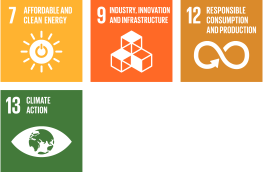
Financial Implication
Strategic Priorities
S2
S4
S6
Rationale for Identifying the Risk/Opportunity
Due to the environmental impacts of its operations, regulatory
requirements, and the growing importance of corporate
social responsibility. By prioritising the reduction of GHG emissions and addressing
climate change, Adani Energy Solutions
can mitigate environmental risks, enhance its reputation, achieve cost savings, and
contribute to global sustainability goals.
This commitment reflects Adani Energy Solutions dedication to operating responsibly and
sustainably, ensuring the well-being
of both the environment and the communities it serves.
Potential Risks & Opportunities and their Impact on Capitals
Risks
| Topics |
Capitals Impacted |
| Greenhouse gas emissionscontributing to
climate change |
|
| Reduction in GHG emissions by
increasing the share of renewable
energy in existing power purchase mix
|
|
| Community backlash |
|
| Reputation damage |
|
| Increased compliance/project costs |
|
Opportunities
| Topics |
Capitals Impacted |
| Resource conservation |
|
| Reduced operating costs |
|
| Addressing physical risks posed byclimate
change |
|
| New market opportunities |
|
| Attract sustainable investments |
|
| Reputation enhancement |
|
Actions to Mitigate Risks/Capitalise on Opportunities
- Corporate Responsibility Committee oversight on
sustainability related operational and financial risks
- Climate-linked remuneration for key management
- Third-party assessments for climate risk and opportunities
- Invest in innovation for climate resilience (RE, solar,
energy efficiency)
- Emergency Restoration System for network reliability
- Expand solar capacity to cut auxiliary power use
- Align with global climate goals for sustainability
- Review climate resilience strategies every 3-5 years
Stakeholders Impacted
KPI's Mapped
- Energy consumption (from renewable vs non-renewable
sources) within and outside the organisation
- Energy intensity
- GHG emissions (Scope 1, Scope 2 and Scope 3)
- Reduction of energy consumption
- GHG emissions intensity
- Ozone-depleting substances
- NOx, SOx, direct mercury emissions, dust emissions
Material TopicEnd Use Efficiency and Demand
GRI Alignment
SDG Alignment
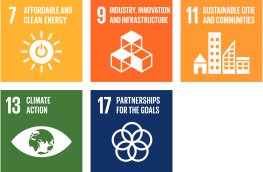
Financial Implication
Strategic Priorities
S2
S4
S6
Rationale for Identifying the Risk/Opportunity
"End Use Efficiency and Demand" is pivotal for Adani Energy
Solutions as it addresses both regulatory compliance and market
competitiveness. Maintaining energy efficiency standards compliance is crucial to avoid
penalties and reputational damage.
Additionally, technological advancements and shifting consumer preferences towards
energy-efficient solutions demand that
Adani Energy Solutions adapt to maintain its market position. Emphasising efficiency not
only reduces operational costs but
also supports environmental sustainability and resource conservation, ensuring long-term
operational continuity and enhanced
corporate social responsibility. This focus can lead to financial incentives and a
competitive edge, attracting cost-conscious and
environmentally aware customers.
Potential Opportunities and their Impact on Capitals
Risks
| Risk |
Description |
Capitals Impacted |
| Non-compliance with energy
efficiency standards |
| Penalties and fines |
 |
| Damage to brand image |
 |
| Loss of employee morale |
 |
| Stricter regulations on product processes |
 |
| Reduced innovation
due to a conservative
approach |
 |
| Increased environmental
impact due to inefficient
energy use |
 |
| Falling behind in
with energy-efficiency
technology
|
| Lagging behind
competitors in innovation |
|
| Loss of market revenue |
|
Perceived as a laggard in
technology |
|
| Skill gaps in new
technologies |
|
| Higher resource
consumption due to
inefficient products |
|
| Not adapting
to consumer
preferences
|
| Decline in sales and
revenue |
|
Loss of consumer trust
and loyalty |
|
| Missed opportunities for
innovation |
|
| Weakened customer
relationships |
|
| High operational
costs |
| Increased operational
expenses |
|
| Potential job cuts to save
costs |
|
| Greater environmental
impact from higher
energy use |
|
| Poor energy
efficiency
|
| Higher carbon footprint |
|
| Negative public
perception |
|
Costs associated with
carbon taxes |
|
| Reduced focus on
sustainable innovation |
|
| Missing outon financial
incentives |
| Higher initial investment
costs |
|
| Delayed adoption of new
technologies |
|
Reduced access to
investment capital |
|
| Viewed as lacking
commitment to
sustainability |
|
| Less focus on reducing
environmental impact |
|
Opportunities
| Opportunity |
Description |
Capitals Impacted |
| End use
efficiency |
Develop Competitive
Advantage, attract
environmentally
conscious consumers
and businesses, enhance
market share and brand
reputation |
|
| Energy-efficient
technologies |
Substantial cost savings,
reduce energy wastage,
lower operational
expenses. |
|
| Efficient energy
practices |
Help Environmental
Sustainability, strengthen
Adani Energy Solutions'
CSR profile, attract
socially responsible
investors |
|
| Government
incentives |
Offset implementation
costs, accelerating
efficiency initiatives |
|
Actions to Mitigate Risks/Capitalise on Opportunities
- Energy Efficiency Standard Compliance Rate
- Penalty Incidence Rate
- Proactively participate in policy development and advocacy
- Foster a culture of innovation and collaboration
among employees
- Establish robust supplier evaluation and audit processes
for
vendors and suppliers
- Develop strategic partnerships with key suppliers
- Provide regular and transparent financial reporting to
investors and shareholders
- Engage in active investor relations
- Implement robust customer feedback mechanisms
for customers
- Innovate and diversify product offerings for customers
- Ensure a strong governance framework and regular strategic
reviews for senior management
- Continuously analyse market trends and adapt strategies as
a strategic response
Stakeholders Impacted
KPI's Mapped
- Energy Efficiency Standard Compliance Rate
- Penalty Incidence Rate
- Customer Satisfaction Index
- Market Share in Energy-Efficient Products
- Revenue from Energy-Efficient Solutions
- Operational Cost Savings
- Energy Intensity Reduction
- Investment in Energy-Efficient Technologies
- Number of Energy Efficiency Projects Implemented
- Carbon Emission Reduction
- CSR Initiatives in Energy Efficiency
- Policy advocacy w.r.t. Energy efficiency and use
- Demand side management programmes
- Public Recognition and Awards
Material TopicWater and Effluent Management
SDG Alignment

Financial Implication
Strategic Priorities
S2
Rationale for Identifying the Risk/Opportunity
Water and effluent management is a material issue for Adani Energy
Solutions due to its
significant environmental, regulatory,
operational, community, and reputational implications. By prioritising sustainable water
practices, Adani Energy Solutions
can enhance its operational efficiency, comply with regulations, build community trust,
and position itself as a leader in the
energy sector.
Potential Risks & Opportunities and their Impact on Capitals
Risks
| Topics |
Capitals Impacted |
| Pollution of land, water and air |
|
| Reputation damage |
|
| Regulatory compliance |
|
| Water scarcity |
|
Opportunities
| Topics |
Capitals Impacted |
| Reputation enhancement |
|
| Increased availability of freshwater
sources |
|
| Opportunity to secure a licence to
operate by demonstrating compliance
with regulatory standards and
commitment to sustainable practices |
|
| Reduce pollution of land, water and
air |
|
Actions to Mitigate Risks/Capitalise on Opportunities
- Monitor and track water consumption across sites
- Rainwater harvesting at substations to
reduce freshwater use
- Replenish natural sources by using less than extracted
- Treat and reuse effluent for horticulture
- Ensure compliance with water regulations and
quality standards
- Reduce water intensity with efficient systems
and technologies
- Plan for water risks like droughts and floods
- Maintain and repair leaks for optimal efficiency
- Review progress toward water positivity
Stakeholders Impacted
KPI's Mapped
- Water withdrawal
- Water withdrawal intensity
- Water discharge
- Water consumption
- Rainwater harvested