




Emissions management
Our approach to emission management is grounded in robust data collection, enabling us to effectively monitor and report our GHG emissions in a comprehensive and timely manner. We ensure data accuracy and credibility through verification mechanisms, including third-party audits. By investing in innovative decarbonisation solutions and implementing various emission reduction strategies, we aim to minimise the impact of our operations on the environment thereby contributing to global climate action.
Value Chain Emissions
AEL is committed to comprehensively managing its carbon footprint by actively monitoring and reporting its value chain emissions. We account for Scope 3 emissions using credible tools and references, including the IPCC cross-sector tool (AR6), India GHG programme, GABI software, and the EPA simplified GHG emission calculator. We currently report on Scope 3 emissions across all applicable categories for the following businesses:
- Mining
- Airports
- Solar Module Manufacturing
- Data Center
- Copper
| Category | Name | Emissions in tCO2e |
|---|---|---|
| 1 | Purchased goods and services | 12,72,388 |
| 2 | Capital goods | 17,475 |
| 3 | Fuel- and energy-related activities | 1,44,169 |
| 4 | Upstream transportation and distribution | 11,599 |
| 5 | Waste generated in operations | 1,709 |
| 6 | Business travel | 1,815 |
| 7 | Employee commuting | 11,893 |
| 8 | Upstream leased assets | 547 |
| 9 | Downstream transportation and distribution | 3,11,828 |
| 10 | Processing of sold products | 9,226 |
| 11 | Use of sold products | 74,43,733 |
| 12 | End-of-life treatment of sold products | 98,460 |
| 13 | Downstream leased assets | 41,140 |
| 14 | Franchises | - |
| 15 | Investments | - |
| Total Scope 3 emissions | 93,65,982 |
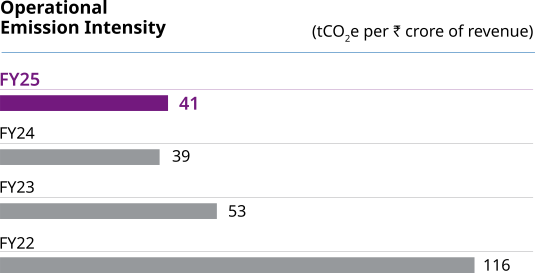
AEL's operational emission intensity has increased marginally in the reporting year in comparison to the previous year, owing to the addition of 3 new businesses - Copper Smelting, Wind turbine manufacturing and Digital Labs to the reporting boundary.

Emission of Ozone Depleting Substances (ODS)
As part of our comprehensive sustainability strategy, we emphasise not only the reduction of GHG emissions but also actively work towards mitigating the emission of ozone depleting substances. Our commitment includes implementing robust measures to prevent the release of ODS and minimise the generation of other harmful emissions. By prioritising these initiatives, we aim to contribute to cleaner air quality and a healthier environment.
Other Non-GHG Air Emissions
In our commitment to environmental compliance, we conduct regular monitoring of our non-GHG air emissions including NOx, SOx and particulate matter, ensuring strict compliance to environmental standards. To ensure accuracy and credibility, we engage third-party laboratories and agencies approved by the State Pollution Control Boards (SPCB) to conduct these monitoring activities. The reports of these exercises are submitted to the respective pollution control boards as part of our compliance obligations.


