




Addressing Climate Change
Strong Climate Governance and ESG Oversight
Management Responsibility
Our Board comprising 100% independent directors, have a direct oversight on climate-related issues, ensuring accountability towards our climate-related goals. At Adani Energy Solutions, sustainability is integrated into our operations through a robust Climate and ESG Governance Framework, led by the Board of Directors and facilitated by Board-led Corporate Responsibility Committee (CRC). It sets and supervises the overall implementation of ESG commitments and disclosures, which is ensured at strategic and operational levels by the senior leadership, executive management and dedicated ESG committees.
Compensation Aligned with Sustainability Performance
Our climate performance is linked to overall remuneration of all Key Management Personnel.
KRAs of the CEO
Includes implementation of climate transition plan and achievement of climate change targets such as increase in RE procurement, decrease in energy intensity per EBITDA, water performance, overall climate action and ESG risk ratings.
KRAs of Senior Management
Performance-based incentives for climate and sustainability goals, such as decrease in energy intensity are tied to the compensation of the Chief Sustainability Officer, Chief Executive Officer and Managing Director.
KRAs of Business Unit Managers
Relevant targets have been incorporated into their performance metrics.
Identifying Climate Risks
We systematically identify and address the climate-related physical and transition risks to our nationwide assets and facilities applying Task Force for Climate related Disclosures (TCFD) / IFRS S2 framework. At present, we cover our operations and select tier 1 suppliers through these assessments. Climate-related risks, including physical and transition risks, are integrated in Adani Energy Solutions’ Enterprise Risk Management framework. The framework is in alignment with COSO (Committee of Sponsoring Organisations) for evaluation of internal checks and adherence to effective management procedures.
The Chief Risk Officer (CRO) is responsible for the overall implementation and effectiveness of the risk framework. Our Chief Sustainability Officer (CSO) & Head Sustainability conduct the Climate Change Risk assessment and recommend relevant actions to the concerned HOD’s of business functions. Finally, it is close looped with the CRO for inclusion in ERM framework for valuation and monitoring.
We use Scenario Analysis to comprehend climate risks, meticulously evaluating each risk, the likelihood of its occurrence over short, medium and long term, and its significance and impact on our business and financial performance. Comprehensive mitigation strategies and adaptation plans are informed through the findings of the risk assessment. We integrate climate considerations into our strategic planning and business models, ensuring these factors are reflected in the financial planning and overall decision-making processes. We hold regular dialogues and engage with key stakeholders from government and investors on our climate-related performance.
Integrating Climate Risks into Business Planning
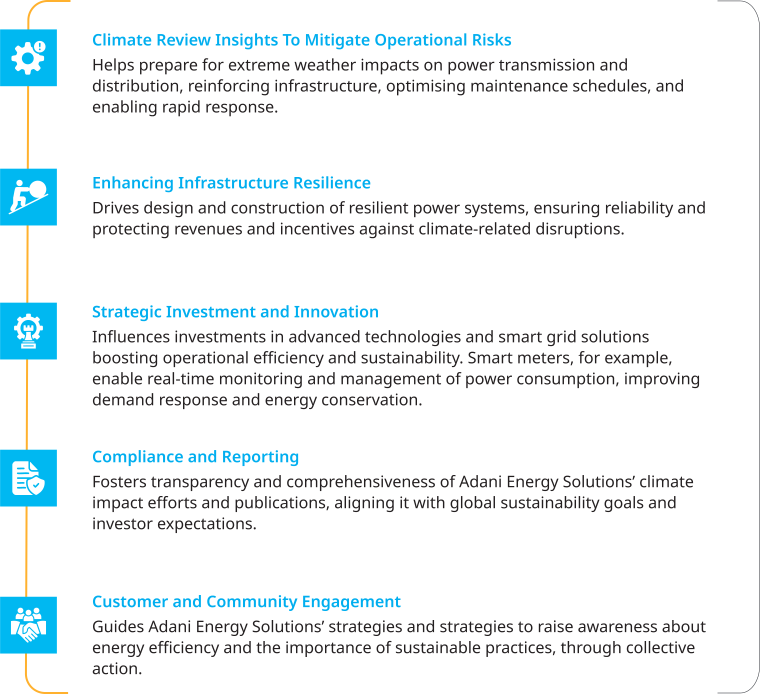
To create a resilient, future-ready business model, Adani Energy Solutions leverages the findings from its climate risk assessment in the following ways:
Decarbonisation Pathways
Progressing Towards Net Zero
While India aspires to become a USD 30 trillion economy by 2050, a recent report1 published by the Reserve Bank of India (RBI) starkly warns that climate change could slash as much as 10% off the country's GDP by then if global emission trends remain unchanged. Adani Energy Solutions remains committed to creating a robust decarbonisation strategy to minimise its carbon footprint and make significant contributions towards India’s economic, and social ambitions.
The Indian Scenario
The rapid growth of Indian economy and heavy reliance on fossil fuels to drive the country’s economic growth and modernisation, has made it the third-largest emitter of greenhouse gases in the world, despite the low per capital emissions as compared to the developed countries. With 50 million citizens getting electricity connections each year over the past decade, the conundrum for India is to meet its growing energy and materials demand sustainably.
India’s Climate Change Commitments
As part of its Nationally Determined Contribution (NDC) under the Paris Agreement, India has set a target of becoming net zero by 2070. Additionally, India intends to achieve 500 GW of non-fossil energy capacity, and source 50% of its energy requirements from renewable energy by 2030. It also aims to reduce the emission intensity of its economy by 45% and create an additional carbon sink of 2.5 - 3.0 billion tonnes of CO2 equivalent through additional forest and tree cover.
To accelerate its transition to clean energy, India has also launched the National Green Hydrogen Mission, which aims to position the country as a global hub for green hydrogen production, targeting 5 million metric tonnes (MMT) of annual production by 2030. Furthermore, India is developing a domestic carbon market to encourage industries to adopt low-carbon technologies and trade carbon credits, fostering emissions reductions across key sectors.
Strategic Approach to Decarbonisation
Our decarbonisation strategy closely aligns with India’s target to achieve net zero emissions by 2070 under Paris Agreement and Nationally Determined Contributions (NDCs). We have set ambitious targets to reduce our GHG emissions, increase the share of renewable energy in our overall power mix and improve the overall energy efficiency in order to achieve transition to a low carbon economy. We are committed to achieving Scope 1, 2, and 3 Net Zero emissions by 2050, aligning with the 1.5-degree centigrade scenario.
Adani Energy Solutions, an Electric Utility company engaged in Power Transmission and Distribution (T&D), Power Procurement, Smart Metering, and Cooling as a Service, is already making significant contributions to India's decarbonisation efforts through several strategic initiatives.
1 https://rbi.org.in/Scripts/PublicationsView.aspx?id=21769

Goals and Commitments
Adani Energy Solutions’ Net Zero Targets

Adani Energy Solutions has committed to becoming Net Zero by 2050 with interim Science Based Targets for Scope 1, 2 and 3 emissions.
Interim Targets for GHG Reduction
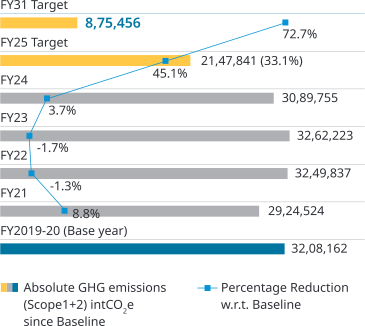
- Reduce Scope 1 & 2 GHG emissions by 72.7% by the end of FY 2030-31 (versus the baseline FY 2019-20)
- Reduce Scope 3 emissions by 27.5% by FY 2031-32 (versus the baseline FY 2020-21)
Interim Targets for Increasing Renewable Energy Share In Our Power Mix
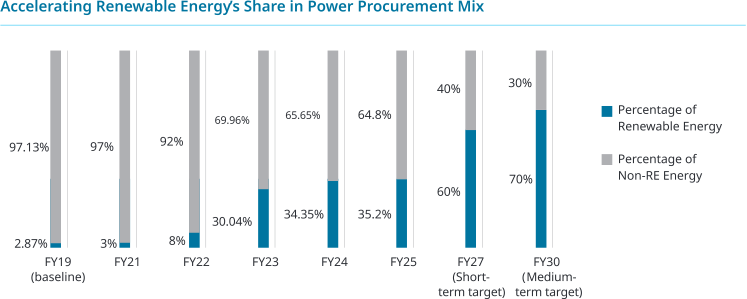
Increase the share of renewable energy to:
60%
by FY 2026-27
70%
by FY 2029-30
Reducing our GHG Emissions (Scope 1+2)
Reducing GHG Emissions is crucial to achieve our Net Zero Target. We have established targets on different time horizons to systematically minimise GHG emissions and emission intensity.
Improving GHG Emission Intensity
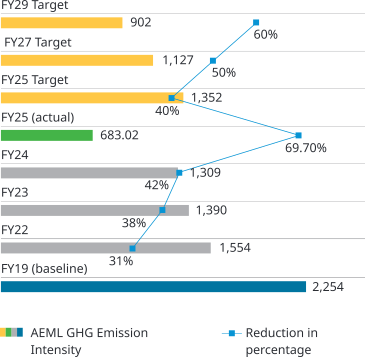
GHG Emission Intensity Reduction (in tCO2e/EBITA ₹ crore) (for Scope 1 + Scope 2)
In FY 2024-25, Targets Achieved
174%
Of FY 2024-25 target
139%
of FY 2026-27 target
116%
of FY 2028-29 target
Targets Achieved in FY 2024-25
117%
of FY 2022-23 target (30%)
50%
of FY 2029-30 target (70%)
59%
of FY 2026-27 target (60%)

We aimed to phase out coal from our power mix by 2030 but successfully accomplished this ahead of schedule in FY 2024-25 itself. Effective September 26, 2024, Adani Energy Solutions carved out and divested its sole thermal asset at Dahanu (ADTPS), fulfilling its commitment to transitioning away from coal-based power.

Decarbonisation Roadmap
Adani Energy Solutions is substantially contributing in driving India’s decarbonisation journey towards net zero by 2070. By embracing strategic initiatives, it is advancing its climate goals and strengthening its leadership in the sustainable energy landscape.
Enhancing Power Transmission and Distribution Efficiency
Adani Energy Solutions has significantly invested in advanced technologies and infrastructure upgrades to improve the power transmission and distribution efficiency. By reducing the power grid losses, Adani Energy Solutions ensures that more electricity generated from renewable sources reaches consumers efficiently. Deploying smart grid technologies, such as real-time monitoring and automated control systems, optimises the flow of electricity, reducing wastage and emissions.
Current Progress
1.2%
Transmission losses( 17.3% from previous year)
4.7%
Distribution losses( 11.2% from previous year)
2,480
ckm High Voltage Direct Current Transmission lines
Promoting Renewable Energy Integration
Adani Energy Solutions actively integrates renewable energy sources into the grid by procuring power from wind, solar, and other renewable energy projects, diversifying India's energy mix and reducing reliance on fossil fuels. Furthermore, it promotes and invests in storage solutions, such as batteries and pumped hydro storage, to manage the intermittent nature of renewable energy sources, ensuring a stable and reliable power supply.
Current Progress
- Achieved 3.3 MW in-house solar PV projects capacity versus 1.7 MW in FY 2019-20, within the operational boundary
- Implemented 700 MW Wind-Solar Hybrid PPA for 25 years to provide clean energy
- Planned expansion of renewable energy capacity with an additional 1,000 MW RE PPA and short-term RE PPA’s underway
- Solar energy utilisation and RE-Green tariff to Offset auxiliary consumption
- 75 MWh Battery Energy Storage Systems [BESS] planned
Implementing Smart Metering Solutions
Smart metering systems represent a transformative technology in the fight against climate change. Adani Energy Solutions extensive smart meter deployment provides consumers with real-time energy usage insights, enabling informed decisions making about their consumption patterns. By promoting energy efficiency and demand-side management, smart meters help reduce overall energy consumption and peak demand, leading to lower emissions.
Current Progress
31.3 Lakh
Smart meters installed
Cooling as a Service
In a country with a tropical climate like India, cooling needs are a significant contributor to energy demand. Adani Energy Solutions’ Cooling as a Service (CaaS) model offers energy-efficient and environmentally friendly cooling solutions, enabling businesses and households reduce their carbon footprint. The district cooling systems centralise cooling production and distribution, further enhancing efficiency and reducing energy consumption.
Current Progress
Orders received but no operational assets as on date
Supporting Electric Vehicle Adoption
Adani Energy Solutions is developing EV charging infrastructure and setting up EV charging station through its Share charge initiative, to support electric vehicles (EVs) adoption, instrumental in reducing emissions from the transportation sector. Additionally, integrating EVs with the power grid enables load balancing and energy storage.
Current Progress
643
EV charging stations under Share charge initiative contributing to 0.43 MU per annum sale
Fuel Switching Corporate Sustainability Initiatives
Adani Energy Solutions implements corporate sustainability initiatives within its operations by adopting energy-efficient practices [PAT], reducing waste and investing in renewable energy. Transparent reporting on sustainability metrics and progress towards decarbonisation goals inspires industry-wide sustainability efforts and helps policymakers, investors to further refine policies and schemes.
Current Progress
- Successfully divested Adani Dahanu Thermal Power Station (ADTPS) from our power mix
- Energy-efficient practices (PAT), leading to 52,271 GJ of annualised energy savings
- Zero Waste to Landfill status with >99% Waste diversion from landfill since May 2022
- Single-use Plastic-free operational sites
Advocating for Policy and Regulatory Support
Adani Energy Solutions works closely with policymakers, regulators, government agencies to advocate for supportive decarbonisation policies and regulations.
Current Progress
- Joined IRENA’s Utilities for Net Zero Alliance [UNEZA]
- Engaging with BEE for Perform Achieve and Trade [PAT] scheme
Stakeholder Engagement
Adani Energy Solutions closely engages with key internal and external stakeholders to accelerate adoption of decarbonisation plans and strategies.
Current Progress
- Engaging Customers through Demand side management initiatives
- Engaging Supply chain partners to drive sustainability initiatives across their value chains
- Engaging with BEE for Perform Achieve and Trade [PAT] scheme
- Engaging with Investors on Climate change, accelerating RE share in procurement mix, and Sustainability Linked Bonds progress
- Engaging with policy maker and regulators through advocacy efforts
Internal Capacities Building
We engage with staff to build and enhance their capacities through internal and external training programmes empowering them on latest climate and ESG trends relevant for their sphere of operations.
Current Progress
100%
Directors and Senior Management made aware of climate change and ESG policies and procedures
83%
Employees trained on climate change and ESG policies and procedures
Internal Carbon Pricing
With the increasing global shift towards a low carbon economy, carbon pricing has become an effective carbon regulatory tool. We have strategically integrated internal carbon pricing into our business decision-making processes to evaluate our vulnerabilities and guide investments. For the reporting year, we have established an Internal Carbon Pricing of ₹4,665 per tCO2e, derived using implicit price approach, with a target to invest ₹800 for every tCO2 e. Setting a price on carbon help us exceed our stakeholder expectations, drive energy efficiency and low carbon investments and stress-test our investments.
Investments in Future Decarbonisation Technologie
CASE STUDY
Background
The Government of India has launched an ambitious initiative of replacing 25 crore conventional meters with smart meters by 2025-26, as a part of the Smart Meter National Programme under the Revamped Distribution Sector Scheme (RDSS). The initiative aims to:
- Improve quality, reliability, and affordability of power supplies
- Reduce AT&C loss to 12–15% by FY 2024-25
- Reduce ACS-ARR Gap to Zero by FY 2024-25
Adani Energy Solutions’ Role
Adani Energy Solutions had forayed into smart metering business to support India’s goal of enhancing distribution companies’ operational and financial efficiencies by strengthening the distribution infrastructure.
As a market leader, Adani Energy Solutions is transforming utility metering systems with advanced metering infrastructure nationwide. As a service partner to distribution companies, Adani Energy Solutions will provide smart meter hardware, communication networks, cloud infrastructure and data management systems under the Design-Build-Finance-Own-Operate-Transfer (DBFOOT) model. Leveraging its expertise from distribution business in Mumbai & Mundra, Adani Energy Solutions is transitioning from a service provider to becoming an integrated solutions platform.
Key Benefits
| Consumers | Distribution Companies |
|---|---|
| Real-time electricity consumption monitoring | Elimination of manual meter reading |
| Time-of-day tariff | Reduction in AT&C losses and minimised downtime |
| Optimisation of power consumption | Electricity theft detection |
| Accurate meter reading and transparent billing | Capabilities for energy audit & predictive maintenance |
| Power outage alerts | Digital grid management |
| Pay bills from anywhere & anytime | Improved financial health through higher collection efficiency |
Investment and Growth Outlook
In FY 2024-25, Adani Energy Solutions has invested ₹20 billion in smart metering to instal 31 lakh smart meters for advanced smart grid infrastructure in India.

Order Book
2.28 crore meter
(As of March 2025)

Presence
Across 5 States
(As of March 2025)

Revenue Potential
₹272 Billion
(As of March 2025)

Market Share (LOA %)
~17%
(As of March 2025)
CASE STUDY
Technology Trends
Integration of advanced hardware, software and communications technologies, smart grids enable utilities to monitor, control and optimise electricity flows in real time for improved grid performance and resilience.
Distribution management system (DMS)
enables utilities to detect outages, optimise voltage levels and manage network configurations for efficient power delivery. Advanced functionalities such as fault management; system restoration and load balancing further strengthen grid performance.
Supervisory control and data acquisition (SCADA) provides real-time grid monitoring and seamless communication with other smart grid technologies such as advanced metering infrastructure (AMI) and energy management systems. AMI enables real-time monitoring of energy consumption through smart meters, allowing utilities to track energy usage patterns, implement time-of-day pricing and ensure accurate billing.
Energy storage systems, particularly battery energy storage systems (BESSs), supports grid stability, by storing energy during off-peak hours and supplying it during peak demand, addressing renewable energy intermittency and reducing costs. Further, microgrids integrates distributed energy resources such as solar panels, wind turbines and fuel cells, operating independently or alongside the main grid to ensure a reliable electricity supply and reduce dependence on large-scale transmission networks.
Real-Time Data Acquisition System (RT-DAS) , provides precise measurements to evaluate reliability indices such as System Average Interruption Frequency Index (SAIFI) and System Average Interruption Duration Index (SAIDI) in non-SCADA towns. By analysing outage data and diagnosing system inefficiencies, RT-DAS supports targeted improvements in power distribution. Meanwhile, an outage management system automates outage detection, alerts field crews and streamlines power restoration.
IoT-based innovations such as smart meters, solar farm monitoring and IoT-based EV charging solutions enable real-time monitoring, theft detection and predictive maintenance, driving efficiency and security across the grid.
Strengthening Transmission Infrastructure
Robust Tower Design
The presence of our transmission network has expanded significantly across India. We employ both traditional and innovative designs into our tower infrastructure to minimise stress, optimise cost and improve network reliability. The technology used in tower designs make them resilient against several environmental factors, such as wind and seismic activities, soil resistivity, water characteristics, hydrological studies, etc.
Modernisation to Minimise Energy Losses
We have invested in design improvements, technology and periodic updates of our transmission and distribution network to minimise energy losses, due to any potential disruptions caused by rising temperatures. This strengthens network efficiency, competitiveness, reputation and margins of the organisation.
Emergency Restoration System (ERS)
Our Emergency Restoration System ensures rapid recovery and restoration post any collapse, enabled by continuous vigilance and a trained workforce. For the lightweight structures, the ERS enables quick restoration within the tower erection tenure of 3-15 days. The effectiveness of the ERS is established through periodic mock drills.
Disaster Management Plan (DMP)
AEML has implemented a comprehensive Disaster Management Plan covering its Transmission and Distribution network. AEML’s DMP is based on the Sendai Framework for Disaster Risk Reduction (Sendai, Japan, 2015), UN Sustainable Development Goals (2015) and Climate Change Agreement (COP21, 2015), and the Prime Minister’s Agenda for Disaster Risk Reduction.
The plan extensively addresses the vulnerability of the network against various natural and manmade disasters, clearly laying down structured mitigation processes, disaster recovery and response plans, and well-defined roles and responsibilities across the organisation to handle disasters.

Climate-Related Policy Advocacy
The organisation is actively leading climate-related policy advocacy through collaboration with government bodies, industry associations, and international organisations to advance renewable energy development, energy efficiency, and sustainable practices. The company's advocacy has had a transformative impact on India's energy landscape, paving the way for a cleaner, greener, and more resilient future.
Commitment to Renewable Energy
Established ambitious targets to increase renewable energy capacity and significantly investing in solar, wind, and other renewable energy projects to address climate change and boost local economy through employment generation.
Wind Solar Power Initiatives
Adani Energy Solutions’ flagship 700 MW Wind-Solar PV hybrid power PPA in Jaisalmer, India, not only provides clean and sustainably energy but also creates employment opportunities and stimulate local economies, while addressing climate change.
Engagement with Government Bodies
Engaging with the Indian government by providing insights and recommendations on renewable energy regulations, incentives and subsidies. These engagements help shape key policies and sustainable practices such as the National Solar Mission, PM Surya Ghar Yojana and the Renewable Energy Act. Adani Energy Solutions Dahanu Thermal Power had set national benchmarks in the Perform Achieve and Trade [PAT] scheme of Bureau of Energy Efficiency, Government of India.
Partnership with Industry Associations
Taking collective action by actively participating in industry associations and forums, such as Confederation of Indian Industry (CII) and the Federation of Indian Chambers of Commerce & Industry (FICCI) to drive climate-related initiatives.
International Collaborations
Actively engaging with the global forums and ESG rating agencies to drive global climate agenda, such as the United Nations Global Compact, The United Nations Energy Compact, IRENA’s Utilities for Net Zero Alliance, Science Based Target’s initiative etc.
Innovative Approaches and Technologies
Complementing policy advocacy efforts by adopting cutting-edge technologies to enhance energy efficiency, reduce emissions, and promote sustainability.
Smart Grid Solutions
Pioneering smart grid solutions using advanced metering infrastructure, real-time data analytics, and automated controls to enhance grid reliability, cut energy losses and integrate renewable energy sources in a better way, optimising energy distribution and consumption.
Energy Storage Systems
Planned to invest in energy storage systems of extra energy generated during peak periods and its release during high demand or low production phases, enhancing grid stability and integrating renewable energy into the grid.
Electrical Vehicle Infrastructure
Advocating for EV policies and developing EV charging infrastructure to support India’s National Electric Mobility Mission 2030 and reduce emissions from the transportation sector.
Impact of Policy Advocacy
Increased Renewable Energy Capacity
Adani Energy Solutions projects have contributed 0.7 gigawatts of clean energy to the national grid, accelerating India’s solar and wind energy capacities, while reducing India’s reliance on fossil fuels.
Enhanced Energy Efficiency
Adani Energy Solutions smart grid solutions, energy storage and other innovative technologies have improved the overall energy efficiency, leading to reduced energy consumption, lower operational costs, and greater grid stability across the board. With more than 13,000 tradable ESCert’s issued under the PAT Scheme, Adani Energy Solutions strengthens Energy Efficiency as a business case for power sector.

Adani Energy Solutions became the 1st Indian Electric Utility to commit to Utilities for Net Zero Alliance, uniting global utilities and power companies to develop renewable energy grids, promote clean energy solutions and advance electrification.
This collaboration enables Adani Energy Solutions to leverage experience of its global peers, while sharing insights on building high-capacity renewable energy evacuation networks.
Advancing Sustainability Through Green Financing
Sustainability-Linked Bonds (SLBs)
Through the issuance of Sustainability-Linked Bonds (“SLBs”), AEML, the retail division of Adani Energy Solutions, seeks to drive positive environmental change in its sphere of influence. AEML leads by example inspiring other companies to follow the suit.
Key Components of Sustainability-Linked Bonds (SLBs)
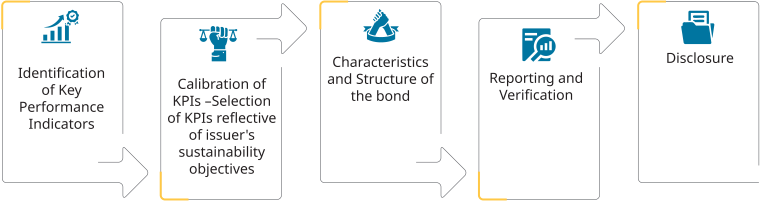
SLB is closely tied with meticulously chosen KPIs and targets to uphold our commitment to delivering sustainable and affordable power to the citizens of Mumbai, while accelerating transition to low carbon economy. These KPIs aligns AEML with the five key components of SLB.
Key Performance Indicators Chosen for SLB

| KPI chosen for SLB | Target | Performance in FY 2024-25 |
|---|---|---|
| Increase Renewable power mix in the overall power purchase mix | 60% by the end of FY 2026-27 and 70% by the end of FY 2029-30 |
35.2%  Refer to the detailed performance Refer to the detailed performance
|
| Reduction in GHG Emission Intensity per EBITDA (Scope 1 and 2) | 40% by FY 2024-25, 50% by FY 2026-27 and 60% by FY 2028-29 w.r.t. FY 2018-19 baseline |
69.7% reduction w.r.t. FY 2018-19 base year Refer to the detailed performance
|
Green Loans
Adani Energy Solutions secured a USD 700 million revolving loan facility, which was designated as a ‘Green Loan’ by Sustainalytics. An independent Second Party Opinion (SPO) from Sustainalytics, assured the loan’s alignment with the green loan framework. This revolving facility supports the following key projects in Gujarat and Maharashtra:
- Government of India’s Green Energy Corridor (GEC) projects in Gujarat, facilitating evacuation and transmission of renewable energy
- Transmission System projects in Mumbai, enhancing grid stability and providing a stable transmission network
This revolving green loan facility marks our commitment to sustainable infrastructure development and advancing renewable energy integration in India’s energy landscape.


