

It also helps in strengthening our supply chain partnerships and aids the overall economic growth of the country with a focus on ethical, environmental and social sustainability.
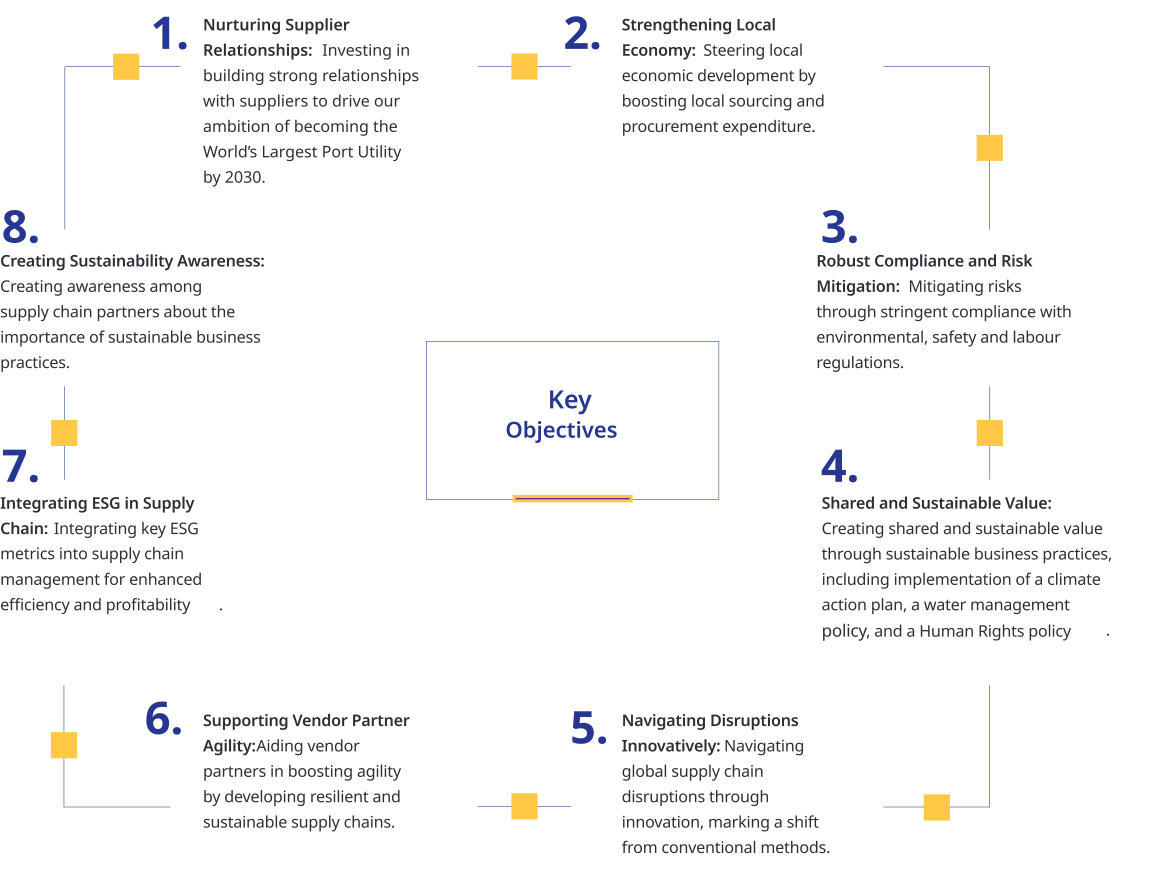
Quality Management, Environment and Safety Certification:Achieve 100% coverage by 2025 – 86% in FY 2024-25
Environment Policy, Climate Action Plan, and Water Management Policy:Achieve 100% coverage by 2025 – 87% in FY 2024-25
Continuously monitor and improve suppliers’ ESG performance: Implement a system by 2025 – 87% in FY 2024-25
Sustainability-based vendor ranking/scoring system and its use in procurement decision-making: Fully implemented by 2025 – 100% in FY 2024-25

GRI 204, GRI 308, GRI 414
Climate Change
Human Rights
Occupational Health and Safety
Supply Chain Management
Regulatory Compliance
Total Suppliers
Total number of Tier 1 suppliers
Total number of significant suppliers in Tier 1
of total spend on significant suppliers in Tier 1
Total number of significant suppliers in non-Tier 1
Total number of significant suppliers (Tier 1 and non-Tier 1)
Total Number of Non significant suppliers in Tier-1

APSEZ perceives its suppliers to be essential business partners and has put in place a well-articulated Supplier Code of Conduct and a Sustainable Procurement Policy.
Suppliers are encouraged to adopt these standards, and compliance is mandatory, fostering a culture of sustainability and respect.

Read further Supplier Code of Conduct
Read further Sustainable Procurement Policy

Ethical Business Conduct

Human Rights

Foster a Safe and Healthy Work Environment

Risk Management

Fair Employment Practices

Corporate Governance and Business Ethics

Minimise Environmental Impact

Reduce GHG Emissions
At APSEZ, we have adopted a comprehensive due diligence process to ensure sustainability and ethics in our supply chain. It covers detailed evaluation of our Tier 1, critical, and monopoly suppliers against a set of Environmental, Social and Governance (ESG) criteria. It is our continuous endeavour to boost adaptability while identifying and mitigating potential supply chain risks and dependencies, keeping in view the need to include responsibilities, risks, and opportunities in our outsourcing operations.
Rigorous evaluation of suppliers based on ESG criteria.
Mandatory adherence to our code of conduct.
Comprehensive orientation and ongoing education for suppliers.
Continuous oversight and evaluation of supplier performance.
Open dialogue and clear communication channels with suppliers.

Our Supplier ESG Programme is aligned to our commitment towards building an efficient and sustainable supply chain across our operations. It covers a series of actions and measures, crafted to identify, assess, and mitigate potential ESG risks, evaluate supplier performance, and implement corrective measures where necessary.

Minimum ESG Requirements and Exclusion of Non-Compliant Suppliers: Suppliers are mandated to meet specific minimum ESG requirements, and those who fail to meet ESG criteria within a set period are excluded.
Preference for Suppliers with Superior ESG Profiles: Suppliers with exceptional ESG practices are preferred. By assigning significant weightage to ESG criteria in the selection and contracting of suppliers, we acknowledge and reward those who contribute positively to environmental preservation, social well-being, and governance excellence. This approach not only incentivises high ESG performance but also aligns with our broader sustainability objectives.

Training for Buyers and Internal Stakeholders: Comprehensive training is provided on social aspects of ESG, including fair labour practices and ethical procurement.

Oversight of Supplier ESG Programme: Board Corporate Responsibility Committee oversees the programme, ensuring integration into corporate strategy and resource allocation. This Committee reports directly to the Board about the state of the programme and its progress.
Continuous Review of Purchasing Practices: Procurement activities are strictly aligned with our Supplier Code of Conduct and with our ESG standards. Through periodic assessments, we scrutinise our suppliers' compliance with our established ESG criteria, promoting a supply chain that reflects our commitment to sustainability and ethical practices.
Cognisant of the complexities and potential risks existing in our supply chain, we follow a meticulous supplier screening process. The process aligns with our understanding of the risks and challenges with respect to global, environmental, social, financial, and business relevance factors. It is aimed at identifying the significant suppliers. This strategy enables us to focus our monitoring and risk management practices on suppliers with the greatest potential impact, thereby strengthening the overall resilience and sustainability of our supply chain.
Our strategy to build a robust ecosystem of suppliers encompasses efficient vendor registration and onboarding processes.
Our specialised web portal, covering Contractor Safety Management and SAP Ariba, is designed to streamline the supplier management processes at APSEZ.
Suppliers are carefully assessed on several criteria at the time of onboarding at APSEZ. These include:

Compliance withLabour Legislation

Effectiveness of Environmental Management Systems

Quality Control Protocols

Safety Performance

Organisational Structure

SocialResponsibilities

Financial Health
The assessment helps in ensuring supplier alignment with our Supplier Code of Conduct and our Sustainable Procurement Policy.
A set of predefined parameters is used to evaluate the suppliers on a grading system of O, B and A, which is decided basis the supplier's revenue details. The system ensures transparent and fair assessment of each supplier's performance and alliance with our sustainability and ethical standards.
| Grade | Criteria (Annual revenue in ₹) |
|---|---|
| O Grade | Less than 25 crore |
| B Grade | Between 25 and 50 crore |
| A Grade | More than 50 crore |
Our efforts are geared towards strengthening supplier oversight on a continuing basis with the aim to maintain the highest integrity and ethical standards. The process covers:
Includes web portal based supplier assessment during onboarding and annual performance review to promote continuing improvement.
Cover site visits, engagement surveys, collaborations with external agencies, and analysis of public information to gain insights about our suppliers.
Each supplier is scored on a 0 to 100% scale, based on their compliance with APSEZ’s standards.
Led by our focus on strengthening our supply chain and ensuring its resilience, we undertake a strategic screening process to evaluate our suppliers on various metrics.
Focus on suppliers that are central to our operations and generally irreplaceable due to their unique offerings; which incudes high-volume suppliers, essential component providers, and those in monopolistic positions.
Supplier evaluation on their ESG performance, including their past actions and commitments towards managing ESG risks; also covers assessment of the broader impacts associated with potential risks, such as environmental degradation, social inequity, or governance failures, that could arise from the geographical, sectoral, or commodity-specific contexts in which they operate.
Is applied for effective categorisation of suppliers, enabling nuanced assessment of suppliers by assigning ESG parameter evaluation scores and grades; aids in identifying suppliers that may pose significant sustainability risks or have outstanding sustainability practices.
| Grade/Score | Above 85% | Between 60 and 85% | Below 60% |
|---|---|---|---|
| O Grade | Low Risk | Low Risk | Low Risk |
| B Grade | Low Risk | Medium Risk | Medium Risk |
| A Grade | Low Risk | High Risk | High Risk |

Suppliers are tiered for streamlined engagement, with Tier 1 receiving special attention. A dedicated team evaluates potential suppliers based on ESG, HR, and techno-commercial criteria.
Environmental responsibility
Compliance with anti-money laundering regulations
Compliance with Human Rights
Compliance with anti-corruption regulations
Vendor onboarding is crucial for mitigating any concerns. Suppliers must adhere to APSEZ's Supplier Code of Conduct and Sustainable Procurement Policy. They undergo screening based on quality, manpower, audit experience, and compliance with environmental and social norms.
Technical and professional requirements
Quality certifications
Health and safety certifications (ISO 45001)
Cyber security
Environmental Management Certification (ISO 14001)
Protection of intellectual property
of new suppliers who were screened using environmental criteria
of new suppliers who were screened using social criteria
APSEZ has established procurement guidelines aimed at reducing environmental and social impacts. To ensure adherence to quality, environmental, safety, and social standards, APSEZ conducts regular internal assessments, desk assessment, and third-party audits. Additionally, APSEZ performs on-site inspections of supplier production sites and factories at all levels.
Environmental aspects
Social aspects
Governance aspects
Third party audit as per Global Reporting Initiative (GRI) Standards
Total number of suppliers assessed via desk-based/on-site assessment
of significant suppliers assessed
APSEZ engages key stakeholders to promote safe and eco-friendly practices throughout the operational lifecycle. Supplier ESG performance is assessed using an integrated scorecard, with 10% assigned for safety and compliance and the rest for overall performance. Suppliers must maintain a minimum score of 90, updated monthly
Country-specific risk
Sector-specific risk
Commodity-specific risk
Integrated scorecard
Number of suppliers assessed with substantial actual/potential negative impacts
The ESG and purchasing teams analyse audit/self-assessment results to identify sustainability deficiencies. APSEZ collaborates with suppliers on corrective action plans, fostering continuous improvement. Persistent non-compliance may lead to termination or non-renewal. High-risk suppliers must provide mitigation plans within a set timeframe, followed by regular follow-ups and re-assessments.
Audit/Self-assessment analysis
Corrective action plans
Non-compliance consequences
Mitigation plans for high-risk suppliers
of suppliers with substantial actual/potential negative impacts with agreed corrective action/improvement plan
Number of suppliers with substantial actual/potential negative impacts who were terminated
Total number of suppliers supported in corrective action plan implementation
of suppliers assessed with substantial actual/potential negative impact supported in corrective action plan implementation
Total number of suppliers in capacity building programmes
of significant suppliers in capacity building programmes
Periodic re-assessments and re-audits are conducted to monitor supplier performance progress, ensuring a continuous improvement cycle involving evaluation, analysis, and corrective measures.
Periodic reassessments
Training & monitoring
We have introduced several development initiatives to educate our suppliers on, and align them with, our core values and operational standards. The initiatives are aimed at promoting a culture of safety, sustainability, and responsible business practices among our suppliers.