We have a comprehensive and matured ERM framework to effectively manage both financial and non-financial risks and achieve strategic objectives. The framework provides a systematic approach to identifying, prioritising, managing, monitoring, and reporting key and emerging risks in a timely, comprehensive manner. Based on the globally recognised Committee of Sponsoring Organisations (COSO) framework for ERM, it ensures the seamless integration of internal controls into our business processes.
Risk management is also integrated with the business planning and compliance functions. To promote an effective risk culture, we have mandated risk-related awareness and training programmes for employees to build awareness of the ERM framework and promote an effective risk culture. This includes regular risk management training for all non-executive directors and focussed training throughout the organisation on risk management principles. We also conduct function-specific risk training, alongside multi-functional climate change and sustainability training by internal and external resources. Additionally, we incorporate risk criteria in developing our services and provide financial incentives that incorporate risk management metrics.
We have integrated a dual approach to risk management, which includes:
The RMC, chaired by an independent director, and various Board sub-committees constituted under it oversee the ERM process, including framing, implementing, and monitoring the risk management plan. The Committee meets at least once every quarter to review risk exposure and management plans on behalf of the Board. The RMC comprises three members, all non-executive directors, with two also being independent directors. All three members have diverse business experience and extensive risk management exposure.
Our risk management framework is structured across three lines of defence with clear roles and responsibilities:
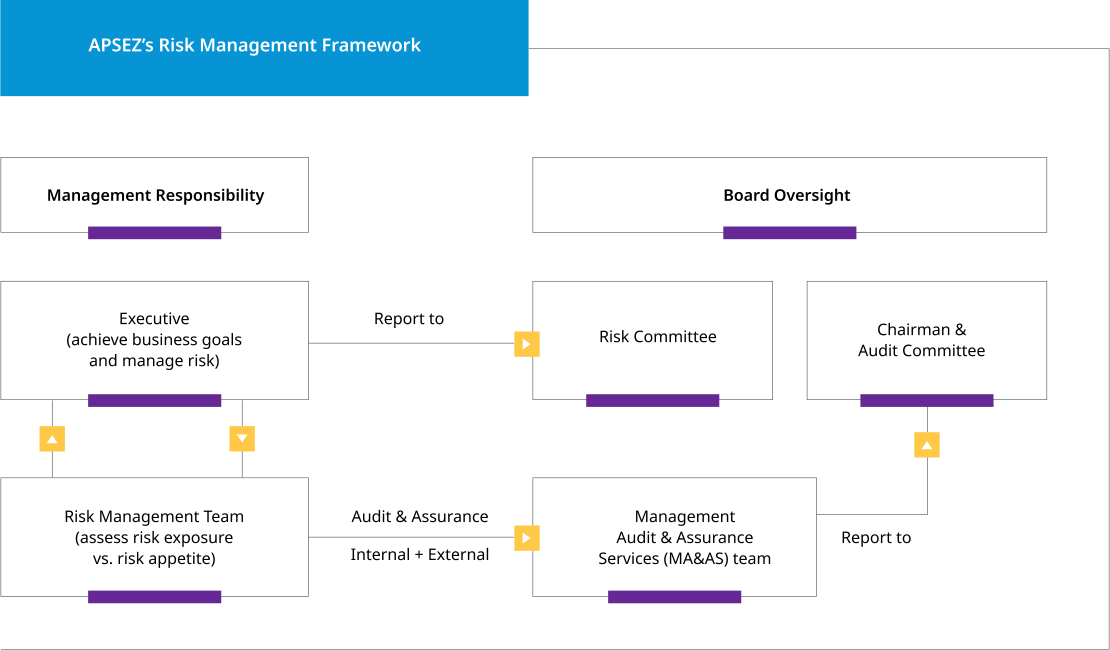
The Executive Management and/or RMC performed the following functions in FY 2024-25:
In FY 2024-25, the RMC conducted four meetings. Our Board-approved Risk Management Policy is comprised identified and assessed material risks. A policy framework was established to better manage risk profile, with a focus on prudent project (conceptualisation, implementation and sustenance) practices and suitable risk mitigation. Our ERM framework further sought to minimise the adverse impact of risks on key business objectives while leveraging opportunities. We also designed and operated a risk assessment model that considered both quantitative and qualitative data
Each department identified (through employee discussions) and submitted a comprehensive list of risks related to their operations and APSEZ using standard templates and tools
Compared the level of risks with previously established criteria, and prioritised them for further action, determining if they were acceptable or needed additional treatment
Considered treatment options to reduce or eliminate negative consequences. Plans included avoiding the risk, reducing the likelihood of occurrence, mitigating and transferring or retaining the risk based on a cost-benefit analysis
Considered treatment options to reduce or eliminate negative consequences. Plans included avoiding the risk, reducing the likelihood of occurrence, mitigating and transferring or retaining the risk based on a cost-benefit analysis
In FY 2024-25, we took proactive steps to identify and address risks through preventive measures and mitigation plans. The risk management team established risk appetites, defining acceptable risk levels for achieving our goals, which were then approved by the Risk Management Committee (RMC). Additionally, the team conducted quarterly assessments to compare actual risk exposure with acceptable levels, reporting any gaps to both the management and the RMC.
| Risk | Category | Likelihood of Occurrence | Magnitude of Potential Impact | Risk Priority | Responsibility |
|---|---|---|---|---|---|
| R1 Political risk |
External |  Regular elections
are a part of
the
democratic process Regular elections
are a part of
the
democratic process |
 Continuity of business
policies by
different governments Continuity of business
policies by
different governments |
|
Site CEO’s Office, CEO’s Office, Corporate Affairs |
| R2 Regulatory risk |
External |  Exposure to
different global regulatory
frameworks Exposure to
different global regulatory
frameworks |
Diversification
limits impact |
|
Regulatory Compliance Team |
| R3 Competition risk |
External | Limited overseas
operations, where
competition is high |
No major competition in
India |
|
Site CEO’s Office, Business Team |
| R4 Financial risk |
Operational | Healthy cash flow, good
credit rating
from global rating agencies |
 Impacts could be high
given the growth
phase Impacts could be high
given the growth
phase |
|
Head, Finance |
| R5 Climate risk (physical & transition) |
External |
Physical risks (extreme weather events) and transition risks (changing
regulations/customer preference and low business viability)
|
Infrastructureintensive operations raise damage costs; significant investment needed in transition
|
|
ESG Team, CEO APSEZ |
Risk rating: High risk Medium risk Low risk

Financial Capital

Manufactured Capital

Intellectual Capital

Human Capital

Social & Relationship Capital

Natural Capital
Capital at Risk

Strategy at Risk
Material Topics
Risk Description
Government change could result in a review of the existing policies or regulatory approvals
Impact on Value
Decline in sectoral appeal, limited corporate growth prospects and chances of investments becoming unviable or less profitable
Mitigating Measure
Associated Opportunities
Political neutrality allows for constructive engagements with all governments and shaping policies that support industry growth.
Capital at Risk
Strategy at Risk
Material Topics
Risk Description
Our expanding global presence subjects us to diverse regulations, and any unfavourable change could affect trade flows.
Impact on Value
Risks of slowdown in operations, decline in credit rating and reduced profitability due to high compliance costs.
Mitigating Measure
Associated Opportunities
Our operations support trade and cover essential products, customers and markets. Favourable regulations in the core industry open opportunities for market expansion and new business prospects.
Capital at Risk

Strategy at Risk
Material Topics
Risk Description
Increase in competitive ports for cargo.
Impact on Value
Reduced market share and pressure on pricing that can lower revenues and profitability.
Mitigating Measure
Associated Opportunities
Increased competitive intensity opens prospects for differentiation through investments in better services, technologies and value-added offerings.
Capital at Risk
Strategy at Risk
Material Topics
Risk Description
Degradation in credit quality, reduced liquidity or operational issues pose risks to our financial health. In addition, evolving climate change regulations and failure to enhanced disclosure standards could limit access to capital.
Impact on Value
Decline in financial health can increase borrowing costs, limit access to capital, and weaken investor confidence, impacting profitability and growth prospects.
Mitigating Measure
Associated Opportunities
Strong capital and liquidity management provides headroom for strategic investments in acquisitions and expansion for long-term growth.
Capital at Risk

Strategy at Risk
Material Topics
Risk Description
Our operations are exposed to physical risks from climate change and transition risks associated with the shift to a low-carbon economy in the future.
Impact on Value
Increase in operational costs due to climate-disruptions or damage to property and need for capex in sustainable practices which can reduce profitability and growth prospects.
Mitigating Measure
Associated Opportunities
Investment in sustainable practices/ technologies can enhance our climate resilience and brand reputation, and open potential to attract investments from eco-conscious investors.
Capital at Risk

Strategy at Risk
Material Topics
Risk Description
Economic or sectoral slowdown can result in cargo demand from the port not materialising as forecasted.
Impact on Value
Lower demand may impact port utilisation and revenue predictability.
Mitigating Measure
Associated Opportunities
Strategically located operations help us in reducing transportation costs, ensuring quick delivery, and accessing essential resources. Diversified locations spread risk, while robust infrastructure and favourable government policies enhance efficiency and profitability. These advantages enable us to maintain resilience and competitiveness during challenging economic times.
Capital at Risk

Strategy at Risk
Material Topics
Risk Description
Growing penetration of digitalisation and modern technologies pose risks like system interruptions, cyber security and privacy breaches and data recovery.
Impact on Value
Loss of reputation or customer confidence, financial losses, and operational failures
Mitigating Measure
Associated Opportunities
Leveraging data analytics and artificial intelligence to predict and mitigate cyber risks can enhance operational efficiency and provide competitive advantages.
Capital at Risk

Strategy at Risk
Material Topics
Risk Description
Delays in commissioning greenfield/ brownfield projects may increase costs and affect their long-term viability, thereby resulting in reputational loss and penalties or fines.
Impact on Value
Effect on customer service, payback tenure and return ratios.
Mitigating Measure
Associated Opportunities
Enhance project management practices and stakeholder engagement lead to more efficient and reliable project execution
Capital at Risk

Strategy at Risk
Material Topics
Risk Description
The communities near our operating locations have increasing expectations. Moreover, perception and consequent actions by fishermen community that are adjacent to our port is an added risk.
Impact on Value
Failure to meet these expectations may result in loss of reputation, fines and licence to operate/business continuity.
Mitigating Measure
Associated Opportunities
Effectively managing community concerns allows us to build stronger relationships with local communities. Through open dialogue and addressing their issues, we can enhance our reputation, foster goodwill, and secure support for future projects.
Capital at Risk
Strategy at Risk
Material Topics
Risk Description
Focus on select geographies could pose risks of regulation changes, geographical tensions, supply chain constraints, changing weather patterns, etc. that could impact port operations.
Impact on Value
Reduced market competitiveness, operational slowdown, and lower stakeholder confidence.
Mitigating Measure
Associated Opportunities
Our presence across global trade routes and a diversified business mix help mitigate geographical risks by reducing dependency on any single market, ensuring access to essential resources to enhances our competitive edge, fosters adaptability, and ensures resilience, allowing us to capitalise on opportunities across various regions.
Capital at Risk

Strategy at Risk
Material Topics
Risk Description
Given that our business is land-intensive, failure to acquire a suitable parcel (by size, topography, location and cost) could hinder our operations
Impact on Value
Reduced growth and market competitiveness.
Mitigating Measure
Associated Opportunities
Developing multi-use facilities and implementing efficient land management practices ultimately improving operational efficiency and fostering growth.
Capital at Risk

Strategy at Risk
Material Topics
Risk Description
We are required to adhere to human rights policy across our value chain. Any failure/ lapse can result in imposition of fines, legal actions, and reputational damage. We have a relatively higher exposure to human rights risk from our value chain, workforce and community.
Impact on Value
Operational slowdown, impact on credit/ESG rating and ability to raise capital.
Mitigating Measure
Associated Opportunities
Demonstrating a commitment to human rights enhances our reputation, attracting socially-conscious investors and customers. Proactively addressing human rights issues helps avoid operational risks and fosters a respectful workplace, boosting employee morale, retention, and productivity.
Capital at Risk

Strategy at Risk
Material Topics
Risk Description
Our business involves engaging in long-term debt to fund infrastructure projects. Any failure in repayment or servicing could impact our ability to finance/ refinance projects.
Impact on Value
Failure to meet debt obligations can affect our ability to mobilising debt at lower costs.
Mitigating Measure
Associated Opportunities
Timely servicing of debt and enhancement of credit worthiness will lead to more avenues for availing financing at lower rates.
Increase in cash and cash equivalent will help company to prepay higher cost debt.
Capital at Risk

Strategy at Risk
Material Topics
Risk Description
Returns risk involves risk of cost overruns, revenue falling short of expectations, rising input costs and higher cost of debt.
Impact on Value
Inability to meet debt obligations can reduce our chances of raising debt at lower costs, impacting shareholder returns.
Mitigating Measure
Associated Opportunities
Availing project finance/funding at lower cost at APSEZ level will reduce the financing cost for the particular port/project.
Timely fund-raising for project will lead to completion of project on time.
Capital at Risk

Strategy at Risk
Material Topics
Risk Description
Increasing capital requirements may impact our balance sheet and financial position.
Impact on Value
Reduced liquidity and creditworthiness, impacting our ability to generate low-cost resources.
Mitigating Measure
Associated Opportunities
Capex deployment flexibility across potential future expansions.
Capital at Risk

Strategy at Risk
Material Topics
Risk Description
Weaker internal financial and operational controls could cause errors, negligence or frauds.
Impact on Value
Impact on operations, financial position, misstatement of accounting records, misappropriation of funds.
Mitigating Measure
Associated Opportunities
Enhanced Financial and Operational Efficiency Strengthened Ethical Standards and Reputation Effective ESG Management
In recent times, climate-related risks have gained importance in our risk management process. This included climate-related physical risks such as rising sea levels and extreme weather events (storms, flooding, droughts and severe winds) and transition risks that comprise technological, regulatory and market changes for a lower-carbon economy.
We have carried out sensitivity analysis involving changing driver metrics linked to various financial and operational parameters while keeping all the other parameters constant. The analysis indicated that a one-day closure of APSEZ’s largest Mundra Port would result in a loss before tax of ₹14 crore, while the closure of all the ports would cause a loss of ₹50 crore.
With increasing climate change, the likelihood of intensity and frequency of extreme weather events will increase in future which may result in greater disruption of port operations. We have conducted a climate vulnerability assessment and risk exposure of 12 of our ports considering 1.5oC and greater than 2OoC scenarios of IPCC AR6. Based on this, a detailed adaptation plan has been created for four of our most at-risk ports.

For more details, visit our website
https://www.adaniports.com/
| Driver | Change | Impact on | Amount (in ₹ crore) |
|---|---|---|---|
| Climate risk like disruption of port operation from cyclone, extreme heatwave, etc. at: | |||
| Mundra Port (our largest port) | 1day | PBT* | (22) |
| All ports | (72) | ||
| Interest rate | +/- 50bp | Profit after tax (PAT) | -/+ 33 |
| Foreign currency risk | |||
| INR / USD | +/- 1% | PAT | -/+ 301 |
| INR / EUR | -/+ 3 | ||
| INR / JPY | -/+ 1 | ||
* Before exceptional items
Amid changing political, economic, social, environmental, legal and technological circumstances, our business is inevitably facing emerging risks. We identify emerging risks as those strategic risks that may become material in the medium (3-10 years) to long term (> 10 years) if not appropriately mitigated now.
We see technological changes for ports and changing geoeconomics leading to a shift in cargo demand as the key emerging risks. While both these factors are strategic to business with the potential to impact the cost and profitability in the medium to long term, their magnitude of impact does not cross our risk appetite at present. However, we are taking appropriate mitigating measures at the highest level to minimise any residual risks for the business in future.
Capital at Risk

Risk and its Description
Skill gaps in workforce to adopt to technological advancements/automation
Major ports worldwide are increasingly adopting automation. APSEZ must therefore build capabilities to leverage digitalisation and technology adoption to stay competitive.
The lack of technologically adept manpower though poses a risk, requiring significant investments in their skilling.
Potential Impact
Mitigating Measure
We have initiated and have in the pipeline several smaller automation projects to build the necessary systems, processes and knowledge base. This is gradually building our internal capabilities and team’s readiness.
Capital at Risk

Risk and its Description
Changes of interstate relations leading to shift in cargo demand/customer base
Protectionist policies and geopolitical confrontation can potentially impact trade volumes and drive a shift in cargo movement/demand.
These developments can be triggered by:
While in recent years, increasing instances of geopolitical confrontations have disrupted trade flow, it may drive volatility in energy-related commodities like crude, POL and thermal coal volume in future.
Potential Impact
Mitigating Measure


