




With its growing focus on adopting advanced technologies to boost operational and cost efficiencies, Adani Ports and Special Economic Zone Limited (APSEZ) is also facing several cybersecurity challenges. To combat these concerns, we have adopted a comprehensive approach to digitalisation. Going beyond simple automation, we harness data simulation and manipulation to deliver superior outcomes. We make continuous investments in technological innovation to anticipate and respond with agility to market changes, capitalise on opportunities, and effectively meet the evolving customer demands.
Our investments in technology:
- Seek to reduce operational costs, provide real-time data for informed decision-making, optimise workflows, and strengthen information security
This approach is designed to:
- Boost our operational capabilities
- Enhance our cybersecurity
- Enable us to resiliently navigate the digital age challenges
Key Linkages
SDGs

Material Topics
Capitals

GRI Linkage
GRI 416, GRI 418
Key Highlights for FY 2024-25
Implementation of Advanced Digital Logistics Systems
Enhanced Cybersecurity Measures for Operational Technology
Deployment of IoT for Real-Time Monitoring
Initiatives for Enhancing Digital Literacy and Skills Among Employees
Implementation of Customer portal to enable customers to perform their transaction from their office and provide them more visibilities on their cargo.

Intellectual Capital

Financial Capital

Human Capital
Customer Satisfaction
Data Privacy and Security
Regulatory Compliance
Digital Inequality
Focussed on Digital Transformation
Amid the evolving needs of our diverse stakeholders, we have adopted a well-crafted digital transformation strategy tailored to their unique aspirations. The strategy is designed to effectively cater to the needs of our employees, suppliers, vendors, and customers. The focus, at APSEZ, is on continuous technological and digital advancement and investment.

Enabling inventory assurance through multi-sensor yards via TLS, SLAM and aerial telemetry of ports.
Empowering Operational Success through Digital Transformation
We pursue an integrated approach to transform our operations, catalysing new growth opportunities and ensuring sustained success. We consistently seek innovative methods to enhance our services, and provide our customers with a seamless and superior experience. Some key examples of such innovations are:
- Successful transformation of port operations and enhanced customer service by integrating advanced technologies and sophisticated software with superior infrastructure
- Enhanced operational capabilities through integration of Artificial Intelligence (AI) and the Internet of Things (IoT)
Establishment of Automated Terminal at Vizhinjam, OCR integration at gates and Ship-toShore (STS) cranes, and Position Detection Systems (PDS) for yard cranes have led to notable enhancement in real-time monitoring and operational efficiency.
We are continually harnessing advanced technologies to drive our efforts to scale up our ports into ‘smart’ ports.
RFID Mesh
Implementation of RFID mesh technology has helped establish a wireless network for connecting sensor devices.
We have successfully piloted the tracking of high-value containers in real-time, monitoring and detection of air pollution, automatic energy management and vehicle movement control, among other applications.

3D Scanning Technique
3D mapping technique was explored to obtain real-time profiles of bulk piles in the stock yard, for use in effective yard planning. This enabled us to measure the area occupied/available for cargo weight at any given point.

Algorithmic Optimisation
Algorithmic optimisation was tested to create dynamic vessel plans, which were then implemented through a central control room for optimal utilisation of port equipment.

Video Analytics
Use of advanced video analytics for test cases has helped in reducing human intervention errors. These include intrusion, tempering, over-speeding, trespassing, fire, smoke, colours, number plate identification, and crowd movement etc.

Comprehensive integration of technology platforms across operations to become ‘future-ready’
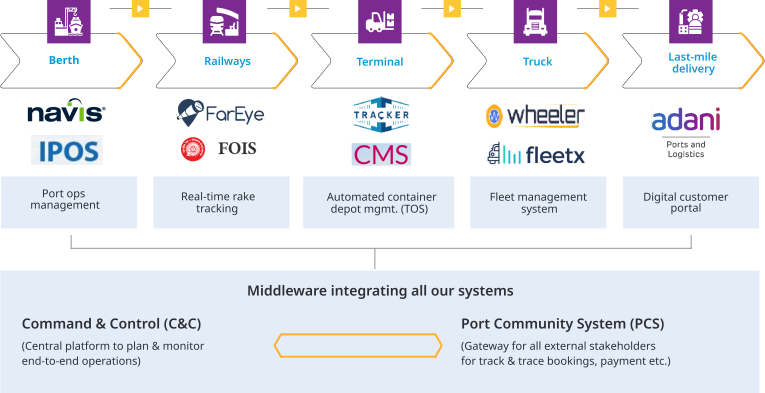
Command & Control (C&C)
The Command & Control (C&C) platform functions as a central hub for planning, monitoring, and managing end-to-end operations. It integrates with various systems to offer:
- The Operations department at APSEZ has established a Strategic Command Centre to drive our logistics strategy
- The centre serves as a central information hub, enabling effective management of real-time expectations while adhering to a comprehensive set of decision-making rules
- It enables optimisation of processes and delivery of exceptional service to our customers
- It uses Data Analytics with the objective of standardising processes and workflows, with its primary goal focussed on improving turnaround time (TAT), addressing pilferage risk, enhancing asset utilisation, improving response time ensuring SLA adherence, and maintaining overall operational safety standards
- Critical alerts, such as Route Deviation, Risky Point Stoppage, Device Tampering. and Frequent Unwanted Stoppage, are logged as tickets in the system. These tickets are automatically assigned to the respective stakeholders for appropriate action and measures. The command centre deploys an advanced algorithm for performing risk assessment for each trip, and generating exceptions for non-adherence. Key technology enablers include GPS, RFID, OR, Automatic Number Plate Reading, along with Biometric Integration with PCS and Government Database
Port Community System (PCS)
The Port Community System (PCS), also known as ITUP, acts as a gateway for all external stakeholders, offering services such as tracking and tracing, bookings, and payments. Key features include:
- Track & Trace: Real-time shipment and container tracking
- Bookings: Streamlined booking processes
- Payments: Secure and efficient payment processing
- Stakeholder Integration: Connecting shipping lines, freight forwarders, customs, and other stakeholders for efficient information exchange


