
Implementing Technology to Improve Efficiencies
As we transition into an integrated transportation utility company, we recognise the importance of digitalisation and automation in driving efficiencies across our value chain. From customer interactions to port operations, storage, and real-time tracking of cargo, we have prioritised technology, and continue to invest in its adoption and implementation.

Our port and logistics assets are seamlessly integrated through a comprehensive layer of technology, enabling us to anticipate and adapt promptly to market needs, competitive opportunities, and customer demands.
Efficiencies in Our Port Operation are Being Driven by:
Navis Terminal Operating System – Efficiently manages port operations by:
- Supporting a broad range of terminal operations: Optimises vessel, yard, and route planning for container movement
- Providing real-time data access: Increases cargo visibility
IPOS (Integrated Port Operating System) – Designed to manage operational activities within a port, IPOS handles transactions, marine operations, vessel operations, gate activities and documentation. Key features include:
- Efficient resource allocation of equipment and labour
- Comprehensive documentation management
- Real-time monitoring of port operations (Used across all our ports, IPOS assists in managing dry, bulk, break bulk, ODC and liquid cargo)
Real-time Visibility of Cargo in Our First/Last-Mile Delivery is Ensured by:
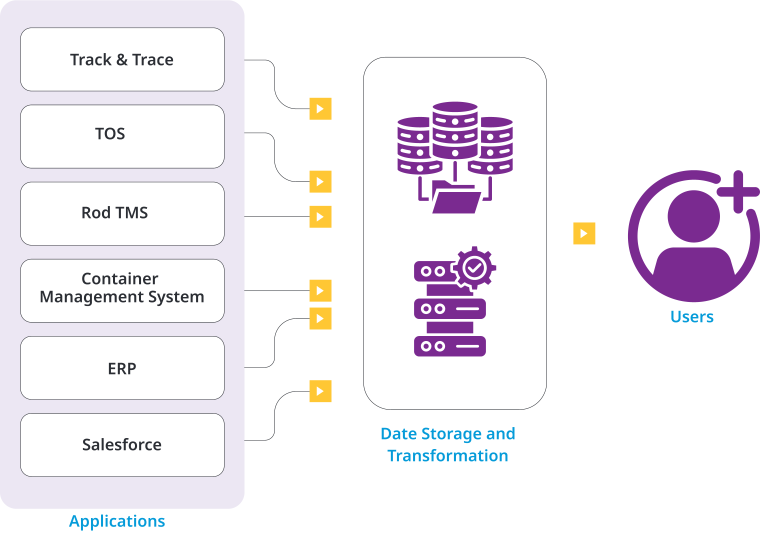
FarEye – Provides real-time cargo visibility across multiple modes (rail, road). Used in our command centres, it assists in centralised monitoring and control, proactively detecting and managing exceptions like delays and deviations.
FOIS (Freight Operations Information System) – Developed by Indian Railways, FOIS provides real-time tracking of freight trains. It assists in planning and optimising rake movements for efficient operations, with timely updates on rake positions and schedules to improve reliability.
LMS, and facilitate logistics close-looping from order to delivery to invoicing, automating first-mile to last-mile, managing strategic decisions like capacity management, and operations management like shipping plans, loading receipts, cargo tracking, and exception management
FleetX – Fleet management software is aimed at improving safety and monitoring. A plug-and-play device is installed in the trucking fleet to detect route deviations (geofencing to prevent unauthorised movements), pilferage, long vehicle holds, and speed limit violations.
Efficient Cargo Management at Terminals is Enabled with:
Tracker – It is designed to provide comprehensive tracking and management of terminal operations. It offers real-time visibility of the location and status of containers, optimising yard and gate operations. The system integrates data from various sources, including GPS and vehicle tracking systems, to ensure smooth communication and decision-making.
CMS – A Cargo Management System (CMS) is a comprehensive platform designed to streamline logistics operations, from booking and tracking to inventory and revenue management. It enhances efficiency and provides real-time insights for optimised cargo handling.
Seamless customer interactions are managed by:
Adani Customer Portal – Our Adani Customer Portal ensures a smooth digital experience, providing real-time access to cargo status, transactions, and operational updates.
Vizhinjam Port – A Shining Example of Technological Innovation
Our Vizhinjam Port is a remarkable example showcasing our continuous innovation in technology. High level of automation makes it one of the most technologically sophisticated global transshipment ports. With best-in-class efficiency, productivity, reduced vessel turnaround times, and remote handling of operations, Vizhinjam Port has set a new benchmark in port operations.
Key Automation Features
- 8 semi-automated and remotely-operated rail-mounted quay cranes (RMQCs)
- 24 fully automated cantilever rail-mounted gantry cranes (CRMGs) in the yard, with operators required only for managing exceptions
- Quayside processes, including capturing containers and internal transfer vehicle (ITV) details, automated with optical character recognition (OCR) powered cameras
- Terminal gates automated with AI-powered OCRs and passive RFIDs
- ITVs equipped with real-time location systems (RTLS), machine learning technology (MLT), and passive RFID systems
Key Automation Benefits
- Reduction in manual handling and improvement in overall port operations
- Greater ability to handle increased cargo throughput with enhanced safety and reliability
- Way paved for drawing transshipment cargo from traditional hubs like Singapore and the Middle East, significantly enhancing India’s position within the global supply chain
Other Major Tech Initiatives at APSEZ
We have Successfully Integrated Cutting-Edge Technology into Our Hinterland Connectivity Strategy.
- Our Virochannagar MMLP is the first terminal in the Adani portfolio to initiate a zero-touch customer experience programme
- Our proprietary technology portal allows seamless customer and supplier interactions
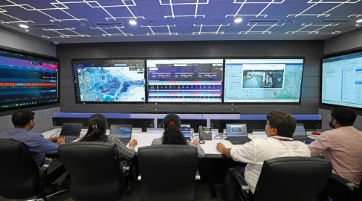
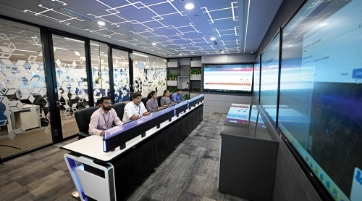
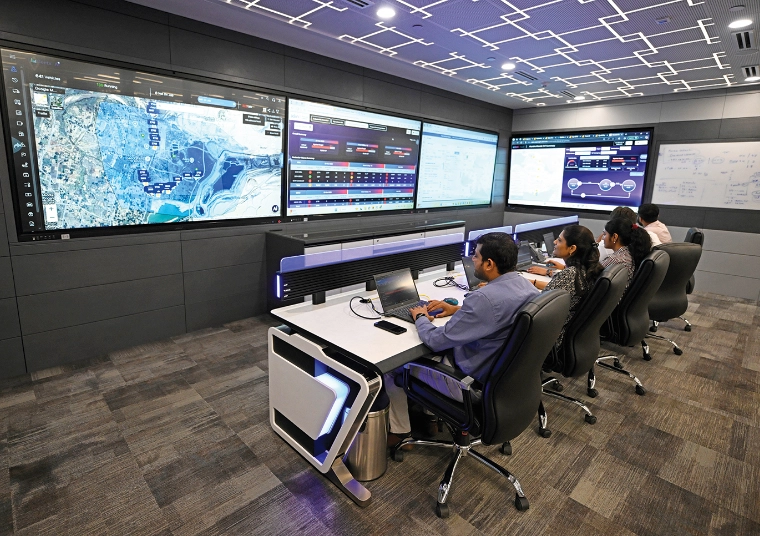
We have Established a State-of-the-art Strategic Command Centre in Ahmedabad.
- It acts as a primary information hub for all logistics operations, including real-time tracking and centralised monitoring of cargo from a single location
- It leverages advanced data analytics to improve turnaround time, increase asset utilisation, monitor SLA adherence, and maintain safety standards
- It is interlinked with local command centres at our logistic parks, improving visibility of the entire supply chain and leading to improved customer satisfaction
We have Launched the Trucking Management Solution (TMS) to Further Complement the Enhancements Delivered by Our Command Centre.
- The platform has been developed in-house, and acts as a transformational marketplace and fulfilment system
- It seamlessly integrates with customer systems, offering comprehensive trucking solutions, including real-time tracking
- It is supported by APSEZ’s SLA-based fulfilment assurance, and presents a diverse range of fleet and commodity options to customers
- It is currently in use across group volumes and external clients, and is focussed on trucking operations, but will eventually be extended across the entire value chain
Recognising the need for technology-leading innovation to achieve end-to-end supply chain efficiency, we will continue to prioritise investments in technology as we transform into an Integrated Transport Utility company, offering unmatched waterfront to last-mile connectivity solutions.
APSEZ Digital Transformation Operational Roadmap (2023-2028)

FY 2023-24NextGen foundation
NextGen - TOS (Navis)
- Process standardisation
- Establising capability (10 MTeUs per terminal)
PCS Foundation
- Paperless & Cashless port entry
- Axle-based billing
- Customer enablement of Marine module

FY 2024-25 Scaling digitalisation
NextGen - TOS (Navis)
- Digital expansion
- Crane operation digitalisation
- Gate operation automation
- Data lake
PCS Scaling
- Elevating customer experience
- Efficient information exchange
- Onboarding all ports

FY 2025-26Transformation
NextGen-TOS (Navis)
- Transformation of planning thru central C&C
- Data-driven action prompts
- Optimisation of inventory (Yard) and resources (EITV, RTGS, Manpower) - Expert Decking
PCS Transformation
- Enabling smart platform ecosystem
- Embed data intelligence
- Enable smart solutions
- Tailormade solutions for customers
Logistics super app

FY 2026-27Reimagination
- Digital innovations
- Digital twin
- Embed mobility
- Al/ML driven operation
- Zero touch ITUP

FY 2027-28Smart operations
- Automated operations
- Auto planning
- AGV-based operation
- Connected integrated assets
- Operate from anywhere
CASE STUDY
Strategic Command Centre -Digitised Data for Decision-Making
- Serves as a central information hub
- Leverages data analytics to standardise processes and workflows, reduce TAT, address pilferage risk, increase asset utilisation, improve response time, ensure SLA adherence and maintain safety standards for overall operations
- Advanced algorithm performs risk assessment for each trip and generates exception reporting (route deviation, risky point stoppage, device tampering, frequent unwanted stoppage)
- Key technology enablers include GPS, RFID, QR, automatic number plate reading, biometric, integration with PCS and Government database