Our Climate Strategy
Led by our sustained focus on reducing the ecological impact of our
business for the realisation of our 2025 Carbon
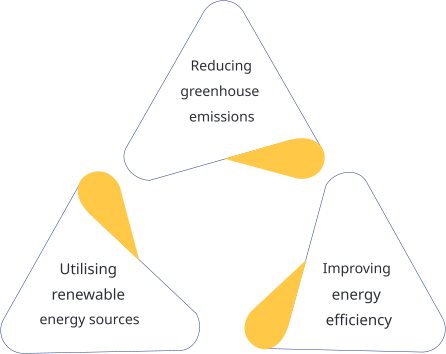
Neutrality goal, we have pillared our climate strategy around:
This strategy is aimed at enhancing our operational
resilience towards the climate change impacts.
It also seeks to develop robust frameworks to integrate
climate change considerations.
Our carbon reduction and resource
preservation efforts are driven by our
initiatives to conserve water, reduce
waste, and adopt energy-efficient
technologies.
Climate Vulnerability Risk
Given the heavy reliance of our business infrastructure on the sea,
we have conducted a Climate Vulnerability Risk
Assessment study. The study has identified Mundra, Dhamra, Hazira, and Krishnapatnam
ports as being vulnerable
to climate change-related risks. It has shown that the rise in sea levels due to global
warming poses a significant
threat to our port facilities, resulting in higher indirect costs, increased turnaround
times, and reduced operational
efficiency. It is imperative for us to take proactive measures to manage these risks
effectively.
Reduce Our Impact
Through low carbon
pathway commitments,
reduce emissions in
operations and supply chain
Build Resilience
Enhance physical and
strategic resilience of both
our operations and key
stakeholders
Strengthen the System
Develop a robust system to
track and ensure integration
of climate change in relevant
business activities
5 Levers of Our Net-Zero Journey
We have adopted a well-defined strategic roadmap to drive our
efforts towards Net-Zero by 2040 – a key goal of our
climate strategy. The roadmap is structured around five levers, each of which
complements and reinforces the other.
To ensure the effective implementation of our strategic roadmap,
we are continuously investing in strengthening
these levers. Regular assessment of the progress is undertaken, and the relevant
strategies are adapted as needed.
Stakeholder collaboration is another important driver of our strategy.
a) Climate Governance
Our climate governance
framework is headed by the APSEZ
Board. Supported by Corporate
Responsibility Committee (CRC),
Corporate Social Responsibility
Committee (CSRC), Stakeholders’
Relationship Committee (SRC)
and Risk Management Committee
(RMC), the Board monitors
performance, adherence to the
standards, and risks faced within
the organisation.
Corporate Responsibility Committee (CRC)
- Oversees implementation of
the ESG strategy and policies,
including the management of
transition risks and delivery
against ESG targets
- Management of ESG priorities is
embedded across the business
segments, at the corporate
and business unit levels,
flowing from the Board
- Reviews corporate level
performance against
environmental and social metrics,
and develops a strategy
ESG Team
- Develops the Company’s ESG agenda
- Supports business functions in driving implementation
ESG Head (Chief Risk Officer)
- Handles business risk management at executive level
- Reports directly to CEO to ensure independence from other
functions
Risk Management
With climate-related risks becoming important to our risk
management process, we have put in place a systematic risk management approach as
part of our climate governance framework.
- Comprises Group-level Risk Management Team to track the
changes in the external and internal business environments in real-time, and
take counter measures
- The ERM and risk assurance procedure is integrated with the
business planning and compliance functions
- ESG Head engages with Risk Management and Audit Committee
on all climate change risks
- ESG head also updates the committee on the company’s
enterprise risk management
- Responsibility to identify and respond to climate change
risk lies with Chief Executive Officer (CEO) at business unit level and
site-level environmental management teams, along with cross-functional teams, at
the site level
- Board of directors discusses climate related issues
annually
Climate Action
Amid the growing global climate change crisis, the need for
urgent and exhaustive action has become accentuated. The Paris Agreement, aimed at
limiting the temperature increase to 1.5 degrees Celsius, as well as the COP 29,
which underlined the need for collective and strong action towards the Paris
Agreement goal, are aligned to the world’s battle against climate change. There is,
globally, a growing demand by stakeholders to accelerate the climate change action
and promote concerted efforts by governments, business and individuals to drive a
sustainable future.
At APSEZ, we have prioritised climate action as a vital element
of our sustainability agenda. Cognisant of the impact of climate change not only to
our business but also the communities and the environment in which we operate, we
pursue a clear climate strategy ensuring operational sustainability. It covers:
- Commitment to ‘carbon neutrality’ by 2025, followed by
net-zero
- Commitment to setting emission reduction targets through
the Science-Based Targets initiative (SBTi) for achieving net zero emissions
We are in the process of setting the emissions reduction targets
for submission to SBTi for validation. As a leader in climate policies, we are
confident in our ability to achieve net zero emissions ahead of the target set under
India's Nationally Determined Contributions (NDC).
Progress Towards Carbon Neutrality
- Total of 338 electric (EITV)s have been deployed across
various locations during the fiscal year 2023
- Fleet of nine Tata Nexon EVs has been introduced at various
sites to facilitate employee travel
- Started withdrawing renewable power from 275MW plant
- Electrification process for our infrastructure is in
progress
Climate-Related Management Incentives
We encourage active participation by our stakeholders, including our
employees, in our climate strategy. We offer them various climate-related incentives
(financial and non-financial) for promoting actions that contribute to mitigating
climate change and promoting sustainable practices.
The incentives are aimed at rewarding and recognising individuals
or entities that demonstrate exceptional efforts in reducing greenhouse gas emissions,
adopting renewable energy sources, improving energy efficiency, and promoting climate
resilience.
Employees
Type of Incentive
a) MADHYAM
- On-line reward scheme introduced at Group level in 2016
- Provides employees with a channel to share their ideas,
suggestions, and insights on strategy, operations, organisation, CSR,
financial and technology with the Chairman
- Ideas assessed at various level from the perspective of
value addition or impact Financial impact – ranging from ₹5,000 to
₹50,000 (based on impact sphere – Group, business unit or department
level), awarded to the employee by the Chairman if the idea is implemented
on ground
- Activities incentivised: Emissions reduction project,
Emission reduction strategy, Emissions reduction target, Energy reduction
project, Energy reduction target, Efficiency project, Company performance
against a climate-related sustainability index
b) Employee Spot Recognition Scheme
- For promoting a sense of belongingness and motivation
among employees
- Recognises and rewards exemplary behaviour/contribution
of employees for implementing best practices in energy saving, waste
management & greener commute
c) Employees Award & Recognition for Technical Projects
- Launched in 2018 to encourage and motivate technical
professionals
- Focussed on plant performance (energy efficiency)
enhancement and adoption of advanced technology to achieve business goals
through scientific approaches towards business suitability and plant
reliability
Business Unit Managers
Type of Incentive
- Corporate ESG targets cascaded to divisional &
departmental levels across sites (all ports, logistics & agri logistics)
- Individual targets set for each site
- Separate tracker for each site and division, with
quarterly target set for FY 2024-25
- Divisional owners (usually CEOs and Heads of the
section at corporate level) have such targets in their dashboards
- Each department has a cascaded target (e.g. Engineering
service, Horticulture, Marine operation); HoDs own the said target
- Performance evaluation assesses target achievement and
outcome is linked with variable pay
CEO
Type of Incentive
- Variable pay linked to various financial and ESG
indicators - Revenue, EBIDTA, ROCE, Health & Safety, Energy Intensity, GHG
Intensity, Water Intensity, Zero Waste to Landfill (ZWL), and Mangrove
afforestation area
- On recommendation of Nomination and Remuneration
Committee, remuneration paid/ payable by way of salary, perquisites and
allowances (fixed component), incentive and/or commission (variable
components), to Executive Directors within the limits prescribed under the
Act is approved by the Board of Directors and by the shareholders in the
General Meeting
Others
Type of Incentive
- 10% of the compensation linked to ESG performance and
organisation performance
Climate Risk Assessment
We are cognisant of the potential impacts of climate change,
including rising sea levels, changing weather patterns,
and extreme weather events, on our operations. We undertake climate risk assessment to:
Systematically identify,
evaluate, and mitigate
potential risks associated
with climate change to
ensure the resilience
of our operations and
infrastructure.
Identify material,
physical and transition
climate-related
financial risks
and potential
business impacts.
Identify, assess
and manage short-,
medium- and long-term
risks, including
climate-related risks,
on an ongoing basis.
We rely on the guidance of the
Task Force on Climate-related
Financial Disclosures (TCFD)
to manage and report
on climate-related risks.
TCFD provides a framework for
categorising and addressing
such risks. Following the
TCFD recommendations helps
in better understanding
and managing the potential
financial impact of
climate-related risks on our
business, and in developing
suitable strategies to
address them.
Climate Change Scenario Analysis
In pursuance of our climate risk process, we have undertaken
qualitative
and quantitative climate change scenario analysis. The analysis seeks to
explore climate vulnerabilities to enhance our resilience to climate-related
risks. The approach helps in assessing and understanding the potential
impacts of climate change on various systems, such as ecosystems,
economies, and societies.
We consider different climate change scenarios to understand and
identify
a wide range of possibilities, covering different levels of risk, uncertainty
and volatility. This, in turn, enables us to ensure that our assets and
operations are equipped and capable of managing climate-related risks
effectively, and are also empowered to seize any resultant opportunities.
We have conducted climate-related scenario analysis on two
scenarios: 2°C or below 2°C, and Above 2°C.
Physical Risk
Acute (extreme weather events)
Chronic (changing weather patterns and rising mean temperature and sea
level)
Transition Risk
Policy and legal Technology
Market Reputation
Emissions Reduction Plan
As part of our Carbon Neutrality Roadmap to achieve net zero carbon
emissions by 2040, we have set forth an emission mitigation plan,
aimed at:
- Reducing energy intensity by operation and maintenance
excellence
- Achieving fuel-switch through electrification of equipment,
such as RTGs, MHCs, ITVs, and locomotives
- Sourcing the entire electricity from renewable sources
- Offseting the remainder emissions
Manging Climate Related Risk
The leadership team, Board and relevant committees at APSEZ provide
oversight of the Group’s principal risks and uncertainties annually.
Our internal controls include policies, processes, management systems,
organisational structures and standards to manage the various business
and associated risks. The Group’s operational risk committee provides
oversight of operational risk management for the Group, including risks
related to climate change and sustainability.
We conducted a Climate Change
Vulnerability Risk Assessment for
the infrastructure related to our
port operations. The assessment
was conducted in line with the
guidelines suggested by the
Intergovernmental Panel on Climate
Change (IPCC) and best practices
for climate risk analysis. This was
followed by a qualitative evaluation
for the four most vulnerable ports,
based on which we identified the
implementation timeframe and the
expected cost implications of the
adaptive measures. Till date, we
have completed the Climate Risk
Vulnerability Assessment for 14
ports to determine their exposure
and sensitivity to changing climate.
a) Internal Carbon Pricing
We deploy an internal carbon pricing (ICP) mechanism to help
minimise our GHG emissions by navigating and
mitigating the potential financial impacts of the existing and anticipated GHG
regulations. This helps in driving low
carbon investments and energy efficiency within the organisation.
Prior to project
implementation, we
conduct a thorough
evaluation of
greenhouse gas (GHG)
projects from a financial
perspective
In case of high
projected GHG
emissions, we
prioritise the
assessment of better
technologies that
can help reduce
emissions.
This enables our projects
to not only meet the
financial objectives
but also contribute
to environmental
sustainability by actively
seeking and adopting
cleaner and more
efficient solutions.
ICP is also used
as a strategic
tool to align
with stakeholder
expectations and
catalyse behavioural
changes within their
operations.
We have implemented an internal carbon pricing mechanism, applying a
price of USD 20 per metric tonne of
CO2 equivalent (tCO2e) on all Scope 1 and Scope 2 emissions from
our operations. We set aside an equivalent
cumulative amount for investment in renewable projects and energy efficiency measures.
As a result, in
FY 2024-25, APSEZ generated a fund of USD 9.5 million through this carbon pricing
measure.
b) Enabling Low-Carbon Services
In line with our commitment to contributing actively towards a
low-carbon society, we offer our customers
a range of sustainable solutions to help them reduce their carbon footprint. We are
focussed on providing
integrated logistics solutions to our customers, with the objective of enhancing the
sustainability of our
services. We aim to offer more sustainable transportation options to them, going
forward.
In FY 2024-25, we used internal
accruals and debt to invest
₹1,664 crore in projects related
to procurement of new cranes,
electrification of equipment, rail
infra, energy efficiency, emission
reduction, environment protection,
water management, waste treatment
and adaptation to climate change.
₹934 crore
Total expenditure on
environmental initiatives of
which ₹512 crore was spent on
renewable generation plant
₹137 crore
Spent on Breakwater
construction