




c) Greenhouse Gas Emissions
Given the growing concerns surrounding greenhouse gas (GHG) emissions and their impact on global warming, there is an increasing focus on addressing the issue. Global businesses face a serious potential impact on their agendas as a result of climate commitments, pledges, and associated actions, as indicated by the recent COP27 negotiations. The need for decisive action to mitigate GHG emissions for building a sustainable and resilient future for all cannot be overstated.
At APSEZ, energy efficiency measures are being implemented across all operational locations. Our efforts are focussed on enhancing the proportion or renewable energy (solar, wind power) in the total energy mix. We aim to continue to invest in decarbonising our operations through electrification and use of renewable energy, through effective actions, collaboration with partners, and innovation. We strive to reduce the emissions through efficient utilisation of energy with the overarching aim of decarbonising our operations.
- Aligned to our "Carbon Neutral by 2025" goal, we are continually striving to increase energy efficiency at all our operational sites through operational and maintenance excellence and increase in the percentage of renewable energy sources (solar and wind power) in the overall energy mix
- As part of our Energy and Emissions Policy, we take several innovative measures to promote the adoption of advanced technologies and strengthen the GHG emissions reduction process
- We undertake regular measurement, monitoring and review of our GHG emissions in accordance with our environmental policy
- We measure, monitor, and review our GHG emissions, adhering to the GHG Protocol corporate accounting and reporting standard, which covers seven greenhouse gases recognised by the Kyoto Protocol - carbon dioxide (CO2), methane (CH4), nitrous oxide (N2O), hydrofluorocarbons (HFCs), perfluorocarbons (PFCs), sulfur hexafluoride (SF6) and nitrogen trifluoride (NF3)
Focus on Reducing Scope 2 Emissions
Our efforts on reduction of GHG emissions are centred mainly around Scope 2 emissions mitigation, since the major source of emissions at APSEZ is electricity consumption, which is categorised as Scope 2 emissions. We strive to reduce these Scope 2 emissions by integrating renewable energy (RE) sources and increasing the RE proportion in our power generation with the aim to reduce the overall direct emissions produced by our operations. In terms of Scope 1 emissions, we are working towards their reduction by transitioning our operations to electric power and implementing energy efficiency measures.
32%
Share of Scope 1 emissions in total Scope 1 + 2 emissions
{Key sources – fossil fuels like diesel, natural gas, and furnace oil (residual fuel oil) use in the equipment and vehicles owned by us}
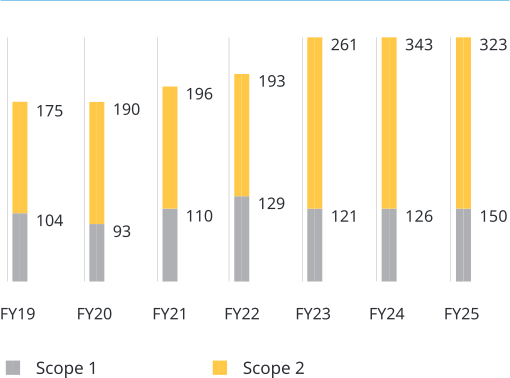
We have successfully achieved emissions levels well below our targeted amounts for the fiscal year 2024-25.
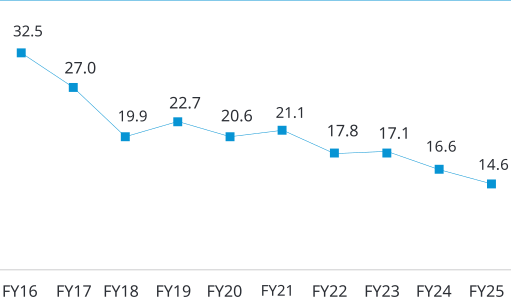
In FY 2024-25, our emissions intensity for Scope 1 and Scope 2 was significantly lower than the previous year.
| Scope 1 (metric tonnes CO2e) |
Scope 2 (metric tonnes CO2e) |
Scope 3 (metric tonnes CO2e) |
|
|---|---|---|---|
| Target FY 2024–25 | 1,65,000 | 3,30,000 | 20,50,000 |
Our growing volume of business led to an increase in our absolute emissions but the emission intensity per unit of revenue witnessed a slight decrease in FY 2024-25.
We are continuously striving to reduce our Scope 1 emissions through use of alternative fuels, electrification, and enhancement in the energy efficiency of our operations.
Emission Intensity (tCO2e/crore)
Emission (KtCO2e)
| Ozone-depleting substances (ODS) | Quantity (Kg) |
|---|---|
| R-22 | 1,162 |
| R-407C | 63 |
| R-410 | 1,034 |
| R-314 | 10 |
| R-32 | 315 |
Scope 3 - Inventory Group (Category-Wise)
At APSEZ, we realise the importance of acknowledging Scope 3 emissions, since they provide an insight into the climate risks associated with our upstream and downstream supply chains. We actively monitor and report Scope 3 emissions to strengthen our carbon reduction initiatives. This helps us in identifying the major sources of emissions throughout our value chain, enabling us to strengthen our efforts in reducing our overall carbon footprint. We use the primary source details, and apply the methods listed in the scope standards of GHG Protocol, for accounting of the GHG emissions against the various categories
| Scope 3 Category | Emissions Calculation Methodology and Exclusions FY 2024–25 (CO2e) |
Emissions Calculation Methodology and Exclusions FY 2023–24 (CO2e) |
|---|---|---|
| Category 1 Purchased Goods & Services | 3,13,802 | 3,27,542 |
| Category 2 Capital Goods | 10,65,334 | 9,81,553 |
| Category 3 Fuel & Energy related Activities | 70,128 | 64,025 |
| Category 4 Upstream Transportation & Distribution | 3,51,059 | 3,41,195 |
| Category 5 Waste Generated in Operations | 311 | 329 |
| Category 6 Business Travel | 1,248 | 498 |
| Category 7 Employee Commuting | 1,438 | 1,321 |
| Category 8 Upstream leased assets | NA | NA |
| Category 9 Downstream Transportation & Distribution | 1,42,427 | 1,12,876 |
| Category 10 Processing of sold products | NA | NA |
| Category 11 Use of sold products | NA | NA |
| Category 12 End of Life treatment of sold products | NA | NA |
| Category 13 Downstream leased assets | 12,517 | 11,513 |
| Category 14 Franchises | NA | NA |
| Category 15 Investments | 47,386 | 46,362 |
| Other downstream | 0 | 0 |
| Other upstream | 0 | 0 |
| Total upstream | 18,03,320 | 17,16,463 |
| Total downstream | 2,02,330 | 1,70,751 |
| Total | 20,05,650 | 18,87,214 |


