



Pursuing innovative practices to improve air quality
Given the impact on air quality by the harmful emissions caused by the fuel combustion in our operations, we have adopted several innovative practices to minimise air pollution. We are cognisant of the adverse effects of pollutants like nitrogen oxides (NOx) and sulphur oxides (SOx) emanating from fuel combustion, and the particulate matter (PM) resulting from cargo handling and storage. To combat these challenges, we strive to continually boost our sustainability performance through robust air quality management practices.
Strategic Approach to Minimising Emissions
Our approach towards reducing the air pollutant emissions triggered by our operations is driven by:
Strict compliance with legal standards and implementation of targeted air quality management strategies, including continuous emission monitoring and focussed emission curtailment measures.

Strong stakeholder engagement for collaborative efforts to address the problem, by working closely with local communities, regulatory bodies, and industry partners with the aim to improve the air quality and reduce the adverse effects of the emissions on our communities.
Deployment of innovative dust technologies to address the challenges resulting from the emission of pollutants from diesel-powered equipment, vehicles and marine vessels, which are the major contributors to the release of particulate matter (PM), NOx, CO, SOx, and various air toxics; advanced technologies are also used to combat the problem of dust caused by cargo handling and storage operations, particularly at our Krishnapatnam and Kattupalli dry cargo terminals.
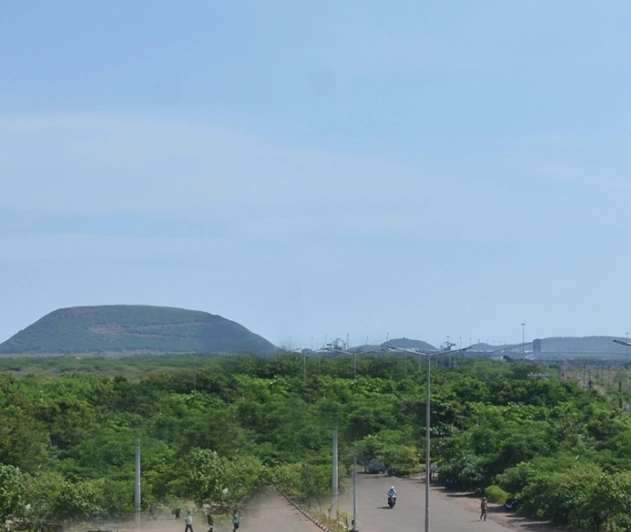
Investing in greenbelt development to act as a natural buffer against air emissions and noise pollution, minimising their impact on adjacent communities.
To address the air quality issues and challenges, we have adopted a well-defined Environmental Policy, centred around guiding our efforts towards enhanced environmental stewardship and sustainable practices. The policy strongly validates our commitment to reducing the non-GHG emissions from our operations through a structured process, consisting of proactive identification, strong monitoring, and robust reporting practices allied with the highest regulatory standards.
Combating Non-GHG Emissions
We have put in place a vigorous Integrated Management System (IMS) for combating the non-GHG emissions caused by our operations. The IMS helps APSEZ in:
Identifying and monitoring the various sources of emission
Conducting comprehensive stack monitoring for various pollutants, including SO2, NO2, PM10, and PM2.5, in line with the stringent guidelines set by the State Pollution Control Board (SPCB)
Other Measures
- Reiterating our commitment to environmental regulations, we publish half-yearly compliance reports, which can be accessed on our website; the reports emphasise our dedication towards environmental responsibility and transparency
- We have implemented the MERCURY software tool to boost our capability to strictly record, monitor, and compare non-GHG emissions against the National Ambient Air Quality Standards (NAAQS); the tool helps in taking quick corrective actions as needed
- We regularly share detailed and accurate emission data with all the relevant stakeholders, enabling the development of effective emission mitigation strategies
Reducing Non-GHG Emissions at Ports
Aligned to our commitment towards minimising the non-GHG operations and improving the air quality, we have introduced several state-of-the-art equipment and initiatives across our ports.
Retrofitting devices in all DG (Diesel Generator) sets at our Ennore and Kattupalli ports, with similar devices under installation at other ports.

Rain guns for fugitive dust suppression at the minerals stack yard.
Mechanised road sweeping equipment for effective dust control.
Pre-wet system ahead of wagon tipping to minimise dust emissions.
Closed conveyor systems to combat particulate matter emissions.
Tarpaulin coverage for rail wagons at the wagon covering sheds to prevent dust emissions
Closed silo systems for wagon cargo loading to cut down on fugitive emissions.
Mechanised handling, including loading and unloading, of cargo from ships.
Dust suppression systems at conveyor lines and transfer points.
Water sprinkling on internal roads of the yard to control dust emissions.
Dedicated team for maintaining proper housekeeping practices.
Movable mist cannons for checking fugitive emissions.
The initiatives are designed to reduce our non-GHG emissions, and promote a sustainable future for our ports and the communities around which we operate.
| Parameter | UOM | FY 2022–23 | FY 2023–24 | FY 2024–25 | FY 2024–25 Target |
|---|---|---|---|---|---|
| NOx | (Mg/Nm3) | 92.04 | 29.08 | 25.22 | 30 |
| SOx | (Mg/Nm3) | 7.51 | 24.46 | 21.54 | 25 |
| Particulate Matter (PM10 & PM2.5) | (Microgram/Nm3) | 13.51 | 54 | 46.43 | 100 |


