




By integrating materiality insights into our strategic planning, we ensure our sustainability objectives address stakeholder expectations while strengthening our business performance and promoting environmental stewardship. Consequently, the outcome of the exercise helps us to align our ESG efforts with strategic priorities, risks and opportunities, while ensuring long-term value generation.
Our Approach to Materiality
At APSEZ, we have been conducting annual materiality assessment since 2015, with a comprehensive review and update undertaken every two years to ensure relevance and alignment with evolving stakeholder expectations and ESG priorities. Our previous materiality assessment was conducted in FY 2022-23 in alignment with the principles of double materiality, wherein we gathered insights from both internal and external stakeholders
In FY 2023-24, we conducted an internal review of material topics, aligning our analysis with global ESG frameworks, emerging trends in the ports and logistics sector, and peer benchmarking insights. A comprehensive bottom-up materiality assessment has been carried out in the current fiscal year, following the approach of double materiality to gain fresh insights and update the list of material topics. The assessment has been conducted in accordance with the guidance provided by key standard setting bodies and frameworks, particularly GRI Standards 2021, and European Sustainability Reporting Standards (ESRS).
We initiated the assessment by identification of key stakeholders which has been performed in accordance with the AA1000 Stakeholder Engagement Standard, that provides guidance on identification and engagement with stakeholders.
Structured Process to Materiality
The materiality assessment process followed a structured and methodical approach which commenced with an understanding of the organisational context – high-level overview of our activities, business relationships, stakeholders, and sustainability requirements of all our entities. This groundwork supported in identifying ESG considerations, pertaining to our business.
We charted a four-step approach as part of the analysis:
 Identify
 Questionnaire Development & Stakeholder
Consultation
Questionnaire Development & Stakeholder
Consultation Assess & Prioritise
 Monitoring & Validation
- Identify: Since impact and financial materiality are interconnected, we adopted the double materiality approach for our evaluation of key topics. This comprises the consideration of the effects of the organisation's actions on stakeholders and the environment, coupled with the financial implications for the company which necessitates adjustments to business strategy, including investment decisions, business model and management choices to mitigate risks or benefit from opportunities. The identification process entailed an analysis of sector-specific dynamics and operational intricacies, in line with the global benchmarks and international standards. These impacts were categorised under Environmental, Social and Governance dimension. The two perspectives of materiality assessment are elaborated below:
-
Impact Materiality: Under impact materiality, we considered the context of our organisation, its sector, and operations to determine several actual or potential and positive or negative impacts on the economy, environment and people. These impacts were further categorised as reversible or irreversible, short-term or long-term.
- Financial Materiality: For financial materiality, we identified risks and opportunities of the identified impacts to determine financial considerations, carried out through the analysis of responses of senior leadership.
All sustainability matters affected by or that have an effect on the undertaking
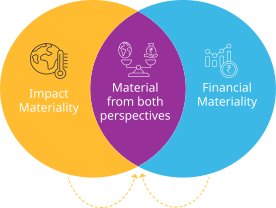
Double materiality – The scope is reflected by the union of two sets
-
Questionnaire Development and Stakeholder Consultation: Building upon the insights gathered from the identification process, we developed materiality assessment questionnaires relevant to respective stakeholder groups. The questionnaires focussed upon capturing the significance to our business and the impact on stakeholders.
With a keen emphasis on capturing diverse perceptions, the questionnaire was circulated among all internal and external stakeholders for their valuable input. For assessing the impacts from impact materiality perspective, scale, scope, and irremediable character were considered in case of negative impacts. Additionally, likelihood of occurrence was considered in case of potential impacts.
To determine the financial implications from company’s value perspective, the responses were sought from the senior management on scale of impacts, likelihood of occurrence as well as potential financial effects of the risks and opportunities identified.
- Assess and Prioritise: The feedback gathered from consultation with internal and external stakeholders was thoroughly analysed considering both financial and impact materiality. The analysis was carried out using a defined scoring methodology. This analysis prioritised impacts and associated risks and opportunities from the wide range of responses we gathered. Furthermore, the outcome was summarised in the materiality matrixrepresenting the significance of material topics from high to medium to low priority.
- Monitoring and Validation: We have aligned our ESG Key Performance Indicators (KPIs) with relevant material topics, Sustainable Development Goals (SDGs), strategic priorities, and risks. These material topics are integrated into our Enterprise Risk Management (ERM) framework and undergo annual review to ensure alignment with our business model, strategy and decisions including CAPEX and OPEX planning. Our Chief Risk Officer provides an oversight of the assessment process. Subsequently, the process followed for the materiality assessment and the outcomes were presented to the Board of Directors for validation and final signoff. Moreover, our process of materiality assessment and its outcomes are verified by a third-party assurance provider.
Materiality Matrix
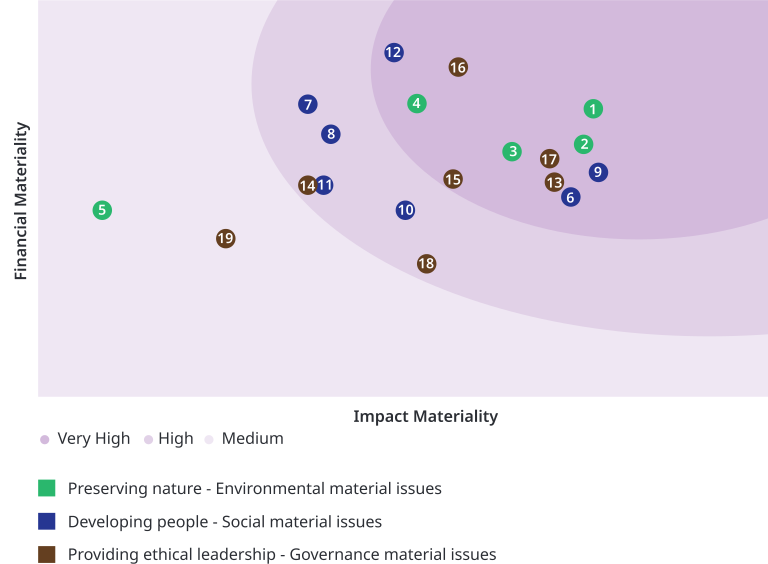
The Identified Material Topics
- M1Climate Change
- M2Biodiversity and Land Use
- M3Water and Wastewater Management
- M4Waste Management
- M5Air Quality Management
- M6Human Rights
- M7Community Relations
- M8Employee Engagement
- M9Occupational Health and Safety
- M10Customer Satisfaction
- M11Diversity Equity and Inclusion
- M12Labour Relations Management
- M13Business Ethics
- M14Data Privacy and Security
- M15Risk Management
- M16Supply Chain Management
- M17Regulatory Compliance
- M18Geopolitical Risks
- M19Digital Inequality
All the material topics listed here hold utmost significance for our operations. However, for the reporting year, we have identified Climate Change, Biodiversity and Land Use, and Occupational Health and Safety as our top 3 significant topics.
All the material topics listed here hold utmost significance for our operations. However, for the reporting year, we have identified Climate Change, Biodiversity and Land Use, and Occupational Health and Safety as our top 3 significant topics.
Addressing the Material Issues
Capitals

Financial capital

Manufactured capital

Social & Relationship capital

Intellectual capital

Human capital

Natural capital
Financial Impact
NegativePositive


