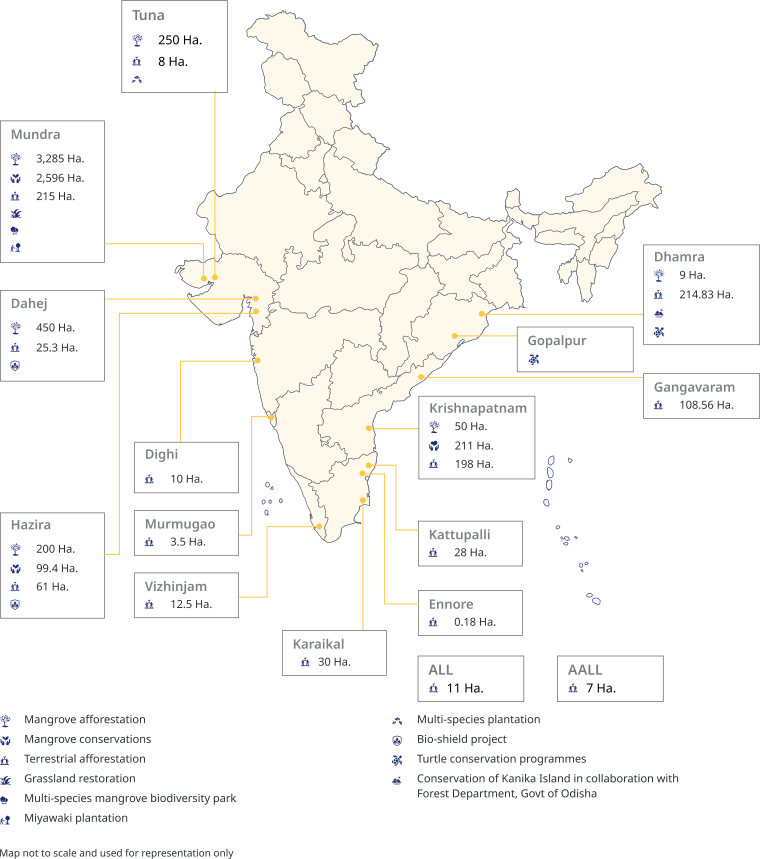
Key biodiversity conservation initiatives
Conservation of coastal biodiversity
1Enhancing Mangrove Biodiversity in Kachchh
Mangroves are vital for coastal ecosystems, offering numerous benefits to both humans and marine life. With its second-largest mangrove cover in India, Gujarat has achieved significant success in mangrove restoration, particularly with the hardy species Avicennia marina.
Project "Mangrove Biodiversity Enrichment in and around Adani Ports Special Economic Zone Limited (APSEZL), Kachchh, Gujarat, India"
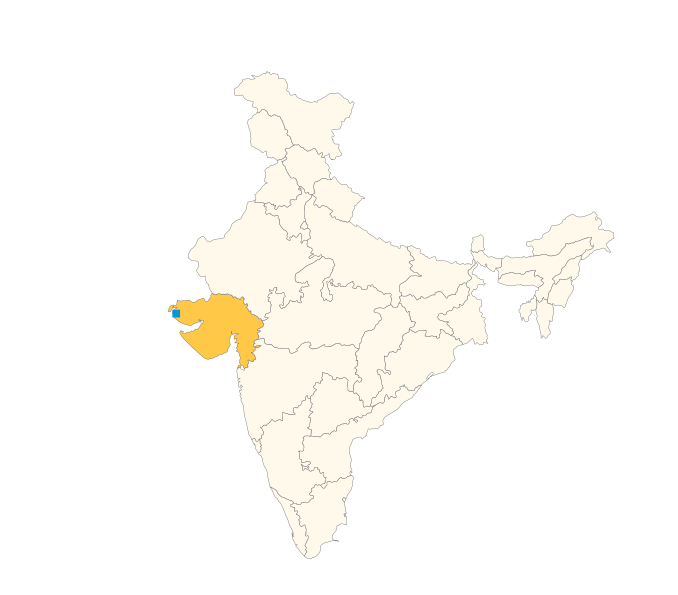
Achievements
Mangrove Spread
35,000
seeds sown in nurseries over 4-hectare area
(15,000 propagules of Ceriops tagal and 20,000 propagules of Rhizophora mucronata)
Restoration
People were engaged to eradicate algae and barnacles. Watchman hired to control camel entry at site.
Macrofaunal Biodiversity Increase
Mudskippers, bivalves, gastropod Pirenella cingulata, dead razor clams and few crablets of Scylla serrata species and mudskippers (Periophthalmus waltoni) seen in and around plantation site, along with catfish and mullets.
Mangrove Survival Rate
Different survival rates among different species.
32.59%
Av. survival rate of Ceriops tagal
87.06%
Av. Survival rate of Rhizophora mucronata
2Bio-Shield Projects
Adani Group has developed natural bio-shields made of Mangroves and local species on Gujarat coasts, with the aim of conserving the soil quality and groundwater tables, safeguarding them against sea water and saline winds. The projects are also helping generate jobs for the local communities.
Dahej Bio-Shield
Adani launched a bio-shield project in Jambusar taluka, Bharuch district, in collaboration with Saline Area Vitalization Enterprise Ltd. (SAVE)
Project Summary
Spread over 1 km long, 180 metres wide area along the seacoast in Tankari village, Jambusar taluka, Bharuch District, Gujarat.
50 metres from the seaward end designated for mangrove plantation, protected by natural bamboo fencing, protecting the coastline, boosting fisheries, and enhancing overall biodiversity in the region.
50 metres allocated for plantation of Piludi, an oil-seed plant that provides additional income for nearby communities.
50 metres used for Sharu and Unt Morad plantations, which supply fodder for cattle during the dry seasons.
Remaining 30 metres planted with fodder, fruit and medicinal plants, offering substantial economic value to local people and helping block the saline winds, enhancing the green cover of the region.
Hazira Bio-Shield
Key objective - Formation of nurseries and the plantation of mangroves and Saru plants to enhance coastal biodiversity and create a bio-shield.
Project Summary
Spread over 18 hectares.
Saru plants planted around pond’s border at the designated Tankari Bioshield-1 site.
Gap-filling undertaken twice after initial plantation.
Support structures erected for plants.
Tuna Bio-Shield
Key objective - To promote diversity among the Kachchh mangroves and protect the coastlines.
Project Summary
Multi-species Mangrove plantation in Kandla.
3 rare species – Rhizophora mucronata, Ceriops tagal, and Aegiceras corniculatum – being planted across 5 hectares area using propagule dibbling.
Of 50,500 propagules dibbled, 30,340 seedlings survived, indicating 60.07% survival rate.
Transitioning Kachchh mangroves from single species to multi-species formations, enhancing ecological services and coastal biodiversity.
3Terrestrial Plantation
Guneri Restoration
3-year restoration project launched in Guneri village in collaboration with Gujarat Ecology Society.
Key objective: To restore grassland habitats and improve biodiversity and soil quality
The project involves ecological restoration across Gauchar land of 40 Ha. in Guneri village.
Active participation of local communities in preparing and nurturing mangrove saplings for a year before transplanting them during the monsoon season.
Trenches created in Bhatagadh plot to retain moisture and support plant growth.
Increased biodiversity seen in both Bhatagadh and Chachh areas, marked by various species of birds, mammals and butterflies.
4Community-Based Initiatives
Terrestrial Biodiversity
'Adani Van’ – a new initiative to cover huge areas with wide variety of trees, including trees with medicinal properties, fruit-bearing trees, and trees that create ideal habitats for birds to nest and rest.
Use of Miyawaki plantation technique and a drip irrigation system.
Development with community participation.
3 Adani Vans planted by APSEZ Mundra July to December 2024 - 22,460 trees planted across 9.5 acres in N Khakhar, Borana, and Dhrub villages.
Total 8 Adani Vans created till date - 75,078 trees planted over 28 acres.
Vruksh Se Vikas (Prakrutik Rath) Mundra
Unique initiative is designed to foster environmental responsibility by uniting communities in tree planting efforts at schools, temples and public spaces.
- Rath travels from village to village.
- 7,136 saplings distributed this year.
- Encourages active participation from residents.
- 1.79 lakhs trees planted till date in Mundra.
- Increasing local green cover, strengthening community’s connection to nature, enriching local ecosystem.
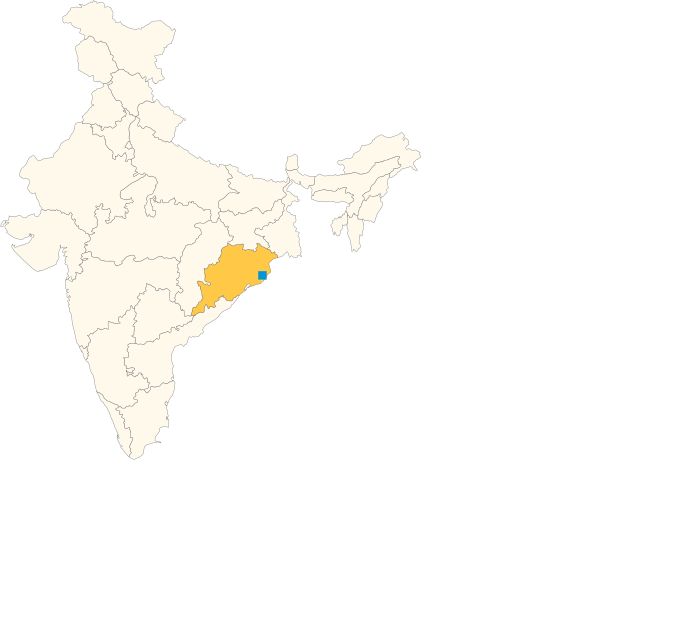
Conservation of olive ridley sea turtles (lepidochelys olivacea) in Odisha
Presence
- Coastal regions of Odisha, particularly deltaic areas where rivers meet the sea
- This region rich in mangroves serve as breeding and spawning grounds for various marine species
- Turtles migrate to the region from October to May to feed and mate
Arribada
- Mass nesting behaviour; thousands of females come ashore at the same time to lay eggs
- Odisha in India is one of the largest mass nesting sites globally, alongside Mexico and Costa Rica
Threats faced
Habitat Loss
Casuarina plantations and beach erosion modify and destroy the nesting beaches.
Fishing Activities
Incidental catch in trawl and gill nets results in significant turtle mortality.
Light Pollution
Strong illumination around nesting beaches disorients both the adult turtles and the hatchlings.
Predation
Eggs and hatchlings are preyed upon by dogs, jackals, hyenas, and other predators.
Vessel movement
Increased vessel traffic in gathering zones disturbs the mating and breeding activities.
Conservation Efforts
Gahirmatha Marine Wildlife Sanctuary
Established in 1997 to protect critical nesting and breeding habitats.
No Fishing Zones
Designated areas around major nesting sites declared ‘no fishing zones’ during the reproductive and nesting periods.
Turtle Excluder Devices (TEDs)
Use of TEDs in trawl fishing nets mandated to reduce incidental catch.
Patrolling and Monitoring
Regular patrolling of nesting beaches and breeding zones undertaken, along with monitoring against predators and human interference.
Community Engagement
Local communities motivated and educated about the importance of turtle conservation.
Gopalpur Port Conservation Activities
(In coordination with the State Forest Department)
- Annual beach cleaning activities at Rushikulya nesting area
- Seaworthy trawler for patrolling during the nesting period
- Educating the local fishing community and inhabitants about importance of conservation
Dhamra Port Conservation Activities
Dark sky-friendly lights installed in port and township areas - to prevent light pollution from affecting turtle movement; designed in consultation with IUCN turtle conservation experts.
Buoys provided to mark the Gahirmatha area - preventing fishing boats from entering.
Trailer Suction Hopper Dredger (TSHD) - for dredging to minimise environmental impact.
Patrolling support (trawlers) provided to Forest Department - for patrolling during turtle migration periods.
Navigation channel placement ensured - port areas and navigation channels located outside turtle congregation zones.
Bhadrak Forest Department supported in conducting awareness programmes on mangrove conservation and turtle protection.
Conducted an awareness programme with the fishing community on November 22, 2024, on turtle conservation and mangrove protection.
Our Efforts have Contributed to Encouraging Results
Mass
nesting seen at Rushikulya and Gahirmatha
4.02 lakhs
average at Rushikulya (over three years)
4.38 lakhs
average at Gahirmatha (over three years)
Biodiversity Conservations & Restorations Across all the Operational Sites