


2026 Goals – Towards Zero Harm
At APSEZ, our commitment to strengthening our safety culture is underscored by our comprehensive OHS governance framework. It is driven by our ambitious 2026 targets, which we are continually striving to achieve.
Robust OHS Governance Structure Promoting Safety
Led by our commitment to achieving zero harm and nurturing a culture of safety for all stakeholders, we have put in place a robust Occupational Health and Safety (OHS) governance structure that embeds our safety proposition across our business operations. The framework is pillared around the ethos of ensuring the well-being of our employees as well as our partners.

The ISO 45001:2018 certification for our Safety Management System has reinforced our adherence to the highest international standards and further underlined out commitment to workplace health and safety.
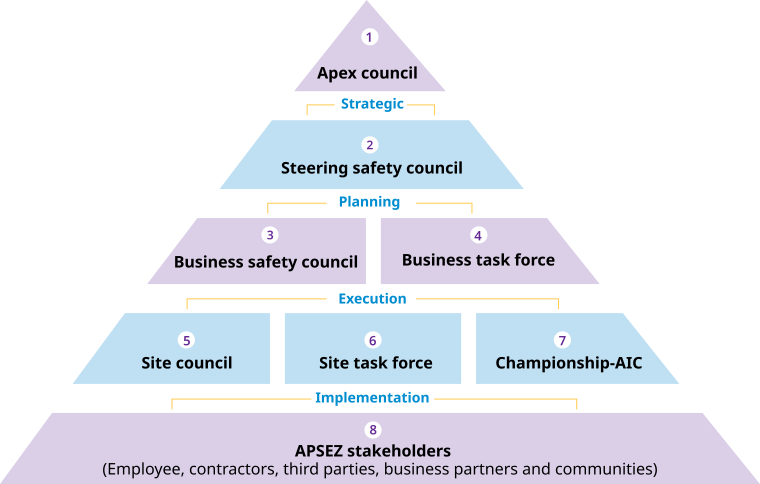
Multi-Tiered Governance Model
Multi-tiered strategy to ensure effective safety oversight and implementation:
Safety Steering Council
at corporate level; establishes overall safety policies and strategic directions.
Business Safety Council
transforms corporate safety goals into actionable plans; oversees implementation of safety initiatives across business units.
Site Safety Councils
at ground level; ensures effective execution of safety practices at each operational site.
Safety Task Forces
Tackles specific safety challenges across the organisation; ensures targeted approach to risk mitigation.
Safety Committee Representation
| Management | Non-management | Frequency of meetings | |
|---|---|---|---|
| Site level | CEO and HODs | Departmental heads and task forces | Monthly |
| Business level | Business unit head, CEOs and safety heads | Taskforce heads and safety heads | Monthly |
| Corporate level | Committee chairman, BU heads and invitees | Taskforce heads and safety heads | Once in two months |
| Board level | BU heads and Chairman | Special invitees | Quarterly |
Outcome towards 2025 safety and health targets: Elevating our safety commitments
We continue to make significant strides towards the realisation of our ambitious goals for occupational and process safety, and health protection.
Regular monitoring and assessment undertaken to identify improvement areas and continually raise the bar of our safety performance.
Several programmes and initiatives have been launched to minimise health and safety incidents and foster an organisation-wide culture of safety.
| Initiatives | Benefits | Status |
|---|---|---|
| All BU senior leaders to participate in safety engagement with employees and contractors as part of the Personal Safety Action Plan (PSAP) - over 2 person-days per employee per year. | BU safety KRAs for the leadership team & employees | As per PSAP, we ensure continuous engagement of the leadership team and employees, which is facilitated in the form of Safety Interactions and is measured as 2 interactions for CEOs and site heads, 8 for site safety leads and HOD with a frequency of 4 interactions a month. |
| Launch 4-hour Contractor Induction pack and creation of awareness amongst the contractors on safety through Saksham programme | Capacity & capacity building | 44,770 participants have been trained under the "Saksham" programme at APSEZ |
| Development of reward and recognition policy covering the best TF (Task Force) member, OHS trainer, staff contractor; SRFA (Safety Risk Field Audit) team and department achieved a high score in SPIS (Safety Performance Indicator Score) and effective implementation of CMP (Critical Management plan) | Excel team engagement in OHS activities | Rewards and recognition programme, wherein 10% employees are rewarded. |
| Improvement in quality of SRFA audits to eliminate maximum 4s and 5s through SRFA; Strengthening of AICs and line function, creating a competitive environment (target electrical safety standards) | Safe workplace | Continuous monitoring systems are in place to track the quality of safety at the BU level through our SFRA audits. We have excelled in our targeted electrical safety standards to minimise the observation pertaining to electricity safety. |
| Study undertaken of structural stability/ integrity, leveraging the maximum benefit of VSR (vulnerable safety risk) audits tool to minimise vulnerabilities | Elimination of VSR | Ensuring compliance and operational excellence through VSR audits aimed at validating the systems against regulatory standards |
| Samwaad: Reduce Unsafe Acts to 4 per hour (UA/hr) and ensure all port employees participate in the monthly Samwaad assessment, aiming for a 90% achievement rate | Engaging workmen in OHS activities | We have achieved more the 2UA/hr for FY 2024-25 |
| Implement horizontal deployment of incidentrelated Comprehensive Corrective and Preventive Actions (CAPA) and Safety Risk Field Audits (SRFA) based on monthly business trends, ensuring 100% compliance monitoring | Proactive approach to prevent reoccurrence in other sites | Comprehensive Corrective and Preventive Action (CAPA) plan developed and executed across all sites for any incidents that may occur |
| Introduction of task force KPI scorecard for 6 task forces and increase in effective involvement of members through tracking, micro tasking and measuring: Review of SSC and BSSC meetings | Line Management Engagement | Monthly SSC and BSSC meetings conducted with management to review ongoing process improvement measures and implement new, forward-looking strategies |
| Establishment of LPSE (Logistics and Process Safety Engineering) learnings and processes for LOTO, W@H, Electrical, CSM Process Safety, Micro Hazard Mapping, Logistic Safety; MOC and SOP tool kit (Pictorial SOPs) across sites | Utilising LPSE trained champions in the BU Safety Excellence Journey | 3 days of exclusive training under LPSE have
been deployed across sites with an average of
30 participants per site per training. (3 projects executed during the year) |
Key Initiatives
To enhance safety and productivity, the Contractor Incubation Series was developed for experience-based learnings, specifically targeting owners, managers, supervisors, and workers. This series encompasses various initiatives, including Saksham and Samwaad.
Saksham
Acknowledging the pivotal role of contracting partners in project execution, the enhancement of worker safety skills is imperative to our safety journey.
- “Saksham”, offers “Experience-based Learnings” through 3D animated modules, facilitated by trainers
- Training coordinators and the OH&S team maintain records and feedback forms, which BUs evaluate to improve training
- Site heads, line managers and training coordinators deploy Saksham
- The Trainer's Handbook ensures uniform training and live demonstrations
- The Saksham & Trainer Handbook Kit is available for download and accessible on the Group Safety Portal and Safety e-LMS Platform
- All contractors are inducted before starting any job, with non-compliance resulting in disciplinary action as per Adani's Consequence Management Policy
Samwaad
Our 'Samwaad' platform is designed to promote worker participation, engagement and knowledge sharing the health and safety agenda.
- The 'Adani GENSUITE' system allows employees to report their safety concerns and any incidents via their smartphones within 40 seconds
- The system provides them with the option of reporting anonymously
- The system is crafted to ensure timely handling of the concern/incident
Safety Skilling Campaigns
We have adopted various safety skill campaigns, which include comprehensive training programmes aimed at enhancing on-the-job safety for various activities.
Urja
- Focusses on electrical safety using the 5E Model (Exposure, Enable, Educate, Equip, Ensure)
- Covers the intricacies of electrical systems, hazard identification, and safety protocols
- Essential for electrical professionals, maintenance workers, and anyone operating in electrified environments
Upkaran
- Provides training for safe lifting activities using the 5L Model (Load, Limitation, Lifting Operation, Lifting Equipment, Lift Plan)
- Includes detailed guidance on equipment operation, inspection, maintenance, and risk assessment
- Aims to empower individuals to handle lifting operations safely and efficiently
Unchai
- Offers training for working at heights using the 5C Model (Climb, Control, Competence, Capacity, Check)
- Combines theoretical knowledge, hands-on guidance, and real-world case studies to help participants identify, evaluate and mitigate risks associated with elevated work environments
- Includes practical exercises, such as climbing towers with proper use of harnesses and rescue kits
Rescue
- Equips individuals with the knowledge and skills needed to respond effectively to emergencies and conduct rescue operations in various work environments
- Crucial for sectors like construction, industry, and hazardous areas, where emergencies can pose significant risks to worker safety. (We will provide a coverage of this later.)
- Included 59 campaigns, accounting for a total of 3,088 man-hours of training, during FY 2024-25
Progressing in the Area of Process Safety
A well-designed process is in place for all expansions and projects at APSEZ. It covers:
QRA
(Quantitative Risk Assessment)
HAZID
(Hazard Identification)
HAZOP
(Hazard and Operability Study)
PSM
(Process Safety Management)
PSSR
(Pre-Startup Safety Review)
Another aspect of process safety at APSEZ includes application of Hazard Identification and Risk Assessment (HIRA) procedures to all operational activities. HIRA was performed for both new and existing processes by a specialised team comprising process safety engineers.
We also engaged independent process safety consultants to conduct gap assessments, identify areas for improvement, and implement risk mitigation strategies as part of our process safety enhancement exercise.
Ensuring Employee & Contractor Well-Being
- Fully equipped emergency healthcare facilities at all sites
- Exhaustive pre-employment and periodic medical assessments conducted for all personnel
- All employee health-related data and records kept and managed safely and securely
- Dedicated doctor overseeing all occupational and individual health initiatives for employees
- A streamline process followed to identify work-related hazards:
- Safety handholding and assessment carried out by a third party
- Monthly self-assessment undertaken by a task force team
- Vulnerability Safety Risk Assessment conducted by a site task force team (TF2 - Contractor Safety Management) to identify and ensure compliance with SOP updates and refinements
- Regular Safety Risk Field Audit (SRFA) carried out at the site level by a task force team (TF2 Contractor Safety Management)
Major Process Safety Initiatives

Tech Monitoring
CCTV systems, equipped with advanced technology, deployed at all hazardous locations, ensuring round-theclock surveillance and real-time alerts.

Safety Awareness
Employees and visitors apprised of safety issues through continuous audio safety announcements in local languages and simulation training modules provided at entry points.

Safety Alerts and CAPAs
Safety alerts issued with respect to incidents, enabling quick redressal through CAPA implementation.

Monthly Reward & Recognition Programme
Successfully recognised 10% employees for their contributions to our safety culture..
Awards
Gold colour Helmet will be presented with Safety Star Logo.
Gifts are like Computer/Tab, Bicycle, Refrigerator, Washing Machine, LED TV etc.
Joint Committees to Promote Safety Culture
APSEZ has in place formal joint management-worker health and safety committees to oversee and ensure the health and safety of the workforce.
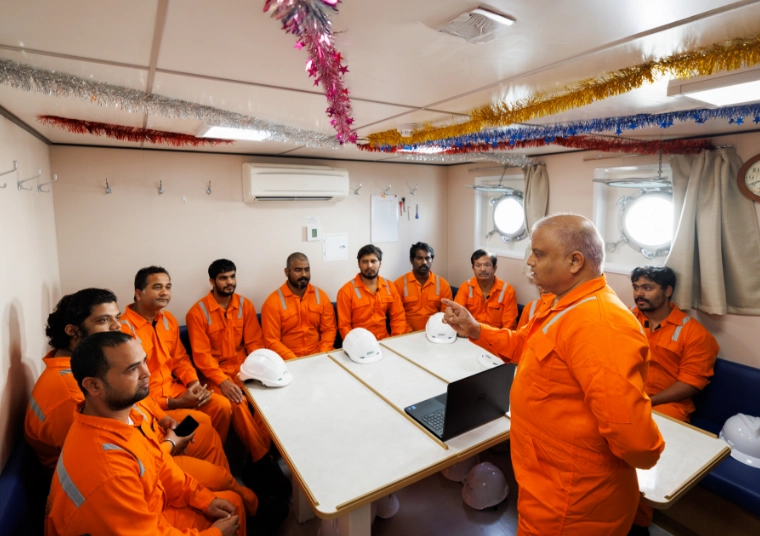
Site-specific committees customised to activity type and operation size, with equal representation from management and workers to ensure balanced perspectives.
Meetings held frequently, in intervals ranging from monthly to quarterly, to undertake detailed review of OHS performance, incident reviews, improvement suggestions, and annual goal-setting.
Transparency and open communication maintained through meticulous recording of meeting minutes, with the same shared with all the relevant stakeholders.
Training provided to committee members, including the Business Site Head, Line Managers, Head of Departments, and Site Safety Head for effective OHS initiatives’ implementation.
Large resource pool available in the form of consultants and other resources to boost understanding and safety practices.
Accountability and informed decision-making ensured through maintenance of detailed records.


