


Prioritising safety training at apsez
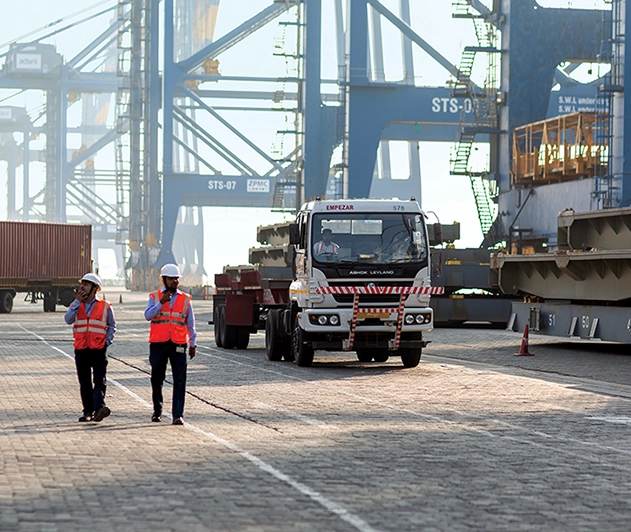
At APSEZ, a comprehensive safety training ethos permeates the entire organisation, encompassing everyone from top management to employees, contractors, and partners. The thrust is on ensuring a secure working environment at every time, in every way
Expert mandatory health and safety training sessions, customised to job-specific risks, backed by regular mock drills.
Accessible e-learning modules provided through the e-Vidyalaya online platform.
Strong Training Culture
Train the Trainer (TtT) programme to boost communication and enable ongoing improvement of safety procedures.
Exhaustive audio-visual induction sessions offering critical safety information from the inception of employment
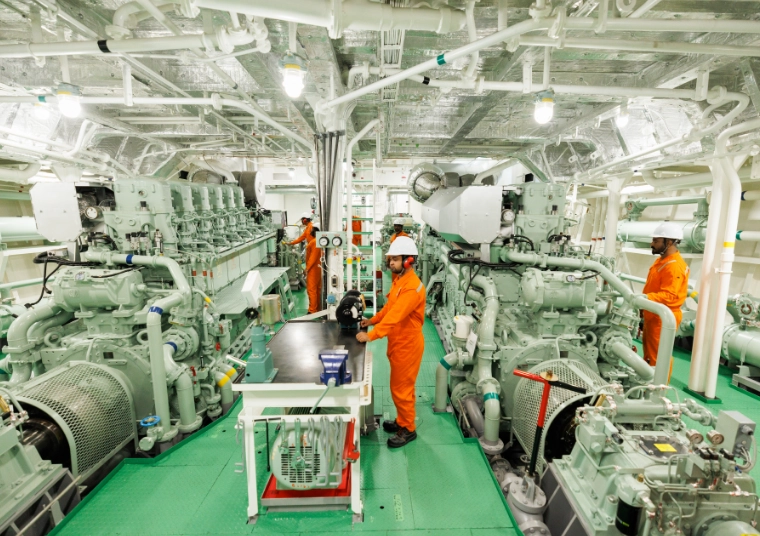
Simulator Training for Safe Handling of Equipment
Dedicated training centres, equipped with advanced simulators, provide employees with practical experience to handle essential machinery safely. This helps in preparing and skilling equipment operators in safe handling prior to actual operation of the machinery.
Audio Visual Videos for Educating Works On-Site
At APSEZ, we have launched a new initiative to create 3D animated videos as a proactive measure. These videos are designed to educate our workforce by illustrating past incidents that have occurred on our premises. The aim is to enhance understanding of potential hazards and to provide clear guidance on preventive measures. This initiative serves as a reference to help workers anticipate and mitigate similar incidents in the future.
Oil Spill Prevention, Preparedness & Response Plan
In alignment with the National Oil Spill Disaster Contingency Plan (NOS-DCP), we have developed a comprehensive Oil Spill Contingency Plan to handle Tier 1 responses for up to 700 tonnes of oil, considered the worst-case scenario, at APSEZ. It involves quick mobilisation of essential equipment and trained personnel.
Key Components

Management Structure
Chief Operating Officer (COO) serves as the Chief Incident Controller; supported by an Incident Management Team.

Shoreline Sensitivity Mapping
We identify and prioritise sensitive coastal areas for protection.

Equipment Procurement
We follow a phased procurement plan for oil spill response equipment, meeting minimum requirements for both Category B and Category A risk levels.

Storage and Disposal
We have designated temporary storage sites for oil and oily waste, with proper plans for disposal through approved recyclers.

Response Strategy
We follow detailed processes for managing oil spills, including response operations, escalation hierarchies, and control measures.

Fire Safety Measures
We are equipped with comprehensive firefighting equipment, early detection sensors, and regular audits.

Training and Drills
We conduct annual training programmes and quarterly mock drills to ensure preparedness.

Simulation Exercises
Regular drills with stakeholders help us assess and refine the plan's effectiveness.

Communication
We maintain essential documents and ensure seamless connectivity with advisory services for effective response coordination.
This robust plan ensures that APSEZ is well-prepared to handle oil spill emergencies efficiently and effectively, safeguarding our operations and the environment.
Scaling the OHS Framework
In order to effectively meet the existing and emerging operations related health and safety challenges, we are continually scaling and strengthening our OHS framework.
- The framework is being expanded to cover logistics, warehouse, and road transportation safety. Training is provided to employees on road safety, defensive driving, and electrical safety, through driver-centric programmes, speed radar guns, and advanced CCTV monitoring with video analytics
- Detailed infrastructure safety assessments are conducted to identify the areas of improvements and action upon them for enhanced safety
- OHS is integrated into the procurement process through online portals like Ariba, to ensure stringent adherence by the suppliers with high standards of occupational health and safety, labour laws, and ethical practices. The Contractor Safety Management (CSM) initiative covers:
- Strategic planning
- Safety meetings
- Online CSM portal
- Toolbox talks
- Site surveillance
- Team members are empowered to immediately stop the operations in the event of an unsafe practice being observed
- Audio-visual tools are strategically placed across the sites to guide the workers on safety

In line with our Human Rights Guidelines, we strictly uphold the workers’ rights to freely form and join trade unions, without fear of intimidation or reprisal, in accordance with legal provisions. A Grievance Management System prevents reprisal in such cases, and also addresses and resolves the concerns of the workers on such count.
Automated OHS Implementation at APSEZ
At APSEZ, we are integrating automated technologies into our OHS framework to enhance workplace safety. We are deploying various automation technologies for predictive insights, real-time monitoring, and proactive risk mitigation to minimise hazards and prevent incidents.
1.Udgam – Employee Safety Learning Management System
In alignment with our vision for digitalisation and Industry 4.0, we have launched UDGAM, our new Safety Learning Management System. The system has been developed using the Adani MS SharePoint.
Key Features
- Offers a secure, unified safety learning framework for all business units
- Transitions safety training from classroom-based programmes to self-learning management
- Provides 24/7 access to knowledge, with features like self-registration, automated certification management, and personalised dashboards
- Is integrated into the OHSMS Digital Transformation, thus reducing the effort required for creating training MIS and analytics
- Uses Power BI tools for management dashboards to support internal governance, reviews, and ESG & sustainability disclosures
Application
The platform operates on a decentralised model with autonomous administration at Group, BU and Site levels, ensuring flexibility and consistent safety standards. Over the past year, we have developed an extensive library of safety training resources, including modules on Defensive Driving and Electrical Safety, with more under development.
The Defensive Driving module is mandatory for all employees, with Group Safety monitoring compliance. The Electrical Safety module is released by BU safety teams based on their needs.
Benefits
- Reinforces our commitment to a safe workplace environment
- Advanced analytics will provide insights into training progress and compliance, enabling continuous improvement in our safety practices
2.Technology-Driven Implementation in Transportation System
Road/Driver iVMS (Fleet Robo)
At Adani Ports and Special Economic Zone (APSEZ), we use Intelligent Vehicle Monitoring Systems (iVMS) to boost efficiency and safety. iVMS is installed in all Adani-owned trucks (>950 in numbers). Integration of iVMS reduces accident risks, enhances driver safety, and ensures efficient vehicle maintenance. By installing GPS-enabled devices in our fleet, we track vehicle locations in real-time, ensuring timely deliveries and optimal routes. This technology is essential for maintaining high standards in our transport and freight operations.
Key Features
- Driver behaviour and vehicle performance monitored through data transmitted to our base, ensuring compliance with safety regulations
- CANBUS adaptors enable seamless, tamper-proof installations, while portable iVMS units allow easy transfer between vehicles
Benefits
iVMS significantly enhances safety across industries through:
- Accident prevention: Monitors vehicle parameters like speed, location, and braking patterns, detecting erratic behaviour to trigger emergency alerts and prompt intervention
- Driver Behaviour Monitoring: Records data on speed, engine RPM, and other parameters, helping improve driver behaviour under Health, Safety, and Environment (HSE) policies
- Preventive Maintenance: Provides real-time vehicle diagnostics, identifying potential issues before they become serious problems
- Compliance and Reporting: Generates detailed reports on driver behaviour and vehicle performance, ensuring compliance with safety regulations and improving fleet management
Rail
- Siren has been integrated (auto/manual) with entry/exit gate for the rake movement or placement
- Height barrier has been installed at various crossing points across Rail track to prevent inadvertent contact with OHE (Overhead Equipment) line
- Set points are equipped with lockable devices to prevent wagon derailing due to improper setting of shunting points
- Safety signage has been placed across the track not to cross during rake movement
3.Technology Implementation of 2D Sensors at APSEZ
At APSEZ, we have implemented advanced 2D sensor technology to enhance safety and operational efficiency across our ports. These sensors are strategically installed on gantry cranes and spill plates to detect obstacles and create safety zones.
Key Features
- When an object is detected within these zones, the sensors automatically stop or slow down the machinery
- This ensures continuous monitoring and reducing the risk of accidents in the busy port environment
Benefits
- Enhances safety while minimising operational downtime
- Allows cranes to operate at optimal speeds
Implementation at Adani Gangavaram Port Ltd. (AGPL) At Adani Gangavaram Port Ltd. (AGPL), SUL-2, SUL-3 and SUL-4 sensors are installed on gantry cranes and spill plates to enhance safety and efficiency. These sensors detect obstacles and create safety zones, automatically stopping or slowing down machinery when an object is detected, reducing the risk of accidents. This technology prevents collisions in vessel operations, minimising damage and repair costs. Operational efficiency is improved by reducing downtime and allowing cranes to operate at optimal speeds, with real-time data and alerts for better equipment management.
4.Implementation of CRMG (Cantilever Rail Mounted Gantry)
Vizhinjam Port has enhanced its capacity with 24 Cantilever Rail Mounted Gantry (CRMG) cranes since July 2024, streamlining container handling and boosting competitiveness. These cranes feature advanced automation systems like intelligent lubrication, vibration monitoring, and automatic fire extinguishing, ensuring high efficiency and safety.
The automation reduces manual lifting, decreasing injury risks. Comprehensive training ensures safe operation, while real-time monitoring allows quick hazard detection and response. The fully automated terminal eliminates the need for field operators, drastically reducing catastrophic incidents and achieving a 99% reduction in human injuries.
This implementation highlights Vizhinjam Port's commitment to operational efficiency and safety, positioning it as a key player in global logistics.
5.ES-T2 | Innovation | AI Technology-based Human Detection System
We have implemented an AI Technology-Based Human Detection System to enhance safety around the Rubber Tyred Gantry (RTG) tracks. This system detects humans within a defined zone and halts the gantry movement when necessary. Previously, operators faced blind spots in the bus bar area due to container stacks, making it difficult to see during crane movements. To address this, we installed six IP-based cameras on the sides, front, and rear of the RTG crane, providing comprehensive coverage of the danger zone.
Key Features
- When a human is detected, the system sends a stop signal to the RTG crane control system, ensuring immediate action
Benefits
- Significantly enhances human safety
- Demonstrates our commitment to leveraging advanced technology for a safer work environment
We have successfully implemented this system at Mundra Port. The cameras installed on the RTG cranes provide full coverage of the danger zones, effectively eliminating the blind spots. The AI system detects any human presence and immediately halts the crane's movement, ensuring the safety of our workers. This implementation at Mundra Port showcases our dedication to creating a safer and more efficient operational environment using advanced technology.

Key Safety Initiatives at APSEZ
- Focussed on road safety, personal safety, visibility improvement, training and awareness, infrastructure compliance, emergency preparedness, and medical emergency response
- Include :
- Segregated lanes for various kinds of road users
- Speed breakers and strict enforcement of speed limits
- Mandatory use of crash helmets and seat belts
- Enhanced visibility at sharp turns and blind zones
- Extensive training for drivers and port users
- Infrastructure development aligned with traffic rules
- Rescue operations protocols and emergency medical assistance
- Technical studies on winds and weather conditions
1,87,540
Contractors participated in awareness sessions in FY 2024-25


