




Awards and Incentives
Long-Term Service Award
The company expresses gratitude and recognises the employees for their long-term commitment, dedication and valuable service over a period of 10 years, 15 years, 20 years, or more. Through this award, we acknowledge and celebrate the loyalty and contribution of such employees to the company over an extended period.
Long-Term Incentive for Employees
A “Retention Bonus” programme provides long-term incentives to employees with over 3 years of experience across various business functions and levels. The employees are rewarded based on both business performance and sustainability goals, such as achieving net zero by 2040.
Short-Term Incentive for Employees
Maadhyam has been introduced as a short-term incentive programme, designed to motivate employees to actively contribute innovative ideas promoting sustainability, operational improvements and organisational excellence. This initiative encourages the submission of ideas that positively impact vital areas such as strategy, operations and safety, while addressing the company’s ESG goals. The ideas are assessed based on their scope of influence, financial impact, and contributions to process or safety improvements. Employees are rewarded at different levels, with the incentives ranging from ₹5,000 to ₹5,00,000, depending on the idea’s impact and successful implementation.
Performance Appraisal
We conduct performance appraisals to evaluate employee contributions and align them with organisational goals. These appraisals focus on assessing strengths, identifying areas for improvement, and setting future objectives to enhance overall productivity and growth.
Bi-Annual Performance Evaluation
APSEZ conducts a bi-annual performance evaluation to ensure a fair and transparent employee performance assessment. A multi-tiered review process is followed, involving direct feedback from reporting managers and oversight from higher departmental authorities. This enables a thorough assessment of each employee's contributions. A four-tier rating scale is used to categorise employees as top, strong, good, or low performers. This helps in identifying and rewarding excellence, and in providing a clear roadmap for improvement and progression. The appraisal systems also cover compliance with codes of conduct, with any breach of the code of conduct making the employee unsuitable for appraisal.
Diligent Evaluation for Promotion
Employees at APSEZ have to undergo a diligent evaluation process to become eligible for promotion. This ensures the integrity of the promotion process and promotes employee trust and loyalty. A series of assessments are carried out for specific roles, with key evaluation areas covering psychometric testing, situational judgement evaluations, case studies, behavioural event interviews, and role-playing exercises. We also arrange for third-party audits, optimising Organisational Citizenship Behaviour and enhancing productivity. Every decision on employee promotion is driven by a detailed review of the assessment results, considering the individual performance scores, the requirements of the position, and the availability of vacancies.
Types of Performance Appraisals
Management by Objectives (MBO)
- The collaborative performance management process sets goals through manager-employee partnerships. Annual strategic planning identifies priorities, expanded into measurable KPIs and projects.
Multi-Dimensional Performance Appraisal (360º feedback)
- The 360-degree review system gathers feedback on job-specific skills, communication, leadership, teamwork, and interpersonal skills, aiding in understanding employee performance and fostering individual development
Team-Based Performance Appraisal
- Employee evaluation based on contributions and collaborative team behavior helps assess the impact of teamwork on overall organizational performance.
Agile Conversations
- Mid-year reviews ensure continuous performance dialogues, discussing KRAs with management and sharing feedback. This helps employees address knowledge gaps, re-evaluate goals, and receive ongoing support from immediate reporting officers.
'Anytime Anyone Feedback'
- Helps individuals seek feedback about themselves or provide feedback about another employee at any time
- Enables employees and their managers gain a better understanding of their work and performance from those with whom they work closely
Individual Feedback Sessions
A constructive feedback session for an individual employee follows the appraisal process. It helps the company assess the appraisal reports and promote an open dialogue on the individual performance metrics and future aspirations. Besides ushering greater transparency into the expectations from the employees, this helps strengthen the employee-manager relationship, enabling continuous improvement and career development.
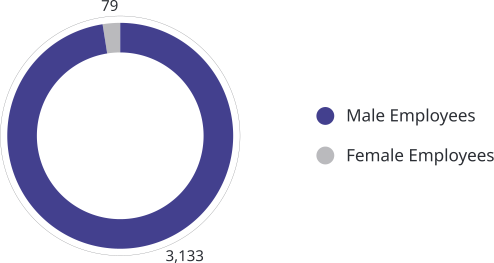
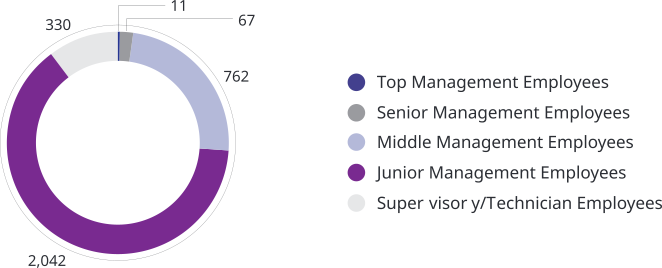
100%
of employees receiving performance appraisal
Performance Appraisal: Gender
Performance Appraisal: Management Level
Performance-Linked Compensation Framework
To promote meritocracy and a culture of equal pay, a structured, performance-linked compensation framework is in place at APSEZ. Employee achievements are recognised and rewarded at all management levels through this framework. This helps promote a high-performance environment in alignment with the company’s strategic goals.
Performance-Linked Compensation Structure
A tiered performance-linked compensation structured has been adopted at APSEZ, based on the grades of the employees. Under this structure, a significant portion of the Total Cost to Company (CTC) is allocated as performance-based incentives:
O1 to E1 Grades
Employees in these grades get performance-based incentive amounting to 10% of their CTC.

E2 to E4 Grades
The performance-based incentive for these employees stands at 15% of their CTC.
GM and Above
At the General Manager level and above, the performance pay is calculated on the basis of both organisational and individual performance metrics, including contributions towards ESG objectives.

A 4-point scale is deployed within the Performance Management System at APSEZ to calculate the performance pay. The scale is designed to accurately reflect the individual’s contributions in calculating the pay. The performance pay structure makes qualitative adjustments based on ESG performance and safety considerations in the case of senior management personnel, in line with APSEZ’s commitment to sustainable business practices.
Performance Pay at APSEZ
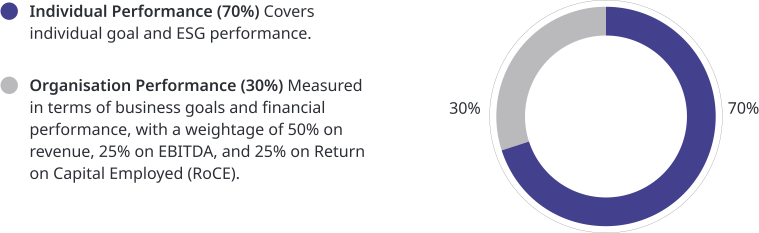
ESG-Linked Performance
Given its commitment to sustainable business practices and workplace safety, APSEZ has strategically linked executive compensation with ESG performance. The evaluation metrics include compliance with the Code of Conduct, Human Rights, Financial and Operational targets, Risk Management, IT, Cyber Security, and Customer Satisfaction. The linkage underscores the company’s commitment to responsible business conduct and stakeholder well-being.
Equal Pay Commitment
The company deploys uniform performance evaluation and compensation criteria for all employees, regardless of gender, with the objective of ensuring an equal-opportunity workplace. It stringently follows a policy of equal pay for equal work, and conducts periodic reviews of its compensation structure to maintain gender pay equity. The Nomination and Remuneration Committee (NRC) recommends to the Board the remuneration of the Executive Directors, including the CEO, based on criteria such as industry benchmarks, the company’s performance vis-à-vis the industry, Tobin’s Q, responsibilities shouldered, and performance/track record.
CEO’s Compensation Structure
The compensation structure for the Chief Executive Officer (CEO) has three components: a fixed salary, a variable pays, and a long-term incentive. This remuneration aligns well with the business size and complexity. The variable pay and long-term incentive are linked to both financial and ESG indicators, which include Total Shareholder Return, Revenue, EBITDA, ROCE, Health & Safety metrics, Human Rights parameters, Energy Intensity, GHG Intensity, Water Intensity, Zero Waste to Landfill (ZWL), and Mangrove Afforestation. The NRC recommends the remuneration of the Executive Directors to the Board of Directors for approval.
| Wages (Management position-wise) (in lakhs ₹) |
FY 2024–25 | ||
|---|---|---|---|
| Executive Level | Management Level | Non-Management Level | |
| Average Male (base salary) | 129.22 | 18.07 | 7.81 |
| Average Female (base salary) | NA | 22.83 | 4.78 |
| Average Male (base salary + other cash incentives) | 182.55 | 20.03 | 7.81 |
| Average Female (base salary + other cash incentives) | NA | 14.53 | 4.78 |
Note:
Executive includes Top
Management Cadre.
Management includes Junior, Middle and Senior Management Cadre.
Non-Management includes Supervisory Cadre.
| Ratio of Wages | FY 2024–25 | ||
|---|---|---|---|
| Executive Level | Management Level | Non-Management Level | |
| Ratio of Base Salary | NA | 71% | 61% |
| Ratio of Remuneration | NA | 73% | 61% |
We regularly conduct a Compensation Benchmarking exercise through AON.


